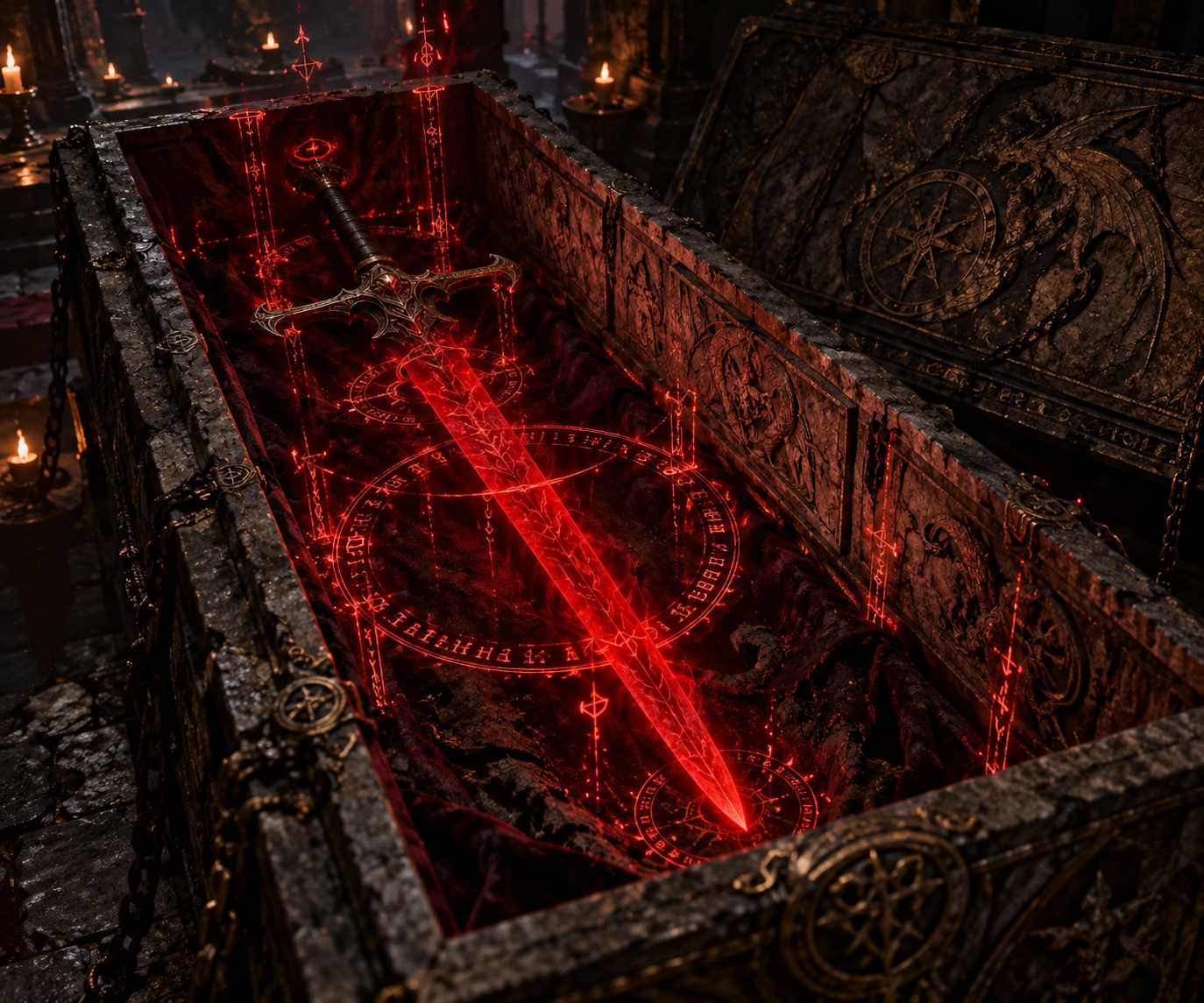
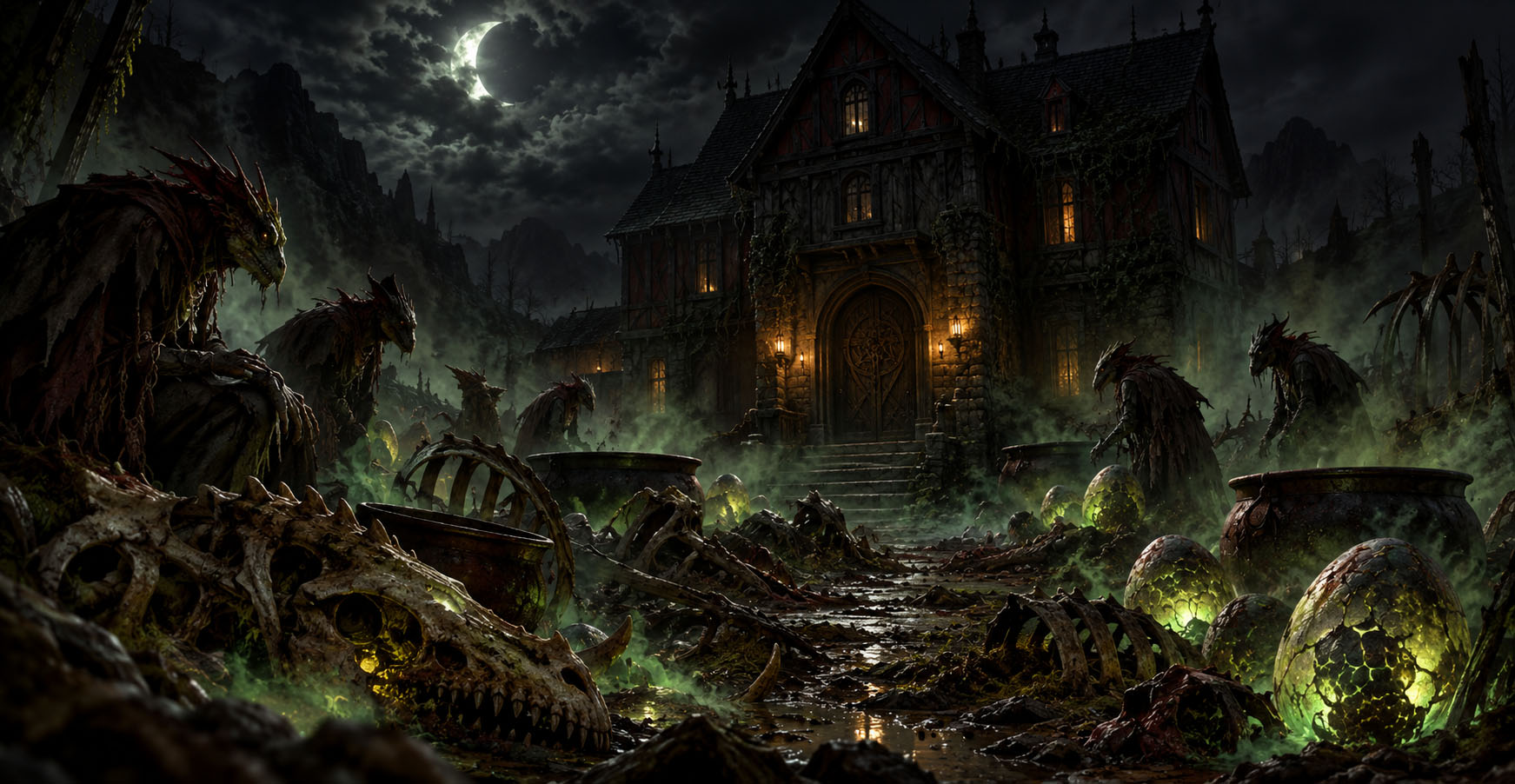
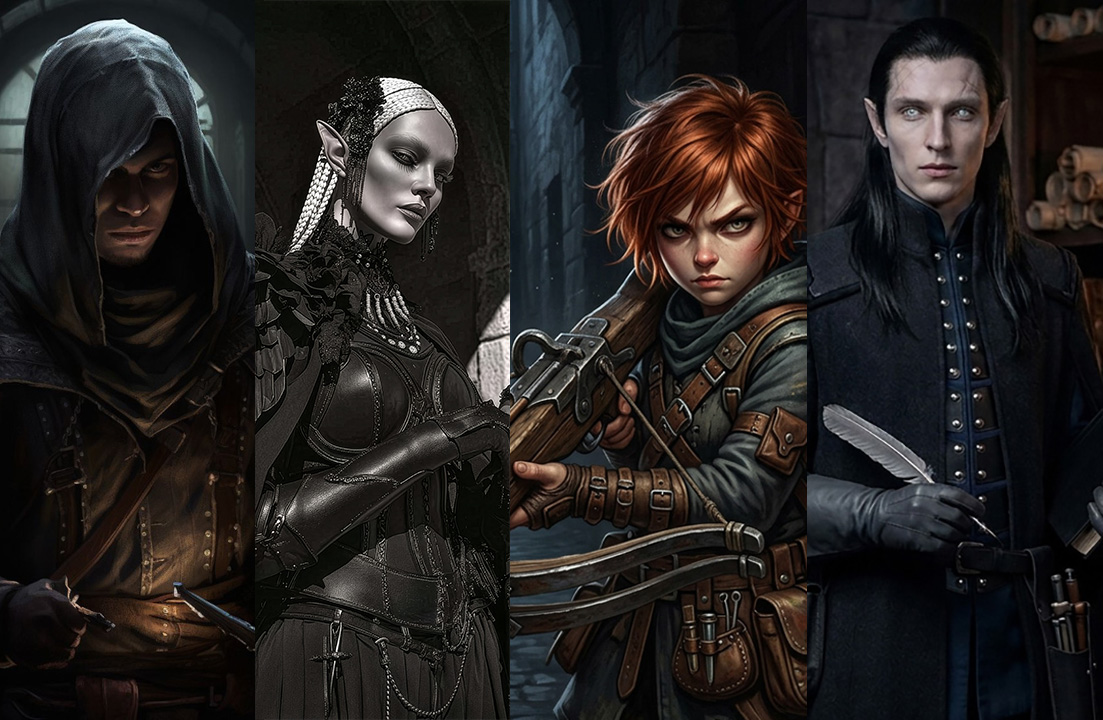
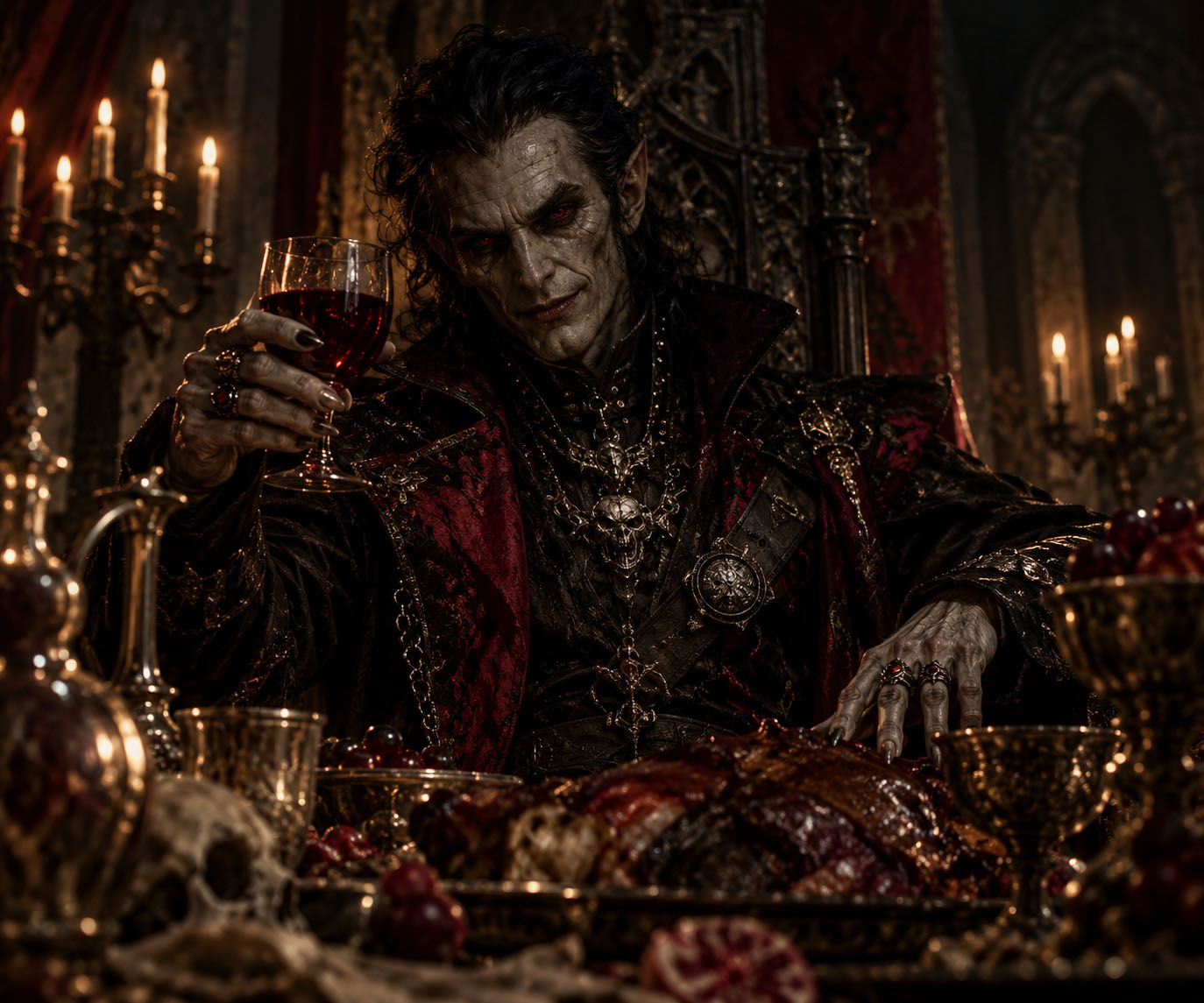
Archive for the The Swords of Creation Category

Rendpyre comes to Ulfdin

Posted in Granitehome, The Bladesong Knights, The Swords of Creation on October 17, 2026 by coyoteandthunder

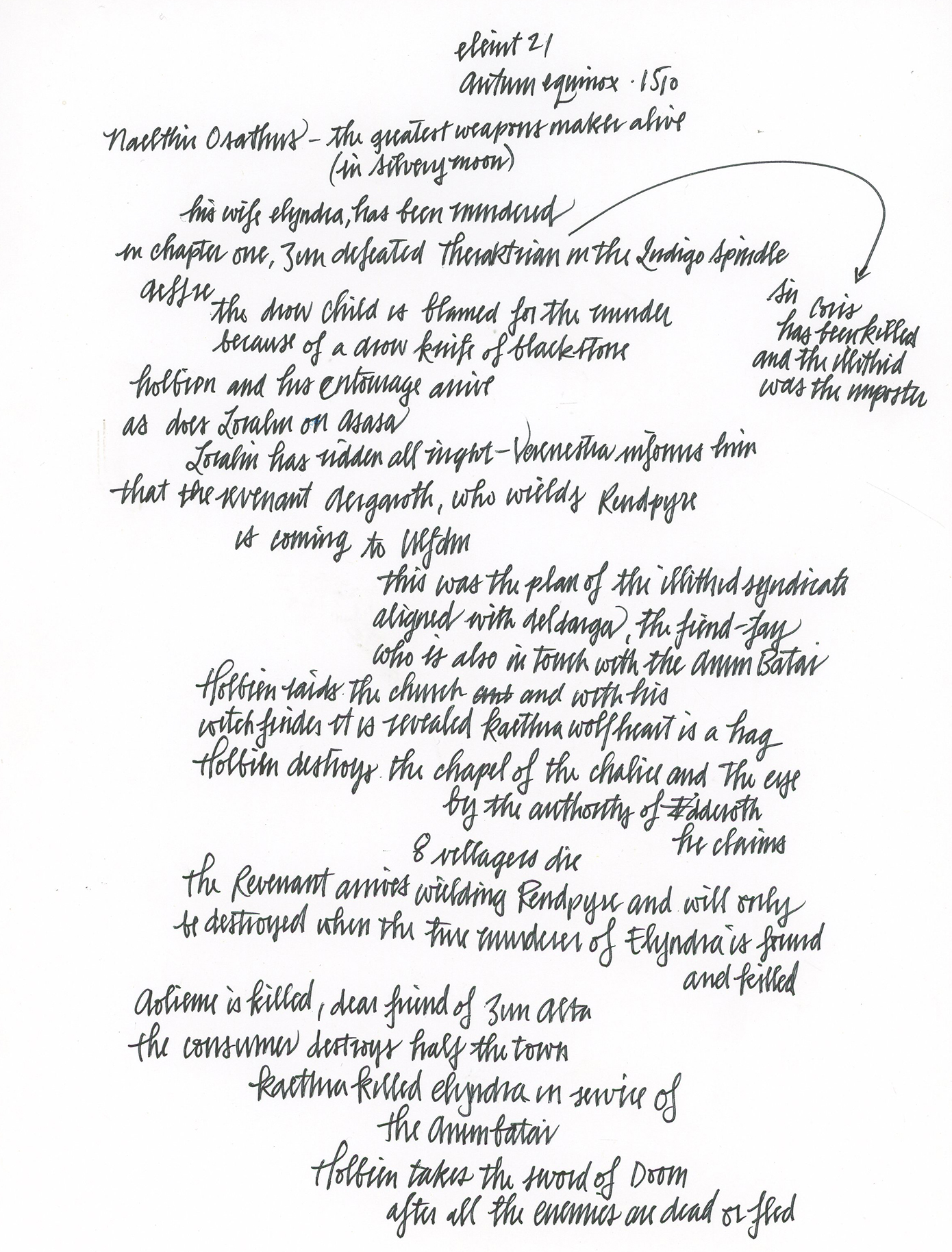
All of the following happened on one day, Eleint 21, 1510 DR, the Autumnal Solstice. Snow fell at dawn after a long, hot summer in Southern Gildensong. An omen of the strange, violent tale about to unfold.

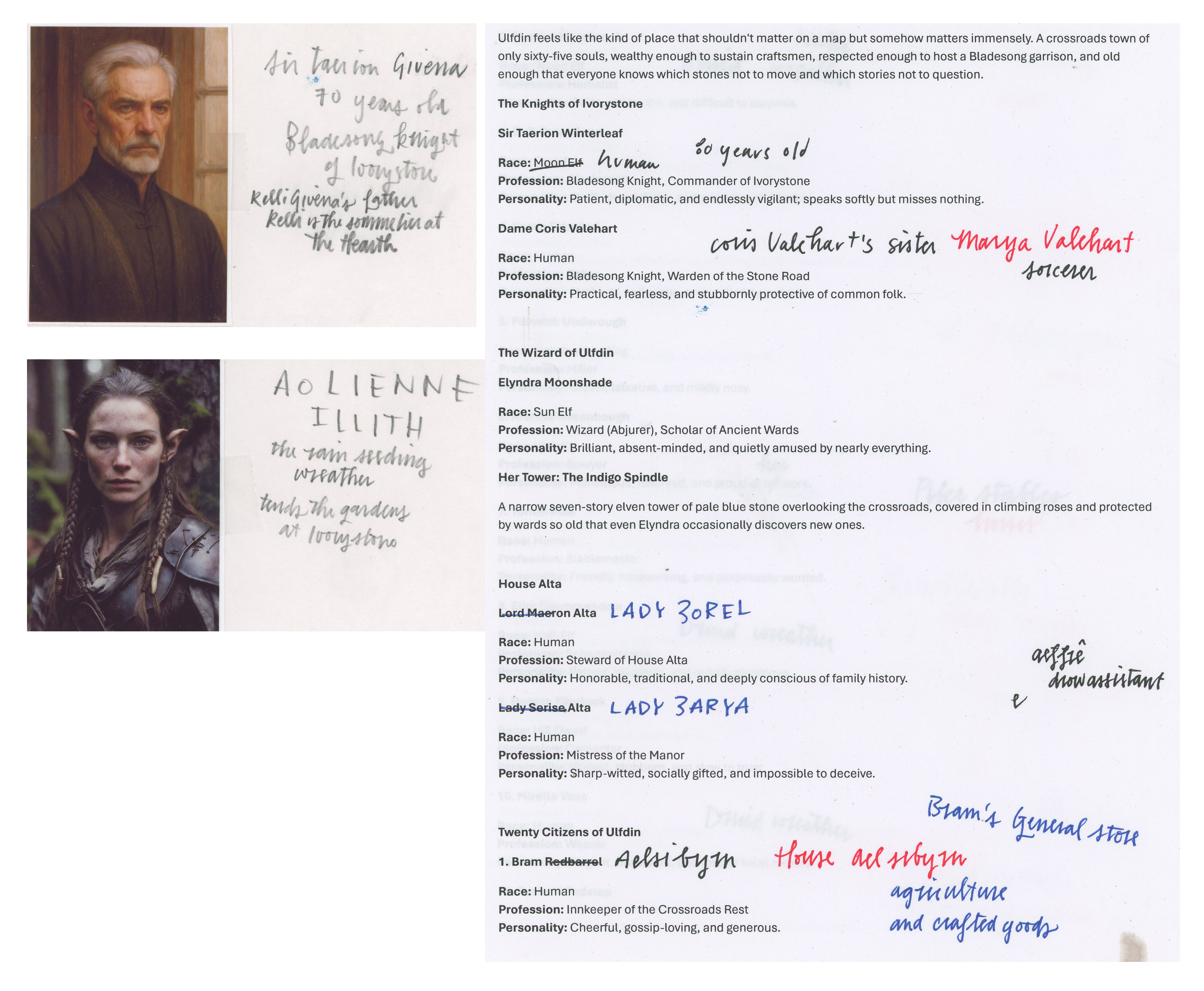
After the murder of Elyndra Osathus, Naelthir Osathus’s wizard wife, a cascade of events followed. Naelthir, who lives in Silverymoon, is Siluvaria’s greatest weaponsmith, and Elyndra lived in the Indigo Spindle on Ulfdin’s east side. Zun Alta destroyed Theraktrian in the Indigo Spindle on the night of Elyndra’s murder. Zun had gone downstairs to the basement after he found Elyndra’s body. There, among other things, he found the illithid. He found a strange airship on blocks in an enormous domed hangar. Theraktrian, the illithid, followed Zun downstairs, as the knight was permitted to go where the illithid was not. The illithid had taken Sir Corlis’s form for many weeks before this moment. After defeating the illithid, Zun was convinced this evil thing had killed Elyndra. When he went back upstairs at dawn, the villagers had found the wizard elf’s body. They claimed to have found a drow-made blackstone blade. Aeffre, the drow child, was brought to the town square as Zun arrived.

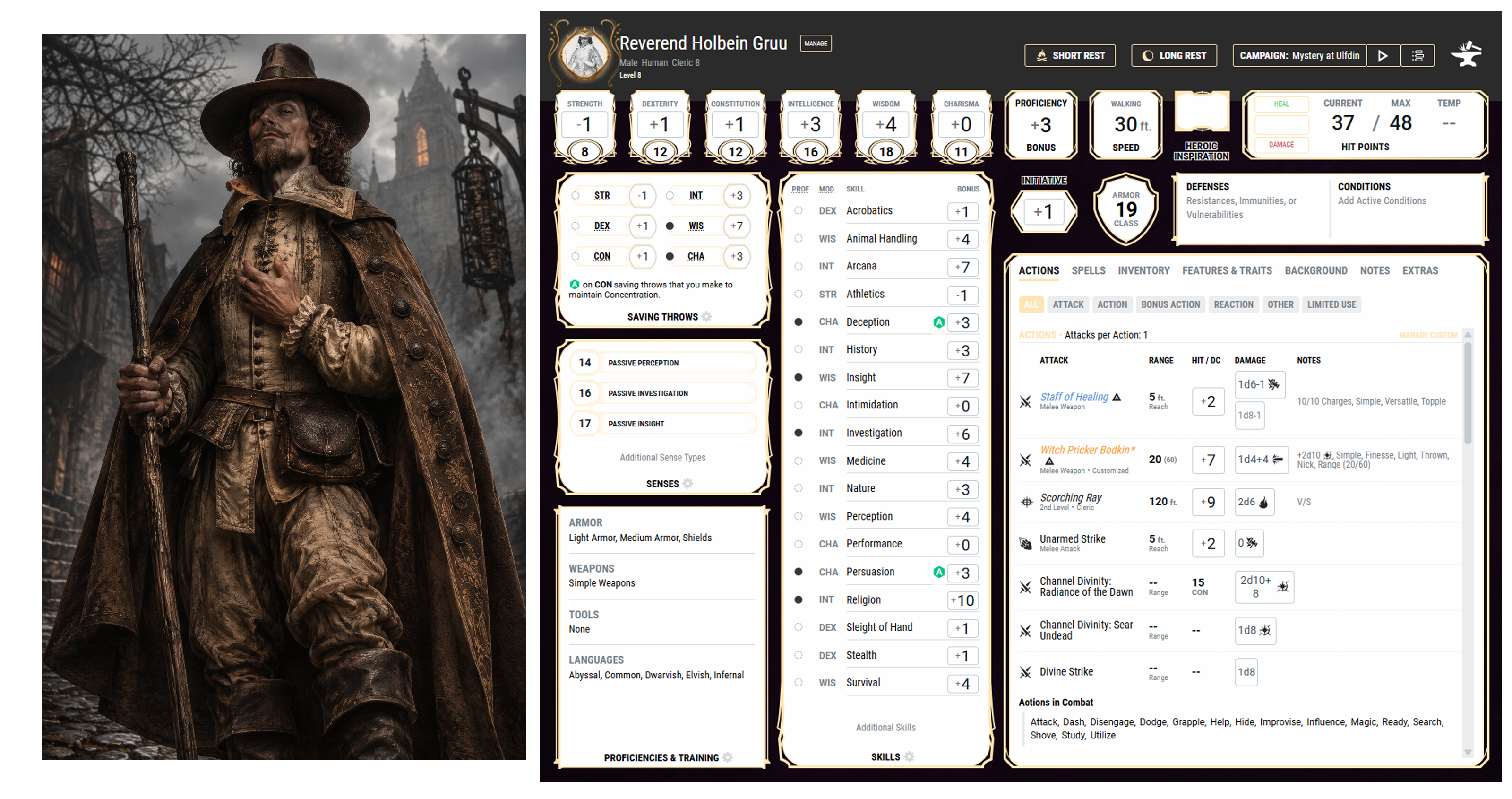
At that moment, Reverend Holbein’s wagons rolled into town, with four retainers in tow, and he announced he was now the judge and jury for any slights or crimes that offended the crown or the gods.

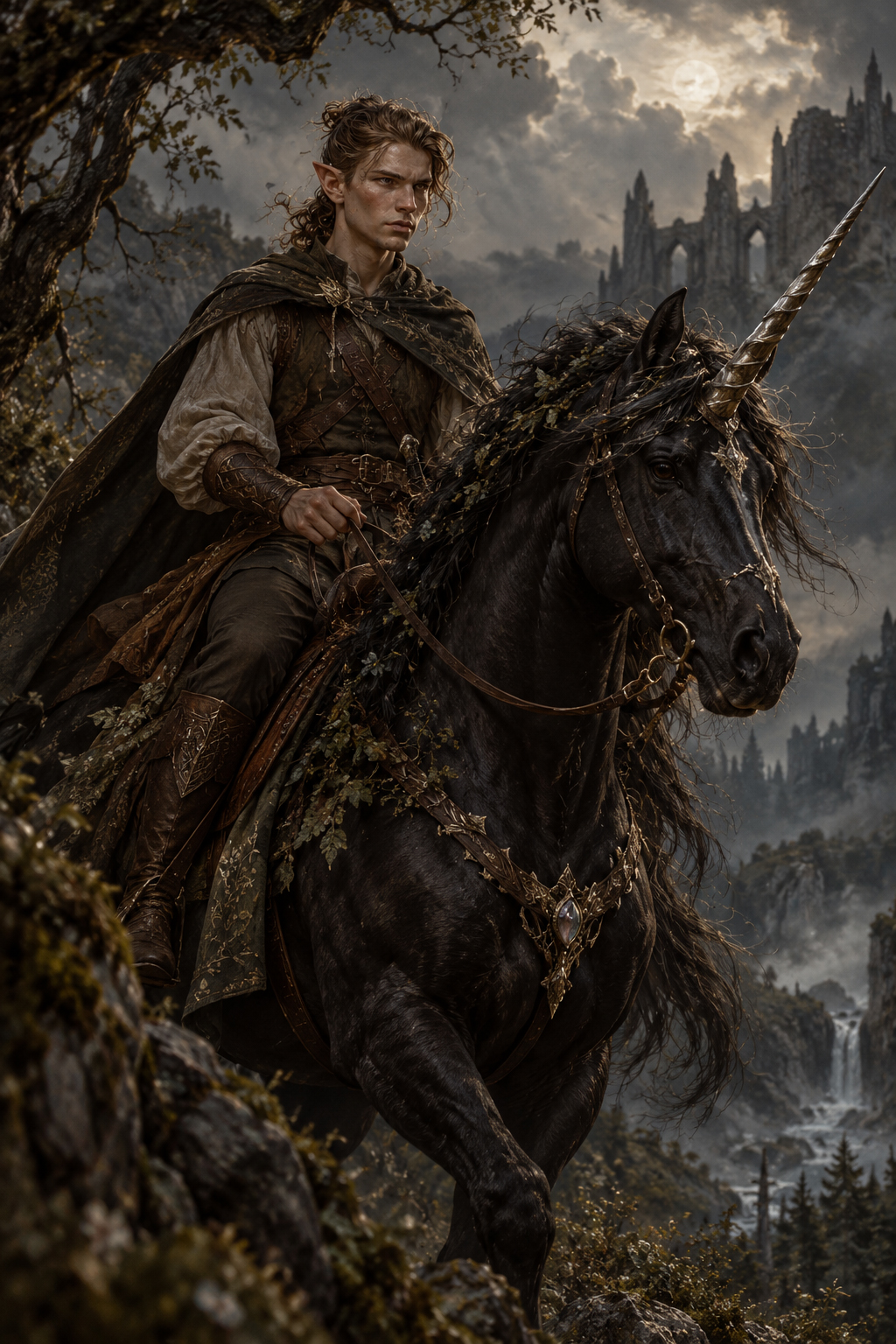
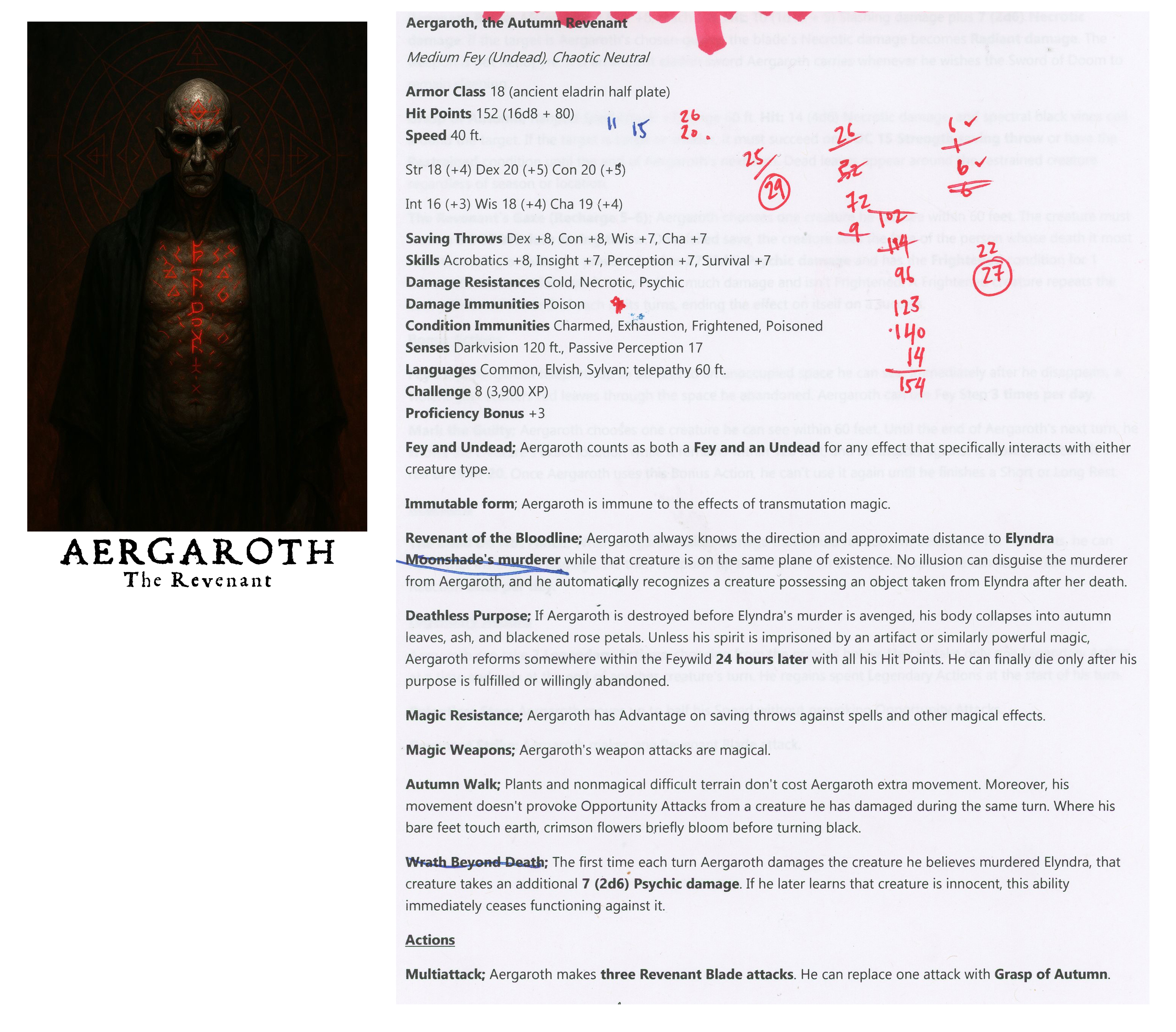
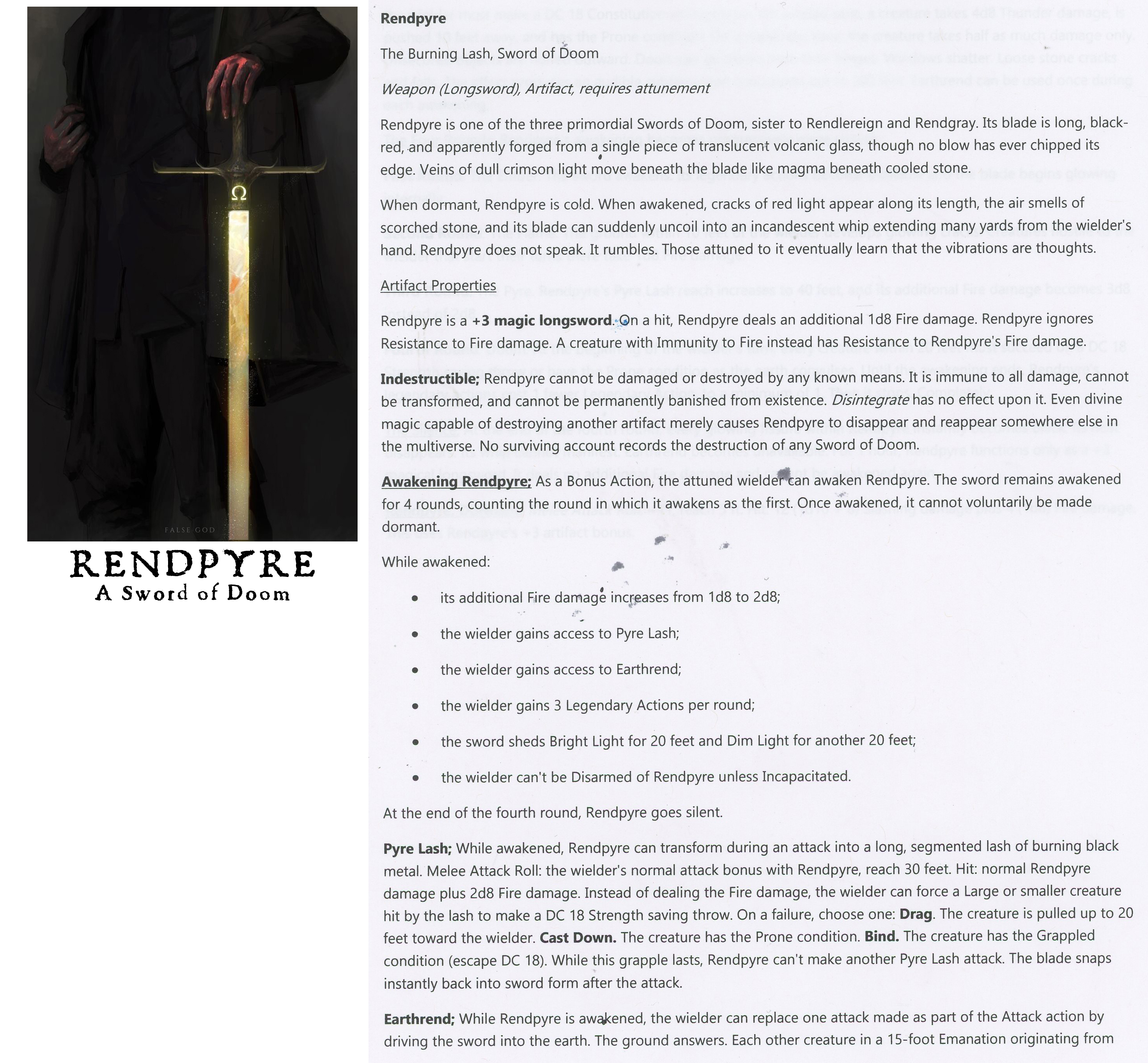
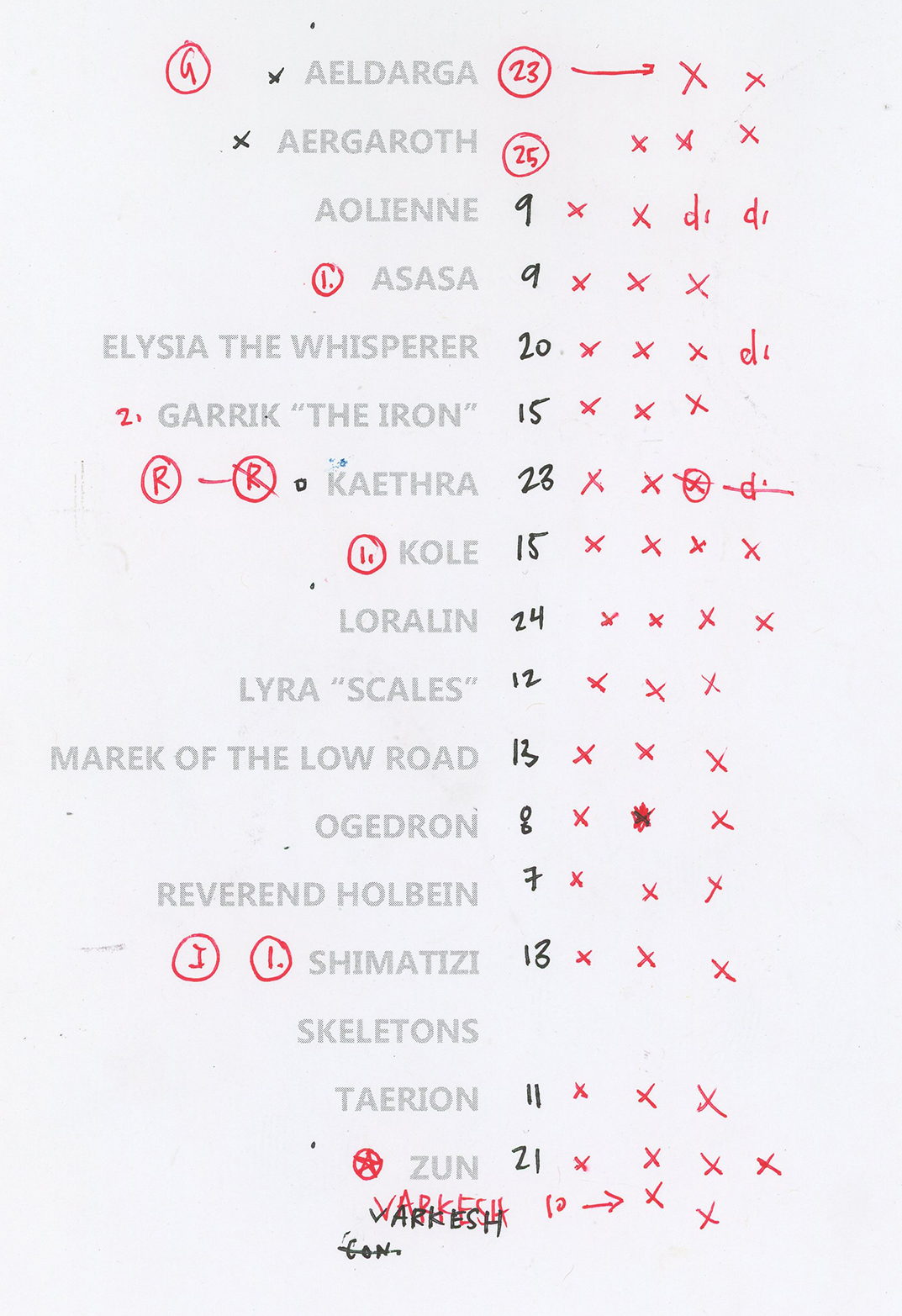
At that moment, Loralin rode into town atop a black-furred unicorn stallion named Asasa, whom he had ridden all night to reach Ulfdin. He rode with grim news. The archfey Verenstra, with whom he had spent the last month spinning farm songs in the North County, told him that, because of the wizard wife’s death, the terrible wraith revenant Aergaroth was sent to find her true murderer. As he said this, Zun knew the illithid hadn’t killed Elyndra. Aergaroth wields a sword of doom, Rendpyre, and Ulfdin would not survive the day should battle ensue.

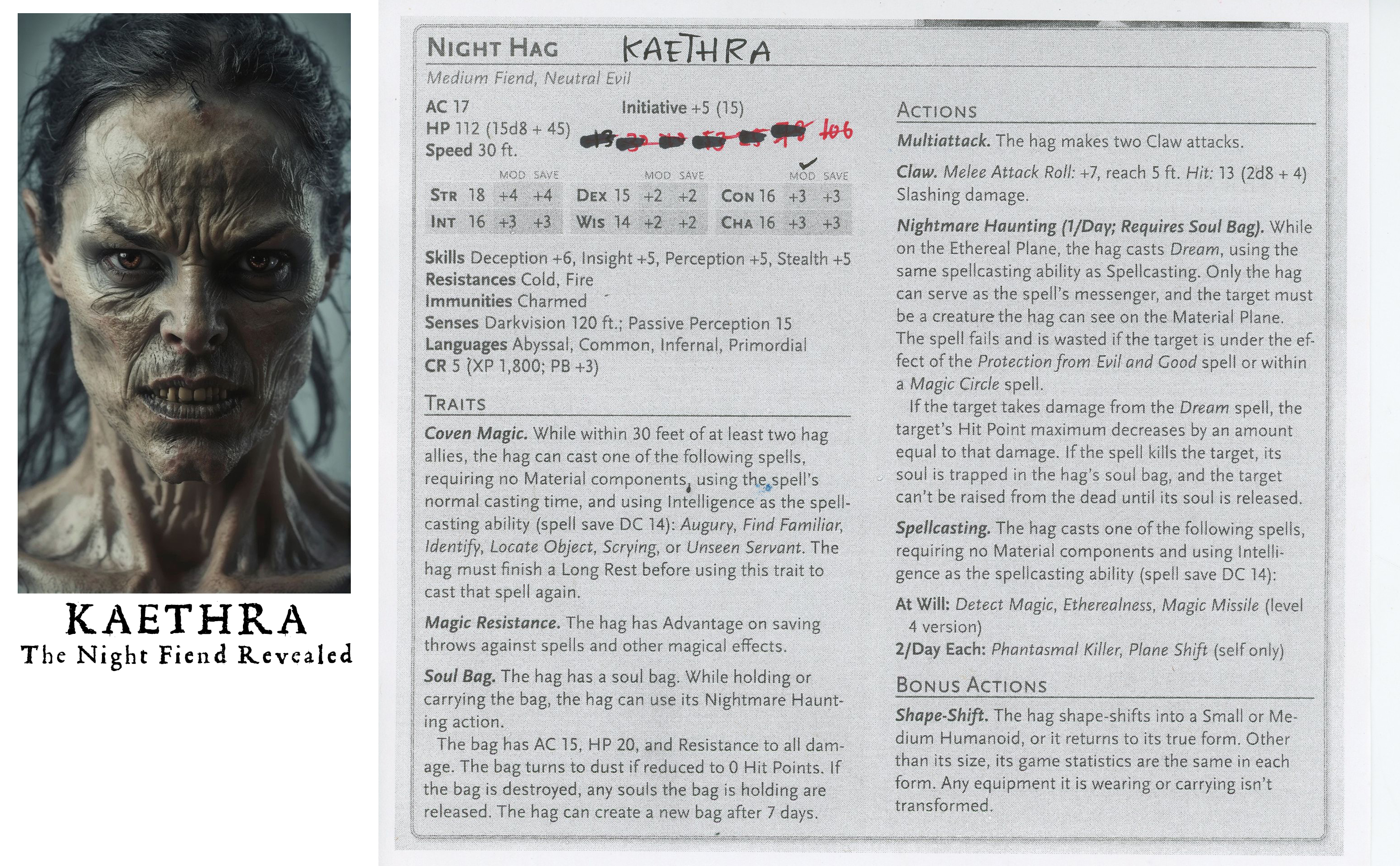
Holbien storms the chapel of the Chalice and the Eye and finds Kaethra Wolfheart, and immediately proclaims her a witch with his holy avenger dagger. So touched by the holy blade, she reveals herself as the fiend hag of Ulfdin. Holbein destroys the chapel and kills eight villagers in the process.

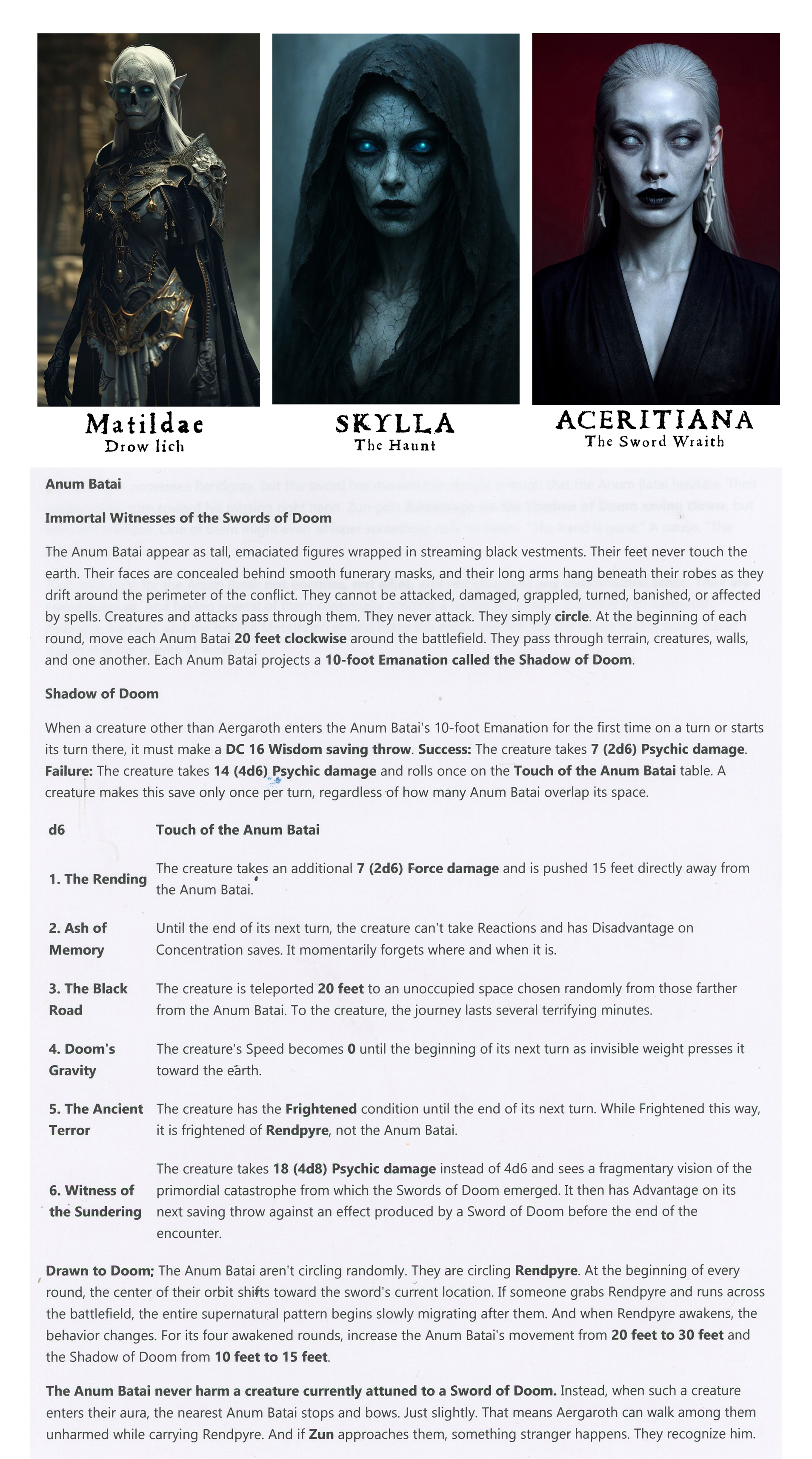
Wielding Rendpyre, Aergaroth arrives; Loralin sees the Anum Batai sword wraith, Acertiana, arrive, with a vision of Matildae, the drow lich, now estranged after Volukai fled the Halls of the Night Mist. Also present was Skylla, Vivianna’s wraith sister and a betrayer of the Silvaeren.

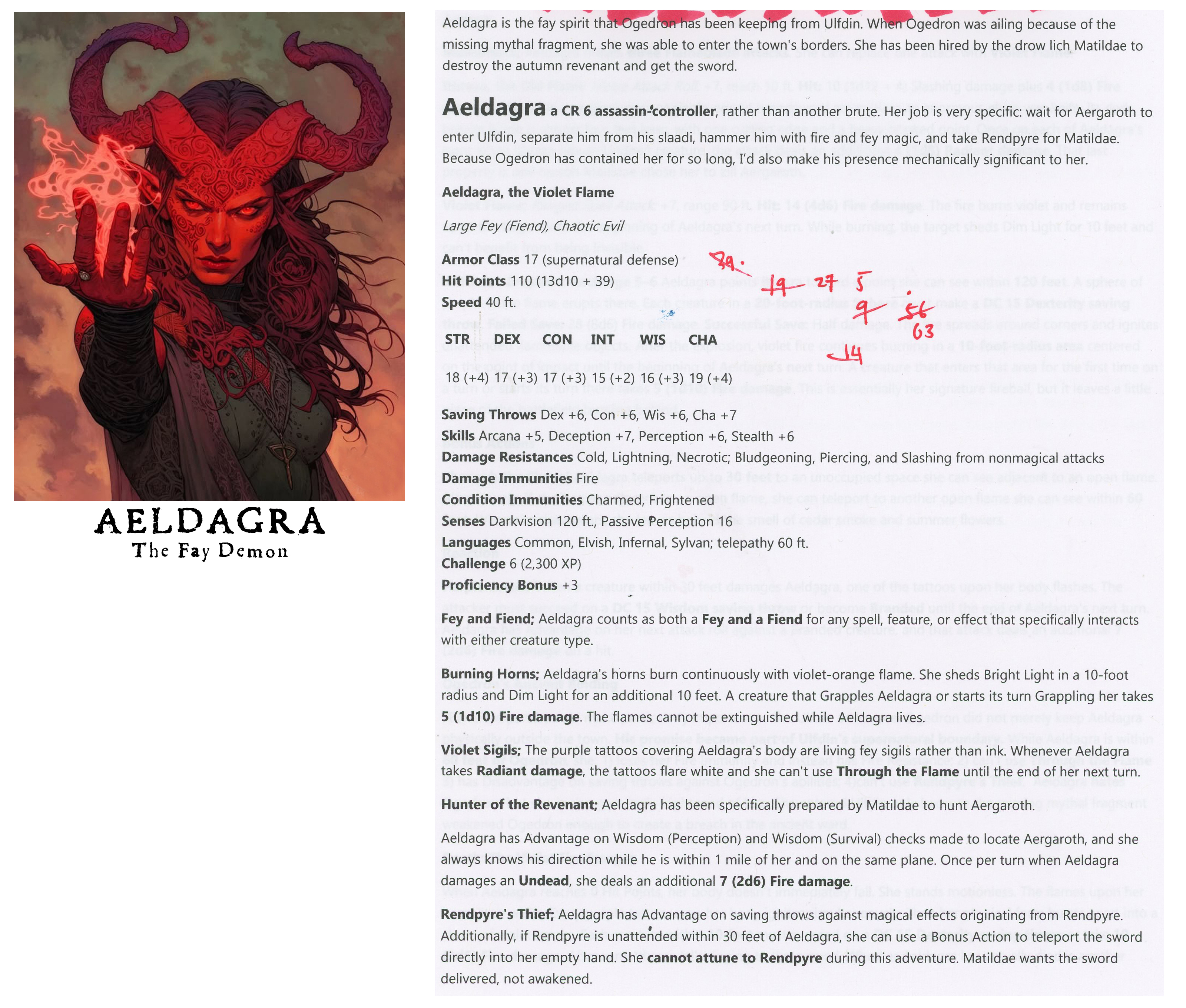
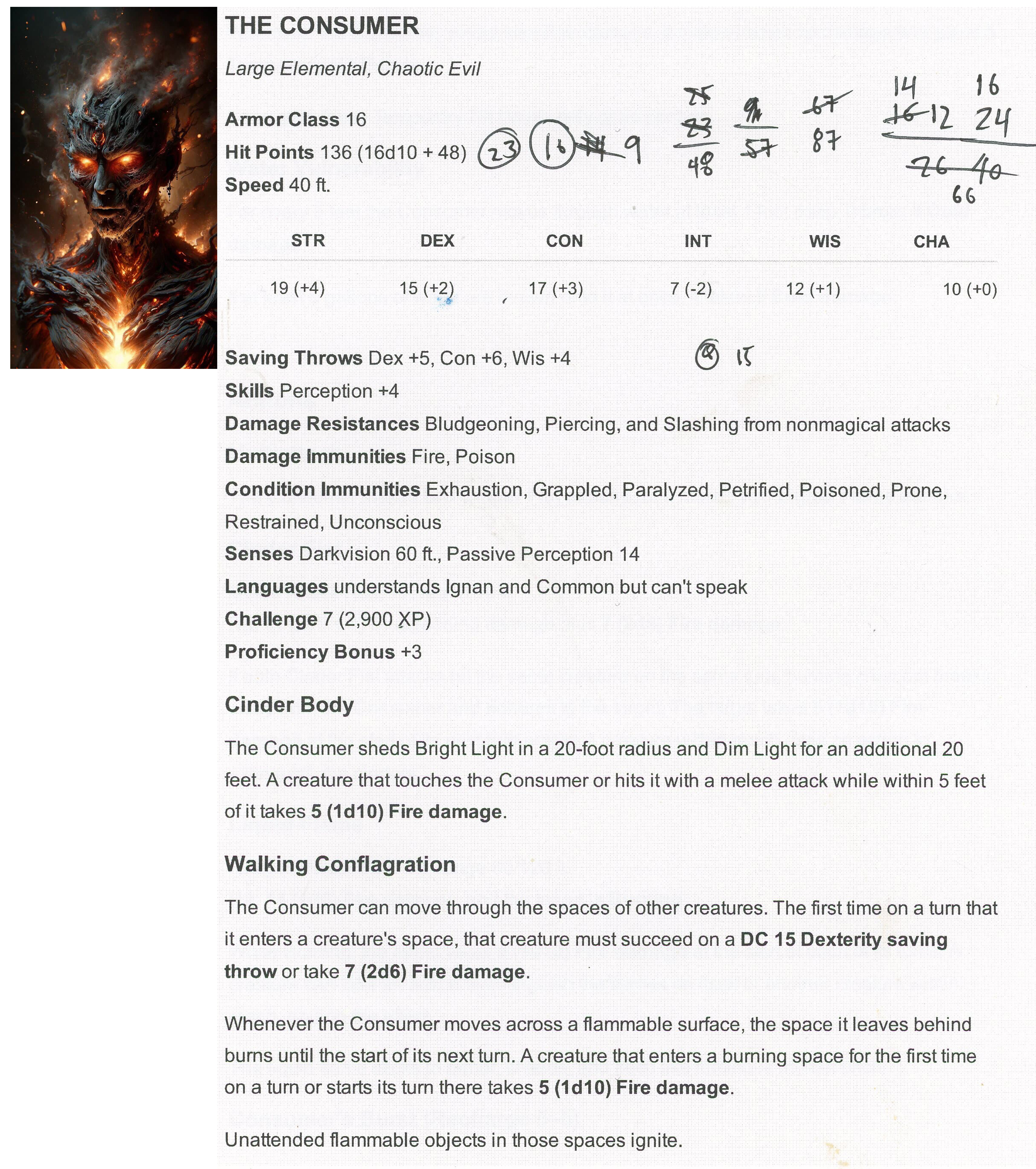
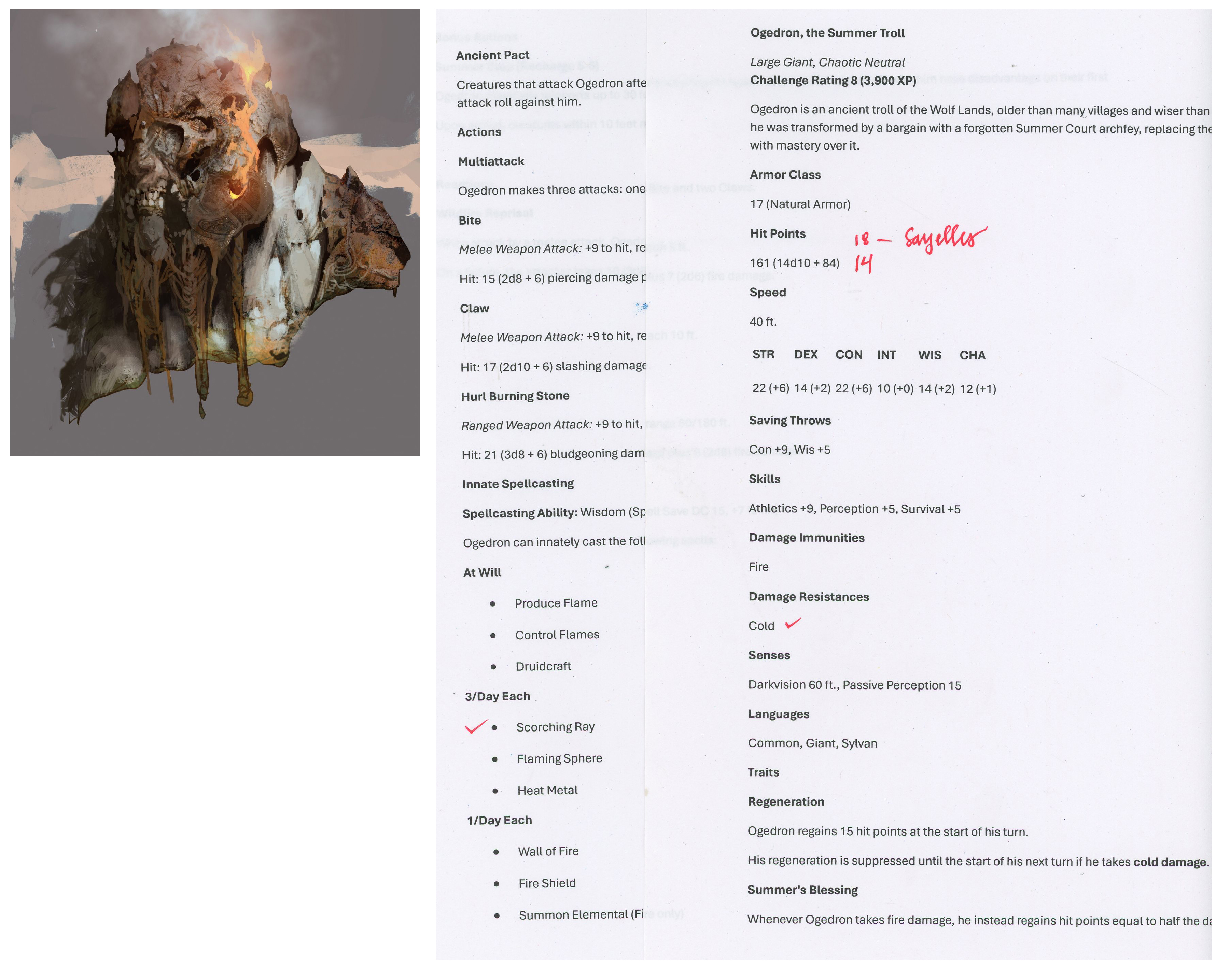
Ogedron the summer troll arrives, along with Aeldarga—Ogedron’s enemy and a fiend-fae. Her agent, the Consumer, a sentient fire elemental, also arrives and burns most of the town.

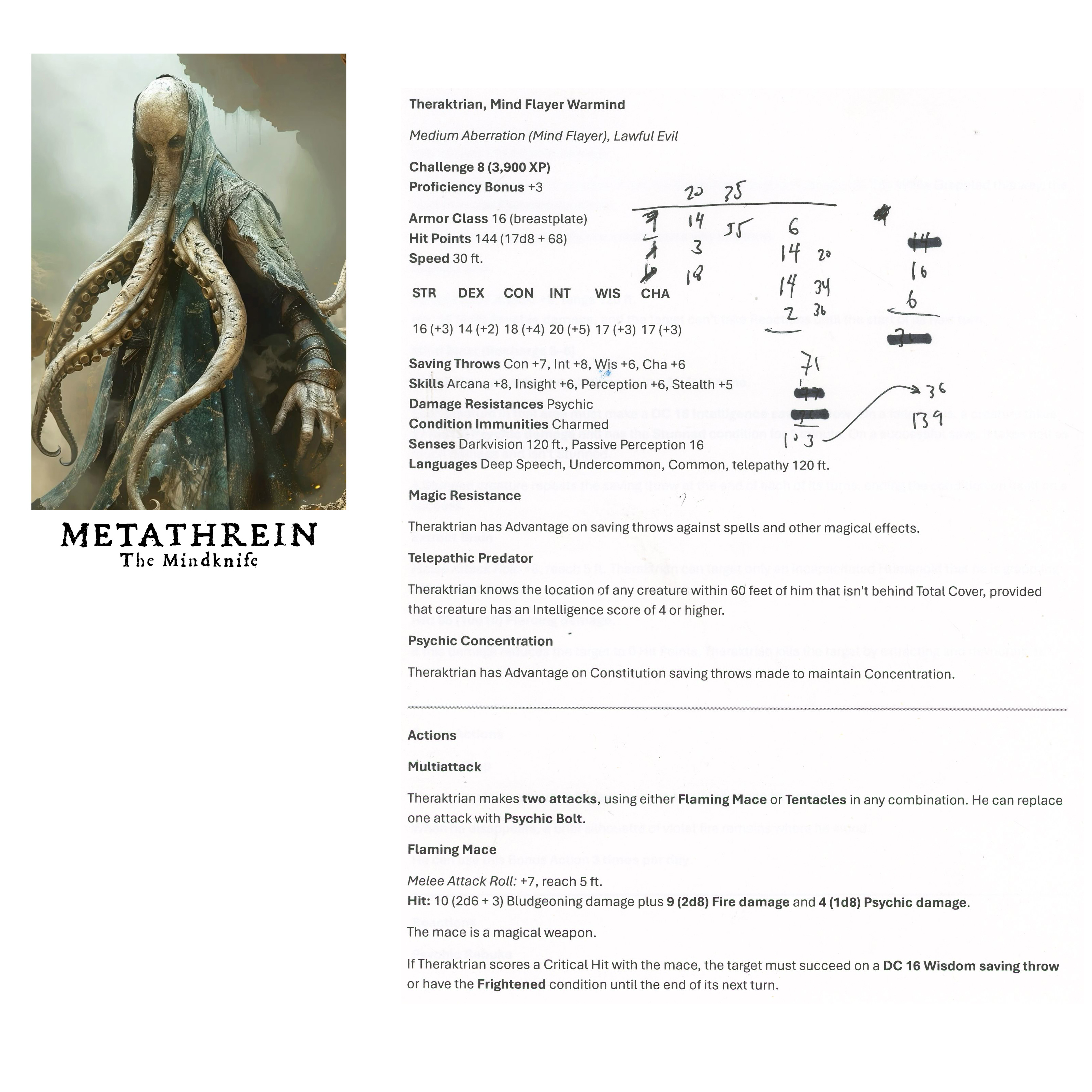
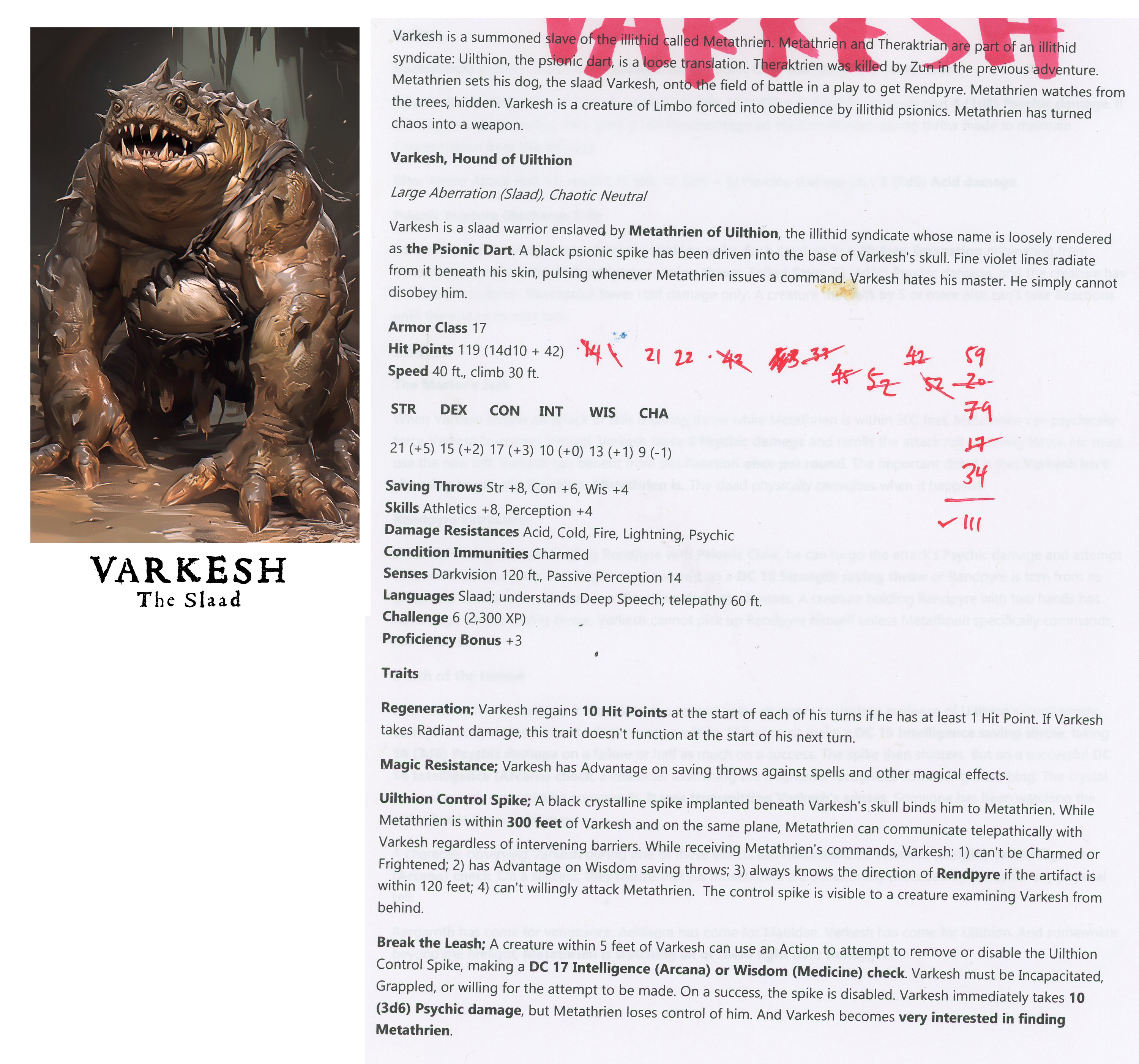
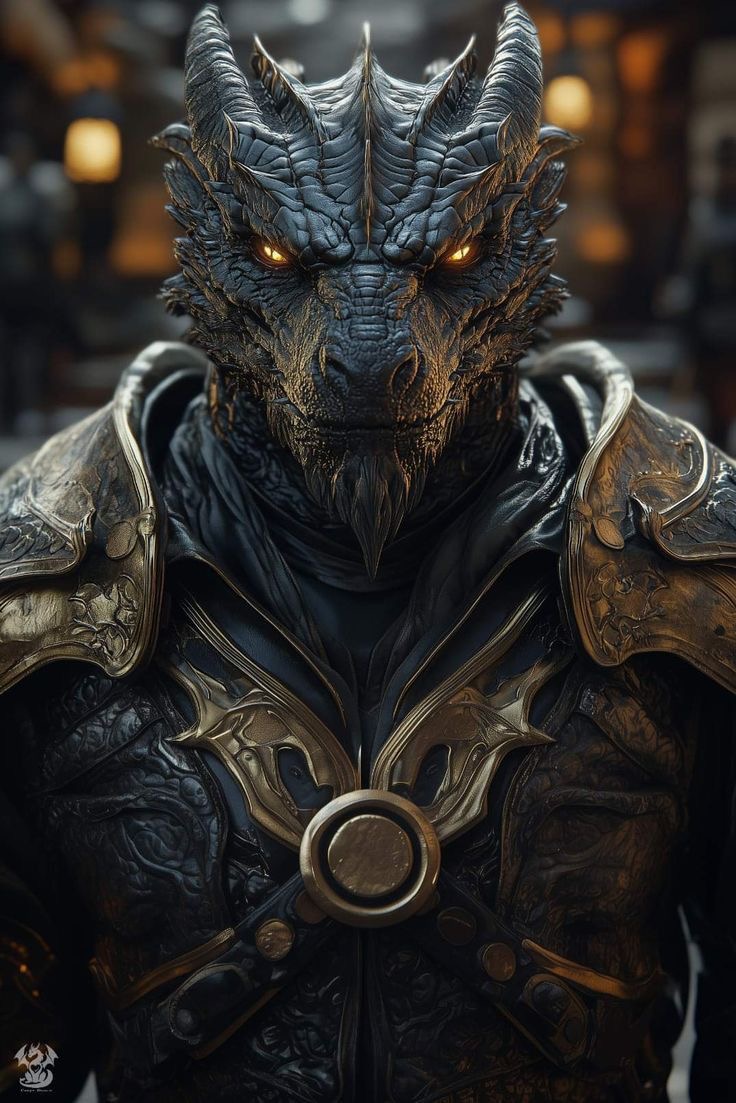
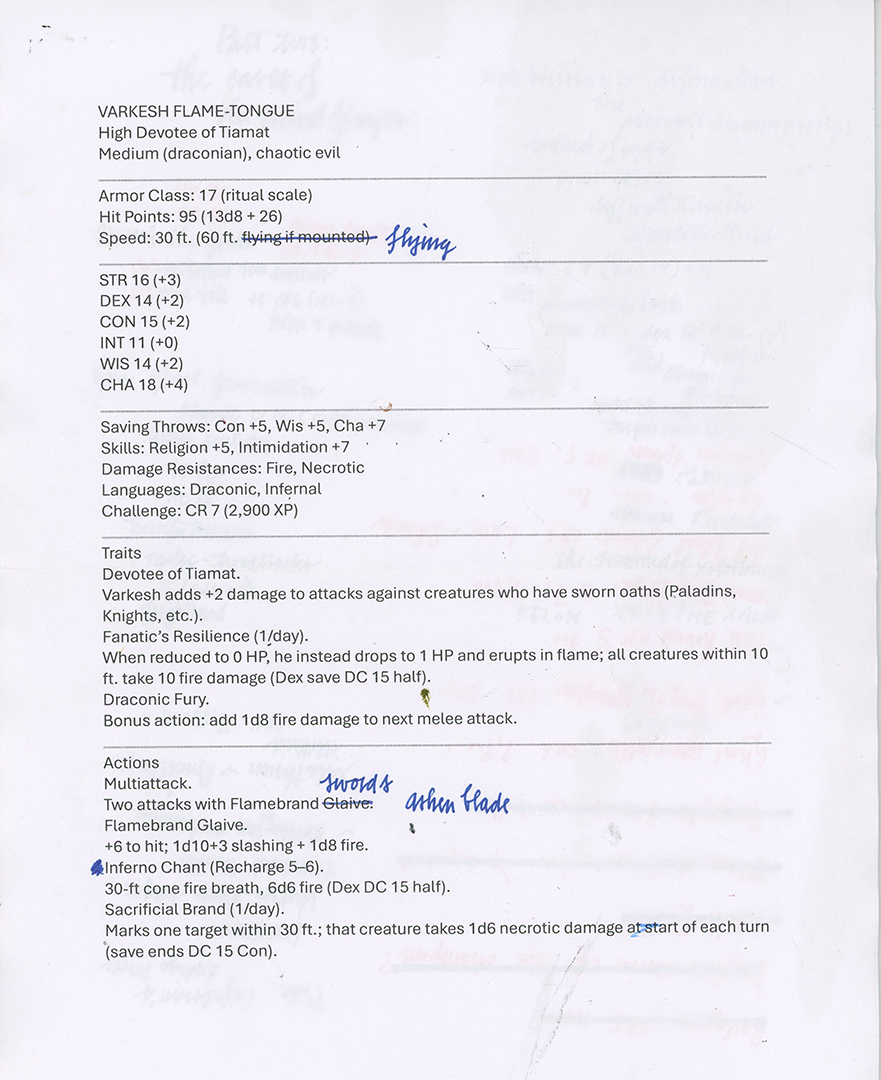
Aolienne dies while defeating the Consumer, saving half of the town by her sacrifice. At this, another illithid, Metathrein himself, arrives with his slaad bodyguard, Varkesh, the imprisoned. Loralin realizes Varkesh is held against his will and frees the aberrant monster. At this, the illithid retreats. Zun and Loralin see now that this was all a grand plot to get Rendpyre on the field. The ultimate treasure. As Kaetha is destroyed, the thing that truly killed Elyndra, Aergaroth is also slain, and Rendpyre falls to the ground. Zun and Loralin suspect that it let itself be captured. Aeldarga retreats. The Anum Batai disappear. Holbein proclaims his authority to take the sword of doom back to Edderoth. Loralin and Zun acquiesce. Was it the right move?

Metatherein and Theraktrian share the same stat block for this campaign

The holding of Rendelreign at Underroot

Posted in Gildensong, The Swords of Creation, Underroot on October 16, 2026 by coyoteandthunder

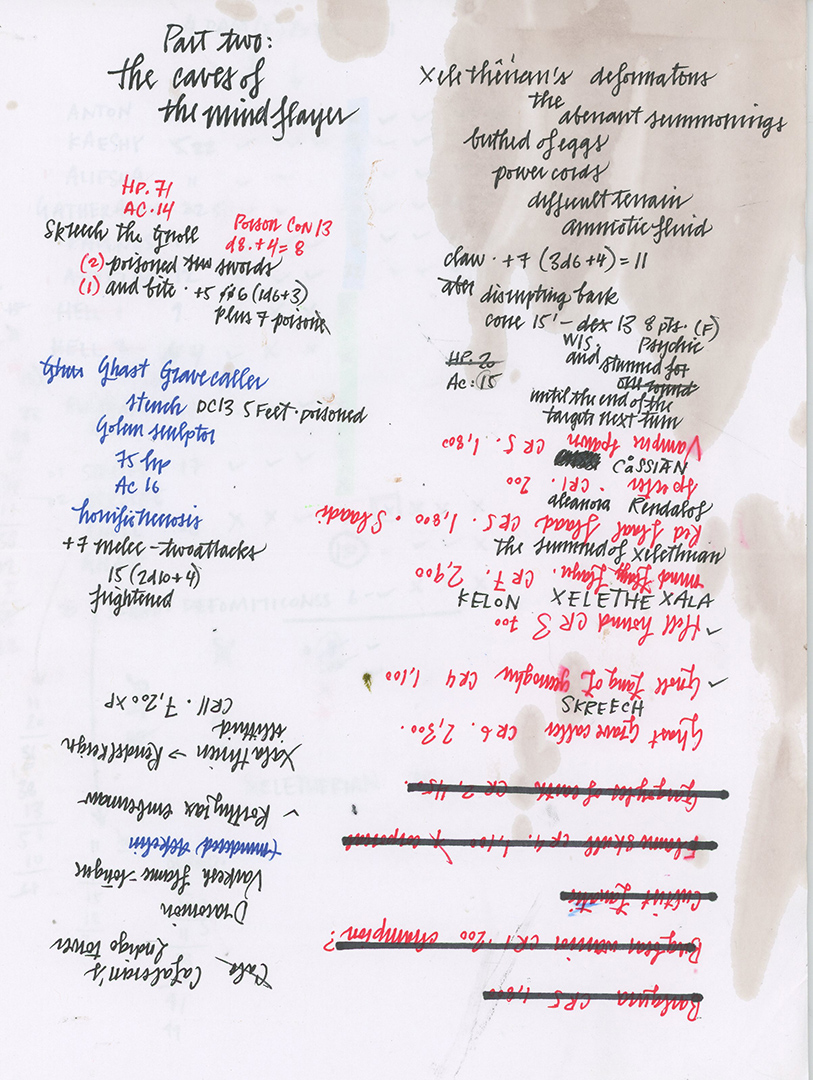
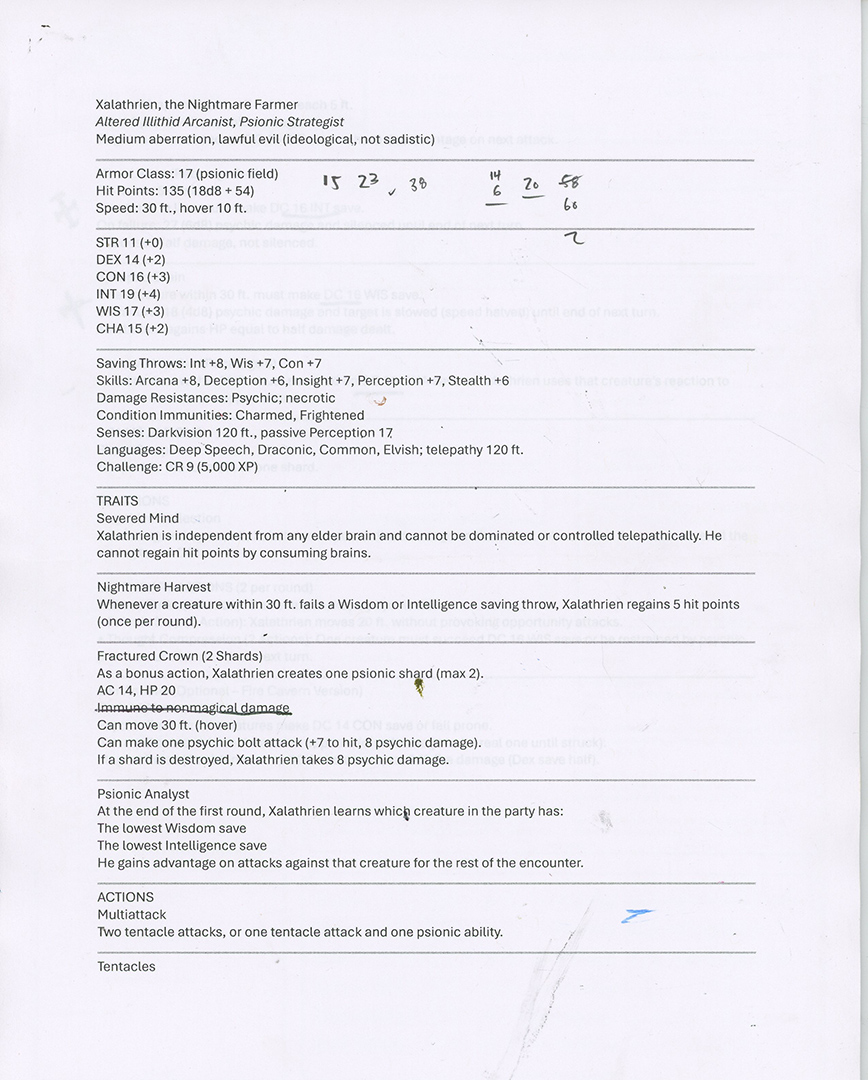
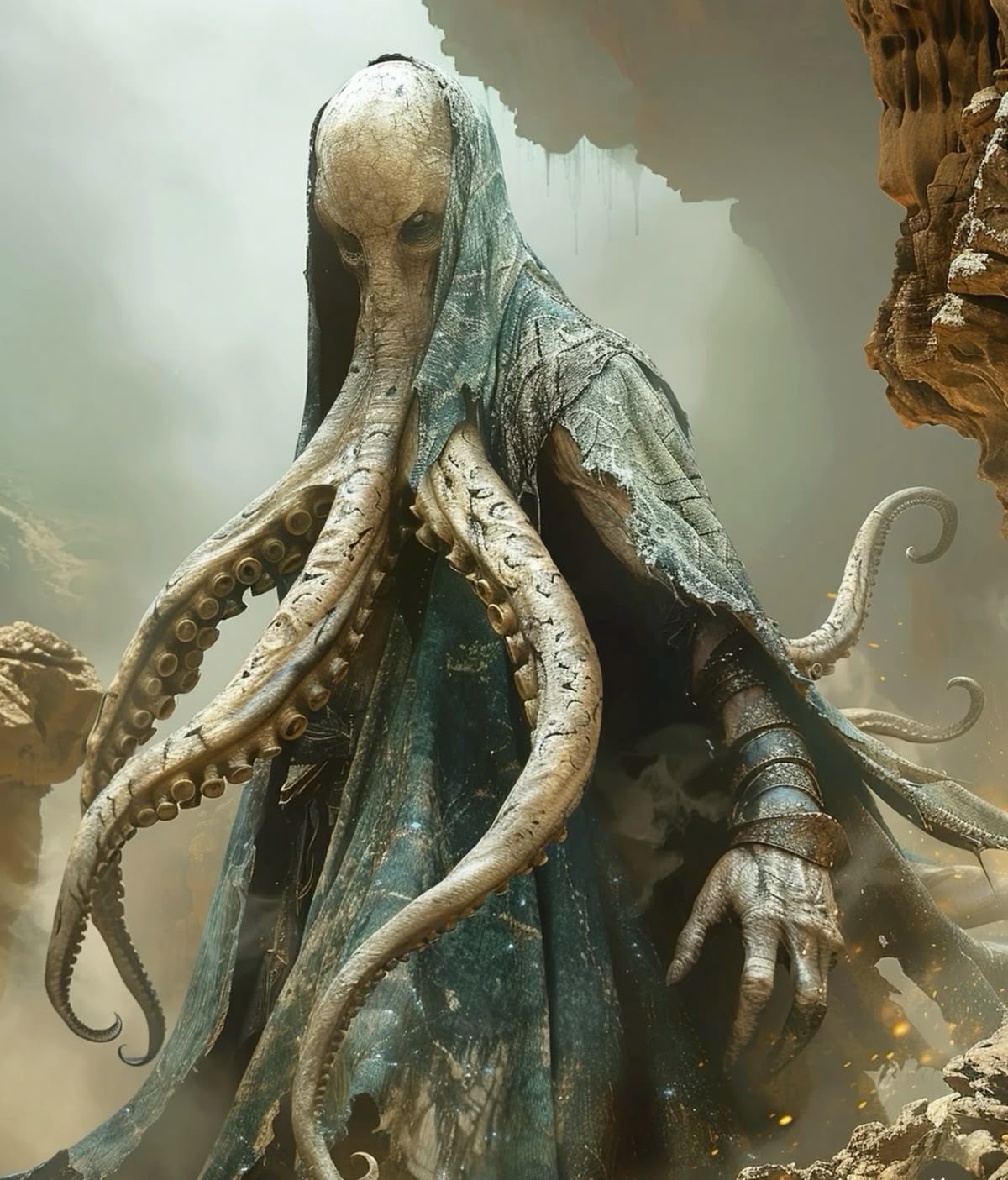
After taking Rendelreign from Castle Edderoth, Vesper, Kaeliss, and Dirk made off with two artifacts: the correspondence of Matildae and the hand of Volukai, and traveled through a shadow portal to the Caves under Enimdere, called Underroot. There, they fashioned a laboratory of deep power with help from a local illithid cabal called the Metathrein Syndicate. Xalathrien, the so-called Nightmare Farmer, leads this cabal, from whom the Bladesong knights previously recovered the sword. The sword thieves took this place because it is imbued with mythal magic, and Kaeliss and Vesper can manipulate the magic to keep the sword docile and still… for now. Dirk destroyed the Slaad guards who worked for the Metathrein, and the laboratory is now safe from the illithid. Safe, until they decide what they will do with this, the most magical and most evil of all blades.

The stealing of Rendlereign from Edderoth

Posted in The Swords of Creation, Underroot on October 16, 2026 by coyoteandthunder

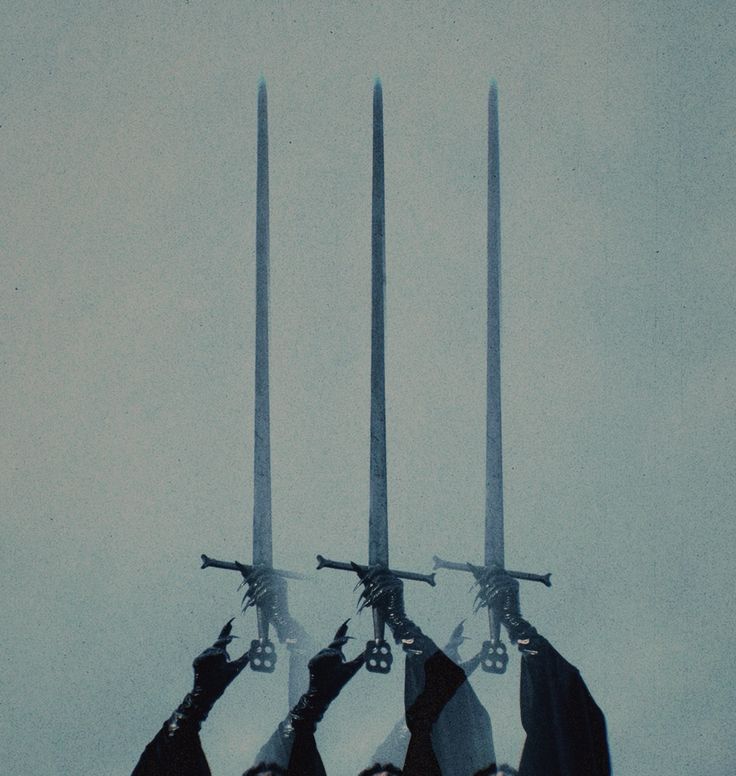
In the spring of 1510, Severin hired four thieves, the legendary thieves of Edderoth, and bequeathed them evil magics to infiltrate the sacred wards of Castle Edderoth; they successfully absconded with the second sword of doom, Rendlereign, Rendelreign Dathryss, the Sovereign of Ruin, the sword of Dominion.

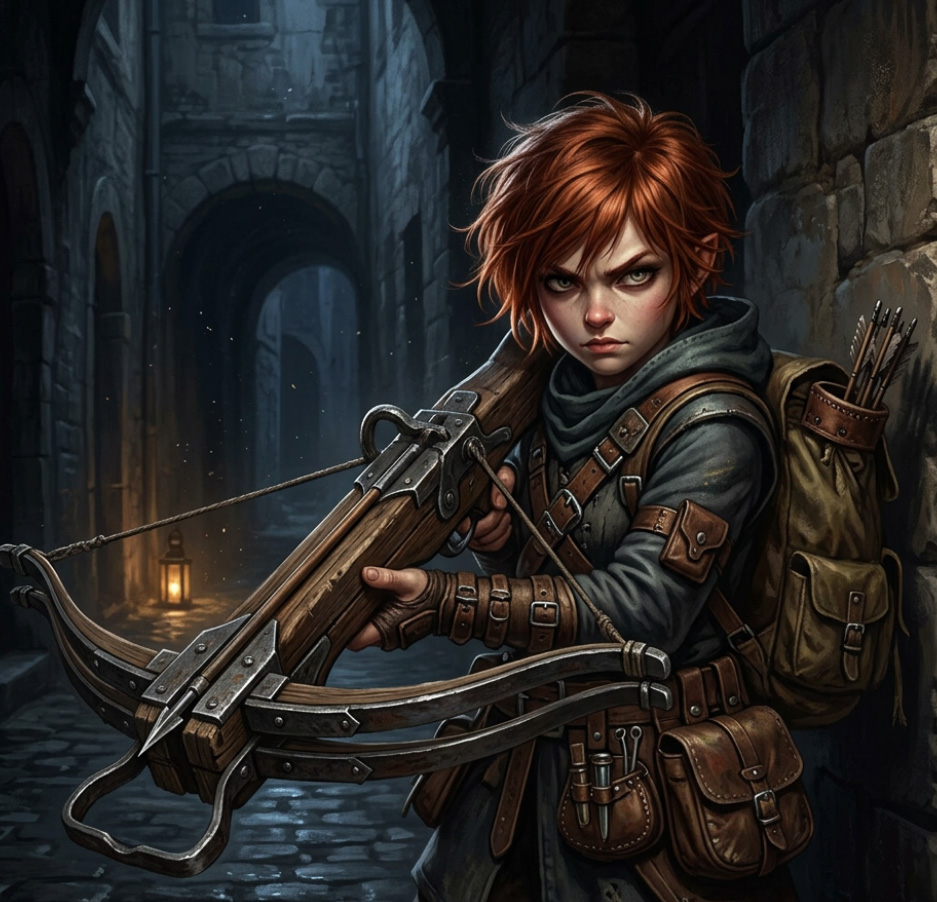
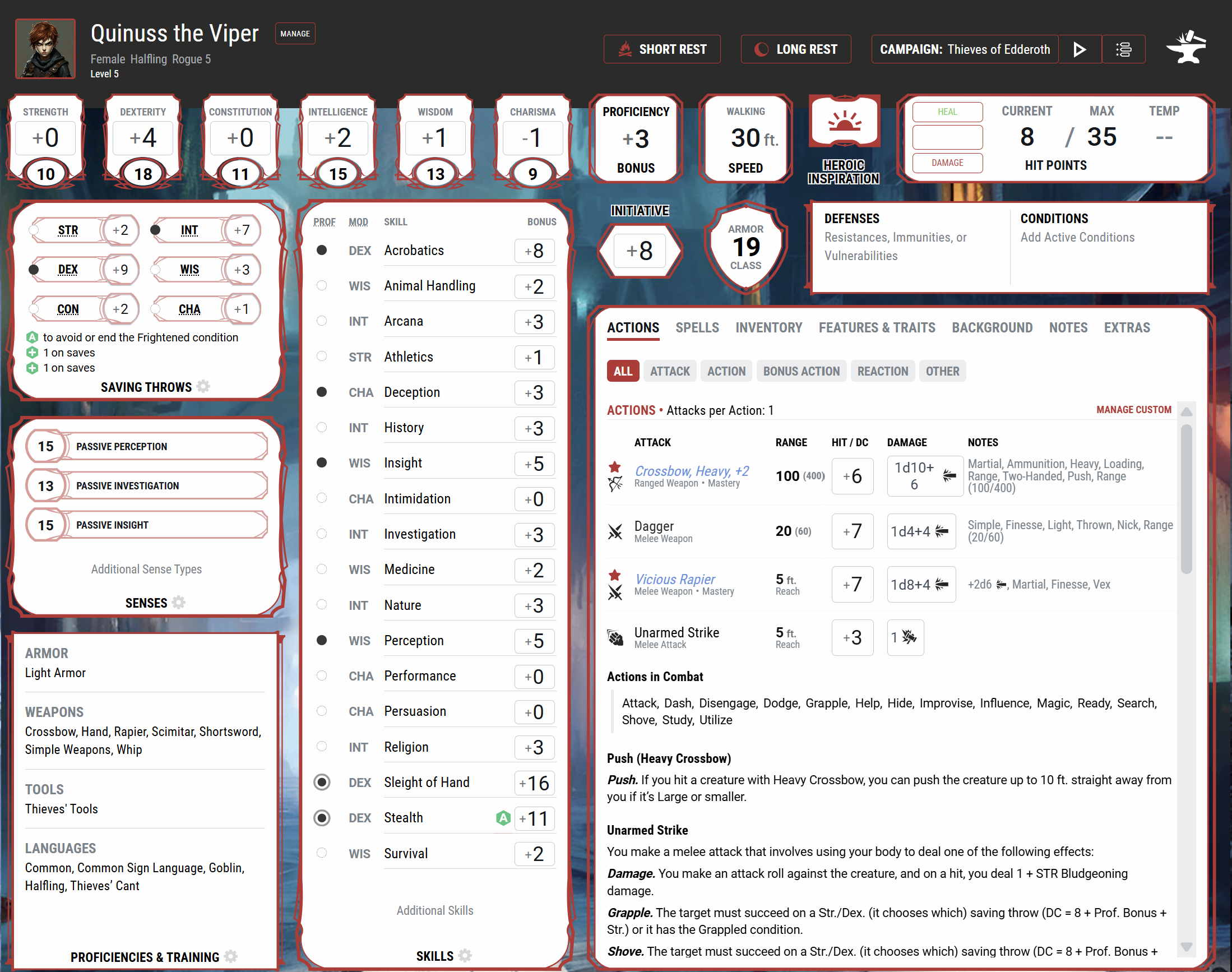
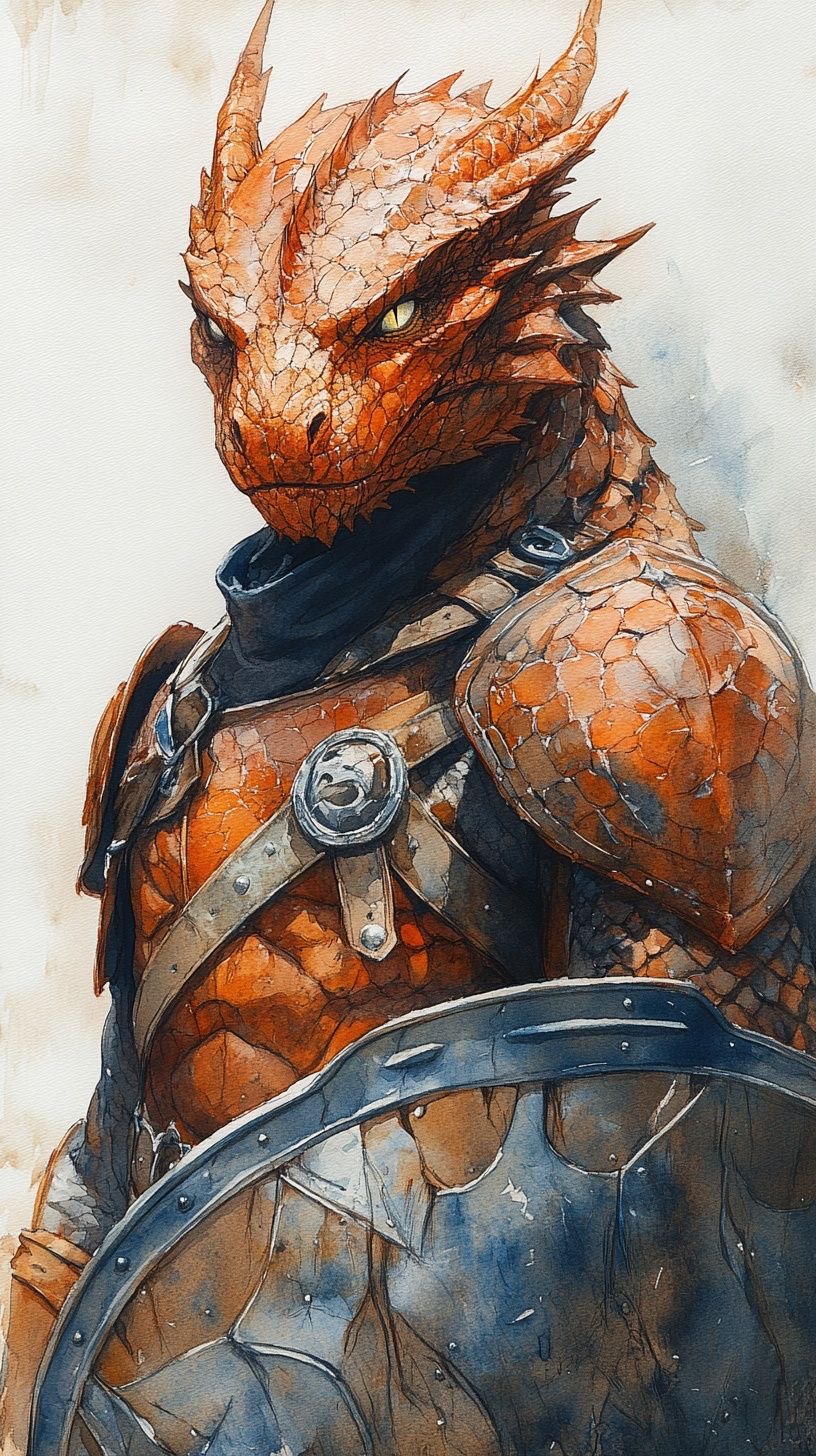
Severin, Hierophant of Tiamat, lord vampire of the Shadowlands, called Mortileux in the elder language of Aidriffon among the elves who remember. Severin summons the four thieves: Dirk the soulknife, Kaeliss the Pact of the Tome Warlock, Vesper the lore master, and Quinnus the Viper with her crossbow. Through the draconian nurseries at the steps of Mansion Dearte, Severin’s crypt-like home, the four approached.

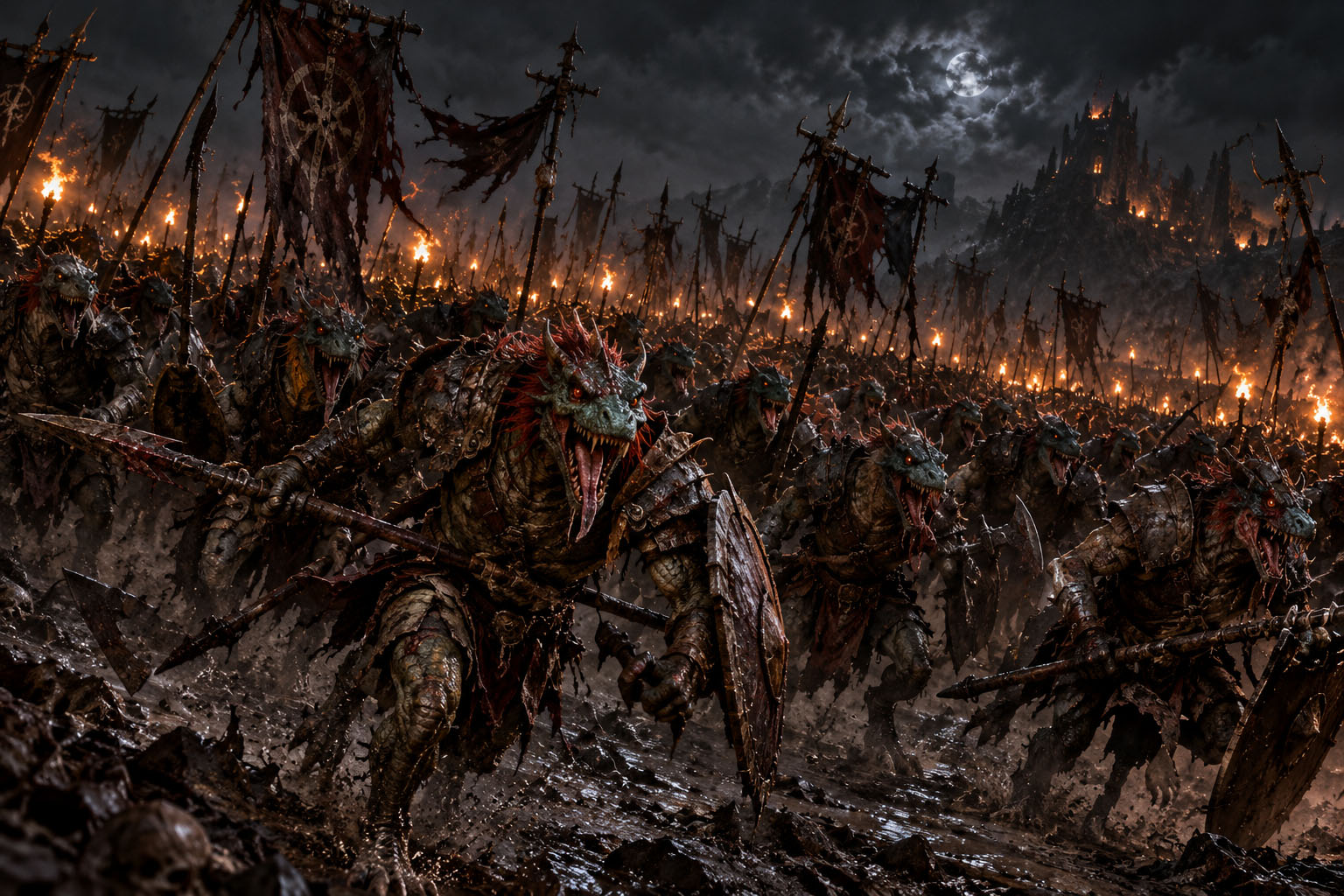
Severin would distract the entire city and castle by launching a draconian army attack on Edderoth from the West. He had been fomenting unrest in Yartar and establishing draconian camps outside the city. The attack would come quickly and be devastating.

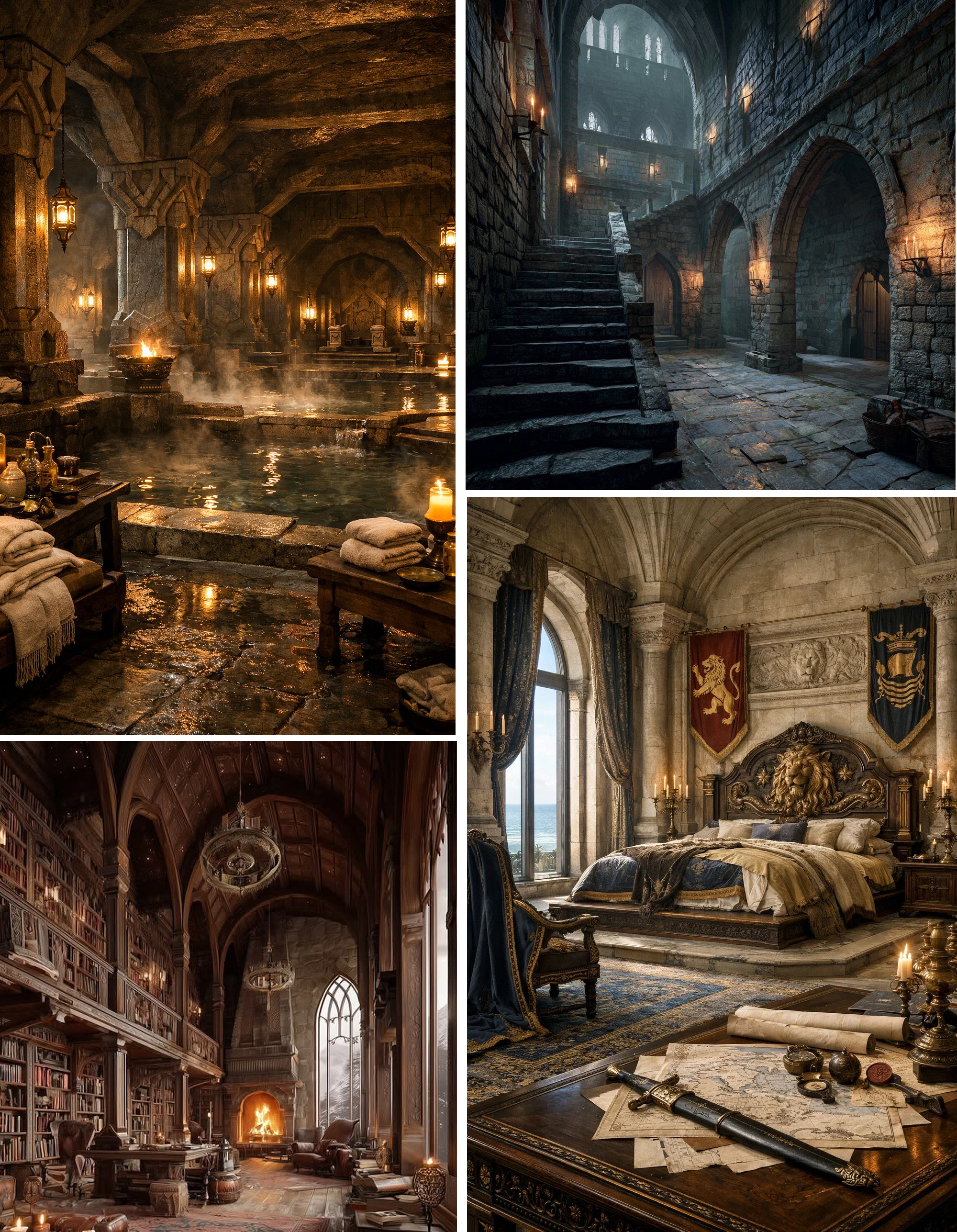
Hundreds of so-called Sivakian (from the Arkedaln/dwarvish word for “savage blade”) draconians threw themselves at Edderoth when the thieves snuck into the Castle through the baths and eventually climbed to Vivianna’s residence to claim the sword of Doom locked in her private vault.

Through the basement baths, up through the entry hall, the library, and finally into the top-floor sanctum of the Lady of the Valley, the Thieves pilfered and stealthily made their way up, encountering only a few guards and a few war golems. All dispatched.

Vivianna was absent. That knowledge was already held by the thieves. They did not expect Uiei, the elmaiden and swordmaster, Vivianna’s lover, to be present. She put up a fight and was killed. The thieves disarmed the vault and the angelic Protectorant who guarded the blade. The thieves took possession of the sword of doom.

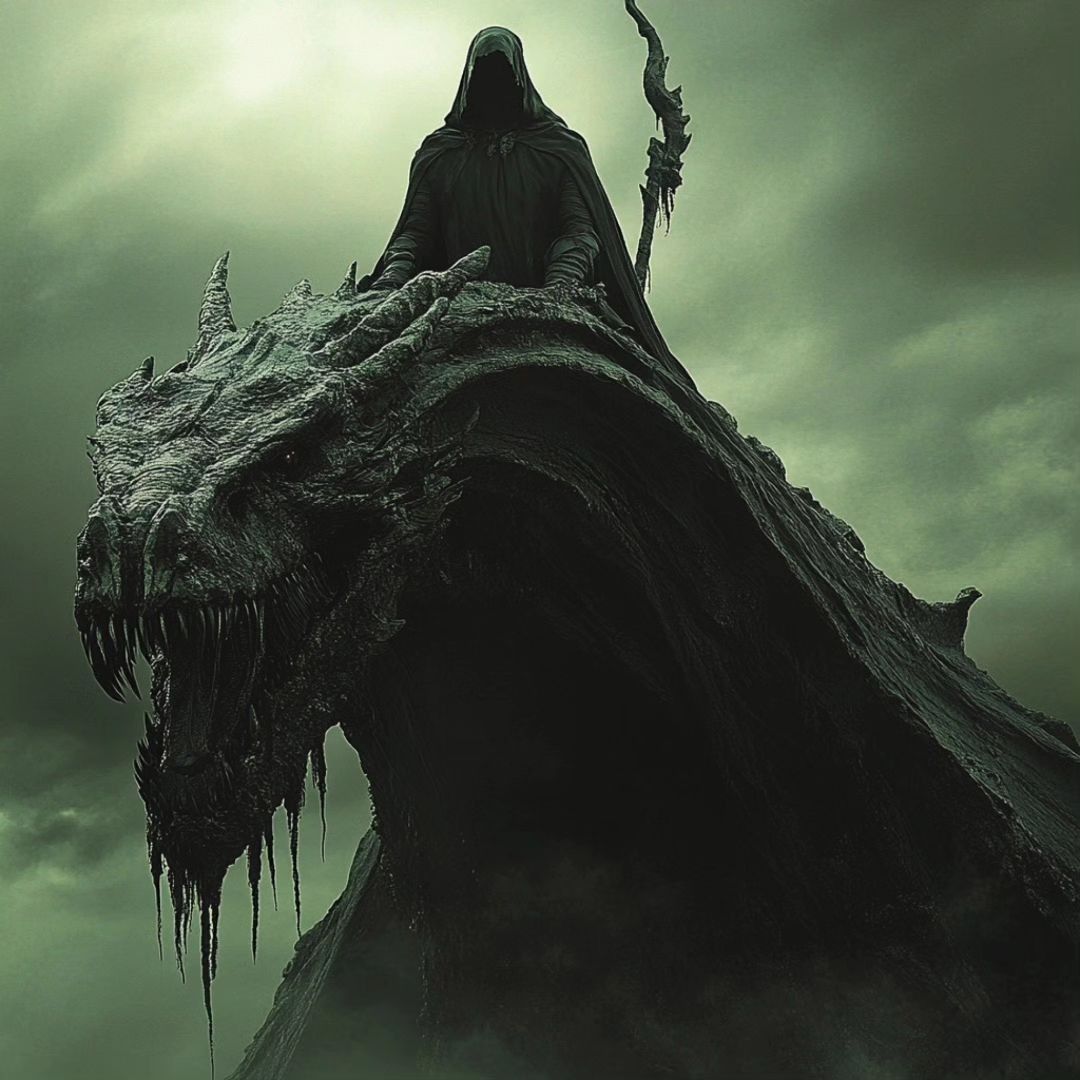
Once the thieves had the sword, Severin sent his witch-lord, a nameless thing on a shadow drake, to the top of the castle. He intended to betray and abandon his hired help. He only needed them to steal their way into the vault. They fought. Vesper created a portal and, with Kaeliss and Dirk, escaped with the sword. Quinnus escaped the disaster through the castle sewers.

The people of Edderoth wonder if the dragon wars have started again. In fact, with the loss of Rendlereign, the Bladesong knights suspect that something more catastrophic than the dragon wars lies on the horizon.

The Song of the Sword Mothers

Posted in Gildensong, Siluvaria, The Scintilliant, The Swords of Creation on October 1, 2026 by coyoteandthunder

The Kingdoms and Ages of Siluvaria

The history of Siluvaria is measured in kingdoms lost, gods divided, and the three great catastrophes by which the shape of the modern world was made. In Old Anontyr, some seven and a half millennia ago, when Bahamut and Tiamat were yet joined in love, the six Swords of Creation were forged amid the wars of the Cathidic Blight. That first age perished in the Sundering, about 4000 DR, when the divine wyrms were divided and the world passed into the age of Ethilistyr, the Dream Water. There Bahamut and Tiamat made war, the first Scintilliant spread across Siluvaria, and the six women remembered as the Anum Batai, the Sword Mothers, came at last to Highspire. Ethylistyr ended in the Rending, around 2000 DR, with the death of Tiamat and the ruin of the old order. Thereafter arose the soaring elven kingdoms of Orsolon, the flying cities and the great Mythals, in the high Age of the Scintilliant. That age in turn passed away with the First Rime of the Frostmaiden, at the beginning of Dale Reckoning, 1,510 years ago.

What follows is called The Song of the Sword Mothers, composed by Verenestra, archfey of the court of Lady Vivianna of Gildensong. Tradition holds that Verenestra wrote the verses upon dried leaves in an ink of wine, soot, and her own blood, and made only three copies: one for the Lady of the Valley, one for the Bladesong Knight Loralin Galdirion, and one for Lady Glasshair of Rainmark.

THE SONG OF THE SWORD MOTHERS

As written upon the Autumn Leaves by Verenestra

Six Mothers came beneath the starry glow,
The Anum Batai, summoned by Mystra’s word,
Five thousand five hundred years ago.

Yet older were the Blades beneath their hand,
For twice a thousand years before their choosing
They had been wrought in lost Anontyr’s land.

There love had kindled in the elder light,
When Bahamut lay beside Tiamat,
And Glory had not yet been sundered from the night.

Six swords they wrought while yet the gods were one,
Three born for Glory and three born for Doom,
Before the marriage of the wyrms was done.

Then Volukai dreamed beneath the poisoned deep,
And through the earth the Cathidic Blight awakened,
Like blackened roots arising out of sleep.

And hatred entered where love once had lain,
Till Bahamut and Tiamat took their names apart,
And heaven learned the ancient taste of pain.

Thus came the Sundering beneath a wounded sky,
The first of three great wounds that shaped the ages,
When love divided and the stars learned how to die.

Yet Mystra gathered what the gods had wrought,
Lest six unmastered swords unmake the Weave,
And bound their fury unto mortal thought.

For steel alone remembers neither breath,
Nor pity, grief, nor consequence of choosing,
And power without a heart is kin to death.

Therefore she sought six keepers for each blade,
Six living tethers fastened to the world,
That mortal hands might govern what gods had made.

Before the Seven Daughters came to fame,
There were the Six, the Mothers of the Swords,
And every blade was wedded to a name.

Three were given unto shining Glory,
And three unto the darker house of Doom,
And thus divided stood the ancient story.

Yet neither good nor evil dwelt alone,
For every sword remembered its first forging,
When dragon love had made all six as one.

Through Ethylistyr the Mothers kept their ward,
While Dream Water shimmered beneath the moons,
And mortal hands grew accustomed to the sword.

Then from the swords arose the Mythal fire,
As elves first learned to weave the land with magic
And lift their hidden cities ever higher.

The Cathidic Blight withdrew from root and stone,
And Volukai passed eastward into darkness,
While green returned to countries overgrown.

In those years the young Scintilliant took wing,
Beyond the ancient bounds of Ethylistyr,
And elves first dreamed of Orsolon’s coming spring.

Then concord flowered for a little while,
And all six Mothers journeyed north together,
Through forest deep and many a starlit mile.

At Alenthia Feiren they made their spire,
The house that later tongues would call Highspire,
Where sixfold magic burned like sleepless fire.

Long ere the Rending, there the temple stood,
Raised unto Mystra and the living Weave,
White above mountain, river, field, and wood.

There every Sword of Creation found its rest,
And all six Mothers dwelt beneath one roof,
Each blade made still against its keeper’s breast.

Even dragons came beneath that sacred stone,
Ghinaetria and Angmehridon together,
When copper and green had not yet warlike grown.

First among the Mothers stood Sciabelle the bright,
Priestess of Corellon, keeper of the Emerald,
Thalorien gleaming with green and deathless light.

Then came the Sisters, three who walked with Doom,
Acertiana bearing cold Rendgray,
Whose shadow made the brightest chamber gloom.

Thayertiala bore Rendlereign the Pale,
Whose edge could sever sovereignty from kings,
And make the mightiest covenant grow frail.

Aetheiatala bore Rendpyre’s crimson flame,
The blade that makes immortal blood remember
That even deathless things may lose their name.

And Mystra trusted these three hearts to hold,
The darkness sleeping in the Swords of Doom,
For mortal love seemed stronger then than gold.

But high above, the stars began to bleed,
For Tiamat’s wrath had entered all creation,
And hatred ripened from an ancient seed.

Then came Kanre Charrir, dragonborn and white,
The sole non-elven Mother of the Six,
Who bore Aeltharion like a star of light.

The Ivory Blade was given to her line,
And blood remembers what the years have buried,
For oath and sword remain by old design.

But Vaelorin, the Crimson, went to one called fair,
An elven-seeming Mother named Emoria,
With midnight eyes and softly silvered hair.

Yet Emoria was a woven lie,
For underneath that borrowed face was Iggwilv,
Mother of witches, hidden from Mystra’s eye.

Thus poison entered quietly through the door,
Not borne by armies, dragonfire, or darkness,
But by one smiling woman on the temple floor.

She whispered where the Mothers came to pray,
And turned the hearts of Glory against Doom,
Until old fellowship began to rot away.

As sun and moon divided in the height,
So Glory looked on Doom with growing loathing,
And Doom mistrusted every child of light.

Beyond Highspire the Scintilliant spread wide,
Their kingdoms rooting beneath Orsolon’s shadow,
While mortal nations gathered at their side.

And Tiamat claimed the breathing earth,
While Bahamut withdrew unto the heavens,
And every quarrel found a darker birth.

For centuries the Anum Batai knew no peace,
The hidden splinter driven ever deeper,
Until even memory begged the wound to cease.

Then came the eve appointed unto fate,
Three thousand five hundred years before this singing,
When Doom’s three Mothers gathered at the gate.

There Acertiana and her Sisters swore the Kai,
The dreadful Vow of Immortnish unbroken,
And bound themselves to Doom, no more to die.

For lords of Dream Water had found beneath the ground
The sleeping flesh of Tiamat herself,
Where the Queen of Dragons lay in darkness bound.

Then came Azinon, master of the streams of time,
To guard Vaelorin from the gathering treason,
Walking through years as others walk a climb.

Before the Six he tore away the guise,
And Emoria was named as Iggwilv,
The Mother of Witches naked before their eyes.

Then Sister rose against Sister beneath the dome,
And Doom drew steel on Sciabelle and Kanre,
While thunder shook the ancient mountain home.

Azinon seized the Crimson from the fight,
And bore Vaelorin down the roads of time,
Beyond the reach of Doom and mortal sight.

Far hence he gave the blade to Springfield’s hand,
That one unborn might answer ancient treason
When Doom returned again to mortal land.

But Thalorien shattered in that bitter hour,
And Sciabelle fell beneath the Swords of Doom,
Her green blood burning through the stones like flower.

Then Tiamat was stricken beneath the world’s dark wall,
And Alenthia Feiren broke upon the mountain,
When heaven answered to the Dragon Queen’s fall.

That hour men afterward named the Rending,
The second wound by which the world was measured,
And Dream Water came unto its ending.

Thereafter came the Orsolon in flight,
Their silver cities wandering above the forests,
And Mythals burning underneath the night.

For long the Swords of Doom knew hidden rest,
Scattered from Highspire and from one another,
While Orsolon’s bright cities ruled the west.

But the three Sisters had escaped the grave’s dark door,
Their Vow transformed them into deathless wraiths,
Neither women of flesh nor Mothers anymore.

Then Matildae came beneath a veiled moon,
And with her brother stole the sword Rendgray,
And Highspire learned that Doom returns too soon.

Her brother then was called Vizix the Veiled,
Though Volukai moved behind the mortal naming,
And many truths beneath that name lay sealed.

They fled aboard the haunted Kellis Ilbyrn through the gloom,
And without their swords the three lost even themselves,
Becoming wandering Mothers bound to Doom.

Rendlereign vanished where the oldest shadows reign,
In forgotten corners of Siluvaria,
And none who sought its resting place returned again.

Rendpyre fled beyond the mortal wild,
Into the shifting countries of the Fae,
Where road and year and memory are beguiled.

Thus sword and Mother share one deathless chain,
And neither wholly lives without the other,
Nor may the wraiths be slain while blades remain.

Until the three return to Highspire’s stone,
The Anum Batai wander through the ages,
Seeking what was theirs and theirs alone.

Yet in their curse abides a bitter grace,
For while the Sword Mothers haunt the mortal world,
Doom cannot wholly show its final face.

The blades may murder, sunder, burn, and mar,
Yet something deeper sleeps within their making,
A final wound reserved for moon and star.

And Tiamat, long fallen, walks once more beneath the sky,
Returned when Vecna’s banishment tore the old seals,
And ancient wings are heard again on high.

But not until three Dooms return beneath the spire,
And Rendgray, Rendlereign, and Rendpyre stand together,
May the oldest purpose wake within their fire.

Then shall the Dragon Queen behold her ancient foe,
And all the Scintilliant shall hear Highspire calling,
From mountain crown to caverns far below.

Then shall the Sixteen gather beneath the darkened sun,
And Siluvaria remember its first morning,
When dragon, elf, and sword were newly one.

And whether Highspire shall become their tomb or door,
No Mother sings, no dragon knows, no god has spoken,
For that last verse is written nevermore.
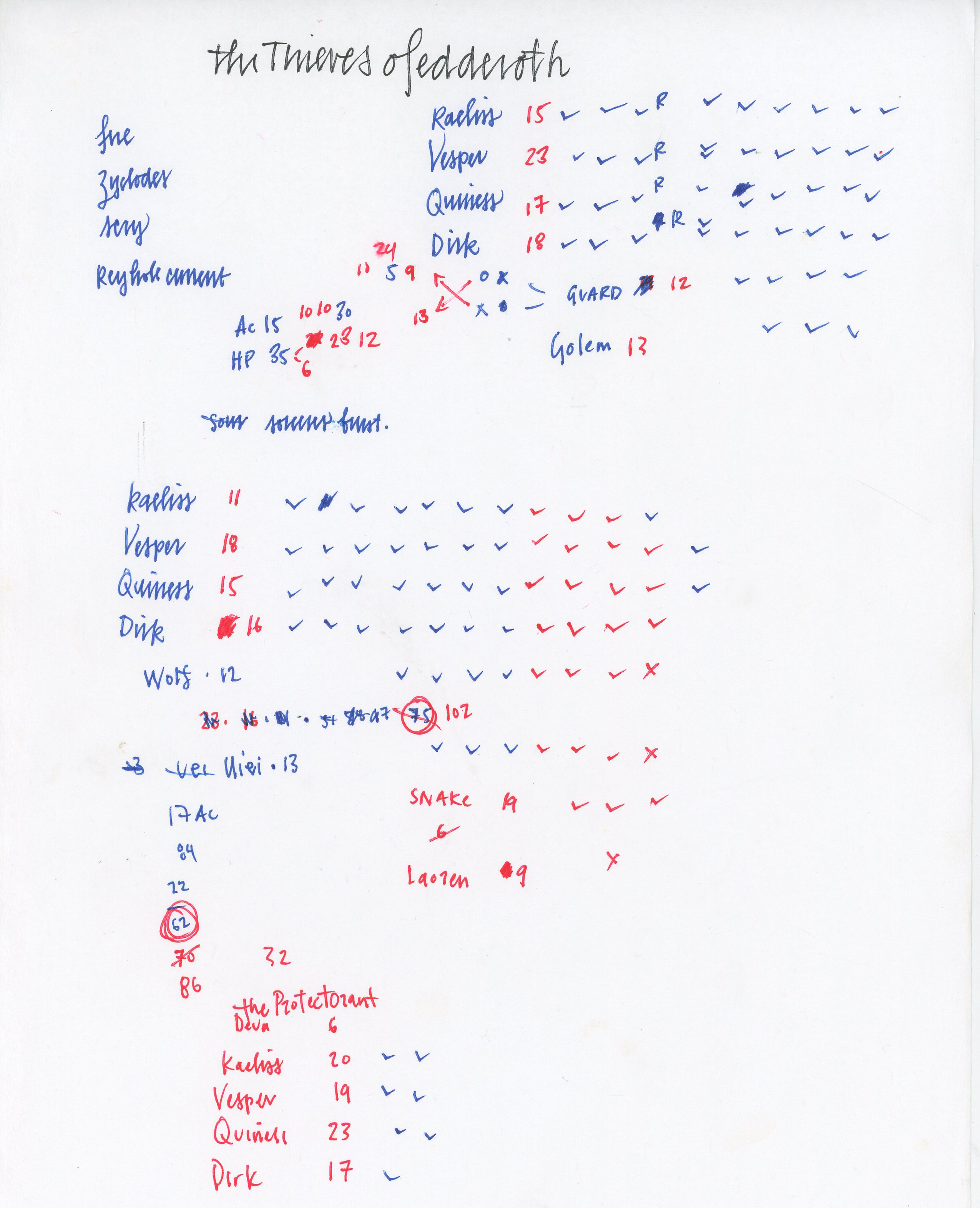
The Thieves of Edderoth

Posted in The Swords of Creation, Underroot on September 22, 2026 by coyoteandthunder
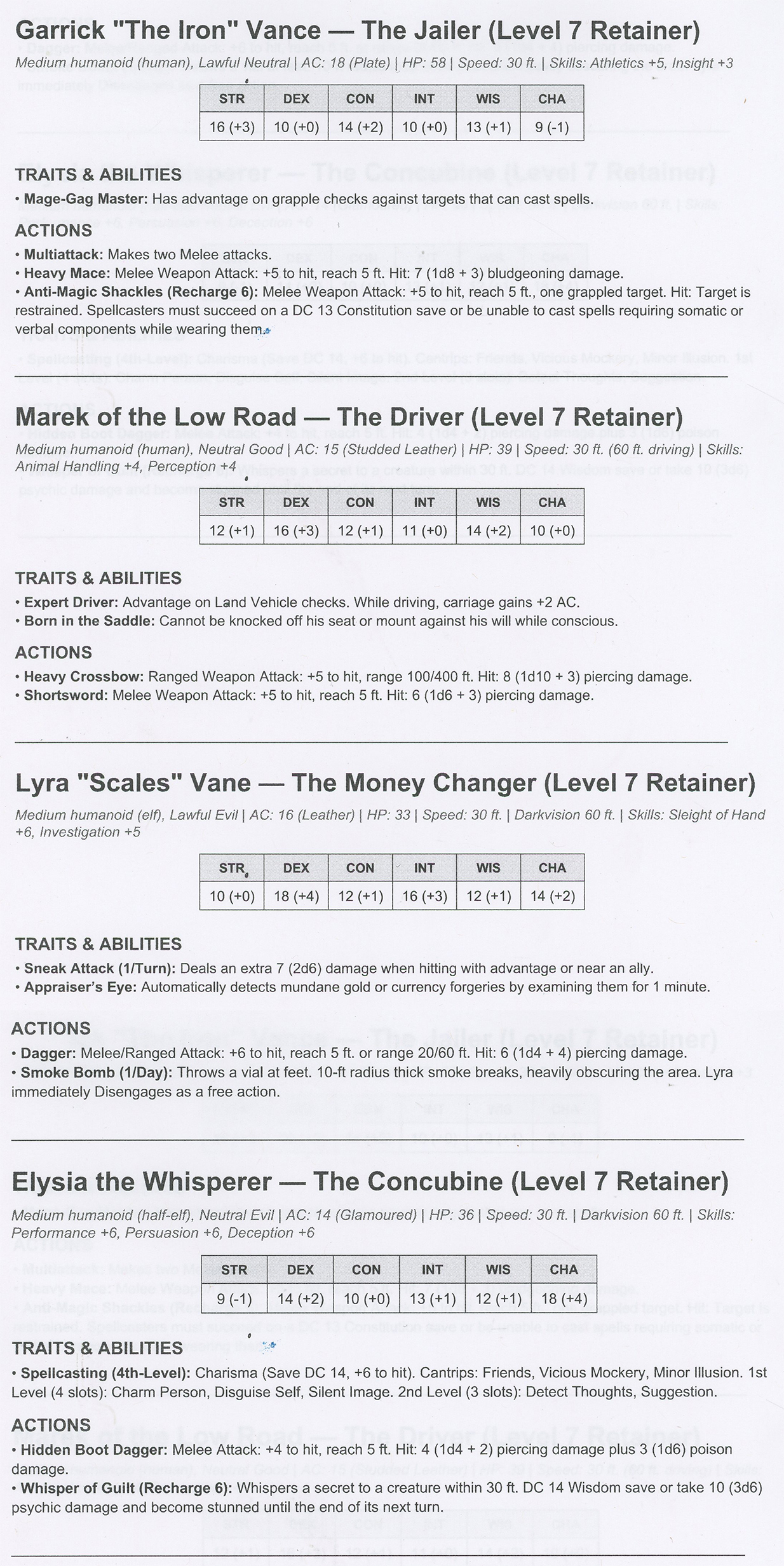
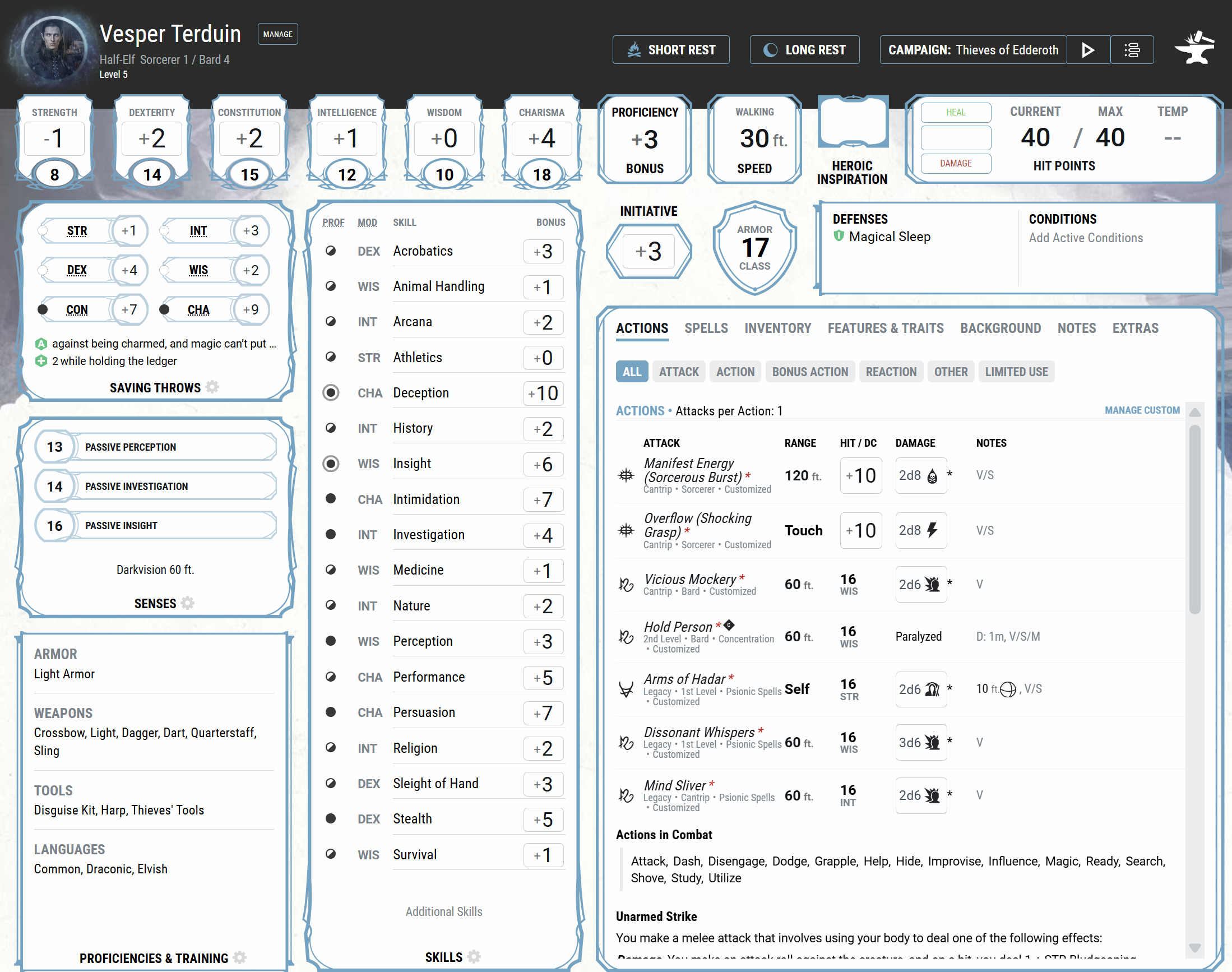
Vesper Terduin

VESPER


● The Zhentarim (The Cover): Vesper was recruited by the Black Network for his meticulous mind. He was a “Deep Archive Sleeper.” His job was to monitor the flow of information in Silverymoon and report on magical assets that the Zhents could seize or influence.


● The Pale Synod (The True Loyalty): While working for the Zhents, Vesper was”audited” by the Synod. They realized his Zhentarim training in espionage and coldcalculation made him the perfect Receiver.


● The Dynamic: He uses Zhentarim resources (safe houses, contacts, dead drops) to hunt for the Synod’s “Stagnant Capital.” The Zhentarim think he’s looking for leverage for them; in reality, he’s looking for the First Word. The Vault of Whispers (The Conclave) In Silverymoon, Vesper was a high-level archivist/sleeper agent in The Vault of Whispers within the Conclave of Silverymoon (the city’s great university of magic).


● The Vault of Whispers Job: Vesper was a cataloger of unidentified curiosities. This department handles artifacts that are too dangerous or too “silent” to be put on public display. It gave him the perfect excuse to spend years alone with ancient, dusty relics
without anyone questioning why he was staring at a stone shard for six hours.


● The Location: Skylla used a front company to ship the cache to the Vault of Whispers in Silverymoon for “appraisal and historical verification.”


● The Vesper Connection: As a Zhentarim Sleeper and Pale Synod Receiver, Vesper was the exact clerk assigned to process this “incoming shipment.” He was the one who was supposed to look at the stolen goods, sign the paperwork, and make them “legal” in
the eyes of the Conclave.


● Summary: Vesper was a Zhentarim Sleeper embedded as a Cataloger in Silverymoon’s Vault of Whispers. While secretly reporting magical assets to the Black Network, he was recruited by the Pale Synod to act as their internal “Receiver.” During Skylla’s heist, he intercepted The Ossified Tongue, an ancient artifact associated with Volukai. The shard bonded to his consciousness, hollowing out his mind to create a psionic “clean room” for Volukai’s whispers.


Aberrant Mind Transformation; When Vesper touched the Ossified Tongue of Volukai in the Silverymoon archives, it didn’t just
give him powers—it turned his brain into a tuning fork.

● The Pull: Even after Skylla vanished with the cache, the “Whispers” didn’t stop. They began to hum at a specific frequency that points toward Castle Edderoth.


● The Knowledge: The whispers aren’t just noise; they are cryptic messages from the disincarnate form of Volukai. Vesper now knows things he shouldn’t: specifically, that a Sword of Doom is currently sitting in the heart of Edderoth.


● The Mission: To The Pale Synod, a Sword of Doom is the ultimate “Liquid Asset.” To Volukai, it is a surgical instrument required to “re-stitch” his disembodied form into the material plane, or possibly even Vesper’s flesh. The Narrative Pivot: From Clerk to Seeker Vesper didn’t just “go” to Edderoth; he absconded.

  1. The Default: After the security breach in Silverymoon, the Zhentarim expected a report. Vesper gave them nothing. He realized the Black Network’s petty squabbles over gold were “statistically insignificant” compared to the return of the First Word.
  2. The Journey: He followed the magnetic pull of the whispers. Every mile closer to Edderoth he gets, the “Static” in his head clears, replaced by the cold, structural clarity of Volukai’s instructions.
  3. The Sword: He isn’t just looking for “an artifact”—he is looking for the specific blade that can return a dead god. He believes that by wielding a Sword of Doom while holding the Ledger of Final Reckoning, he can bridge the gap between the Pale Synod’s theory and Volukai’s physical return.

Timeline

  1. The Shipment: Skylla steals a cache from Edderoth and ships it to Silverymoon under a false merchant name (“The Amber Trade Guild”) to have it “verified” (laundered).
  2. The Audit: Vesper, working his day job at the Vault of Whispers, opens Case #882. He finds the Ossified Tongue.
  3. The Awakening: Proximity to the Tongue triggers his Aberrant Mind psionics. He begins to hear the “Whispers of Volukai.” He realizes this is the opportunity the Pale Synod has been hunting for centuries.
  4. The Theft: Before Vesper can alert his Synod handlers or his Zhentarim superiors, Skylla (disguised or using magic) raids the vault and takes the cache back.
  5. The Pursuit: Vesper is now tracking Skylla hoping to “repossess” the assets and complete the ritual that will make him the Vessel. But the whispers of Volukai fill his mind and direct him to Edderoth and the Sword of Doom.
Kaeliss Thorneveil

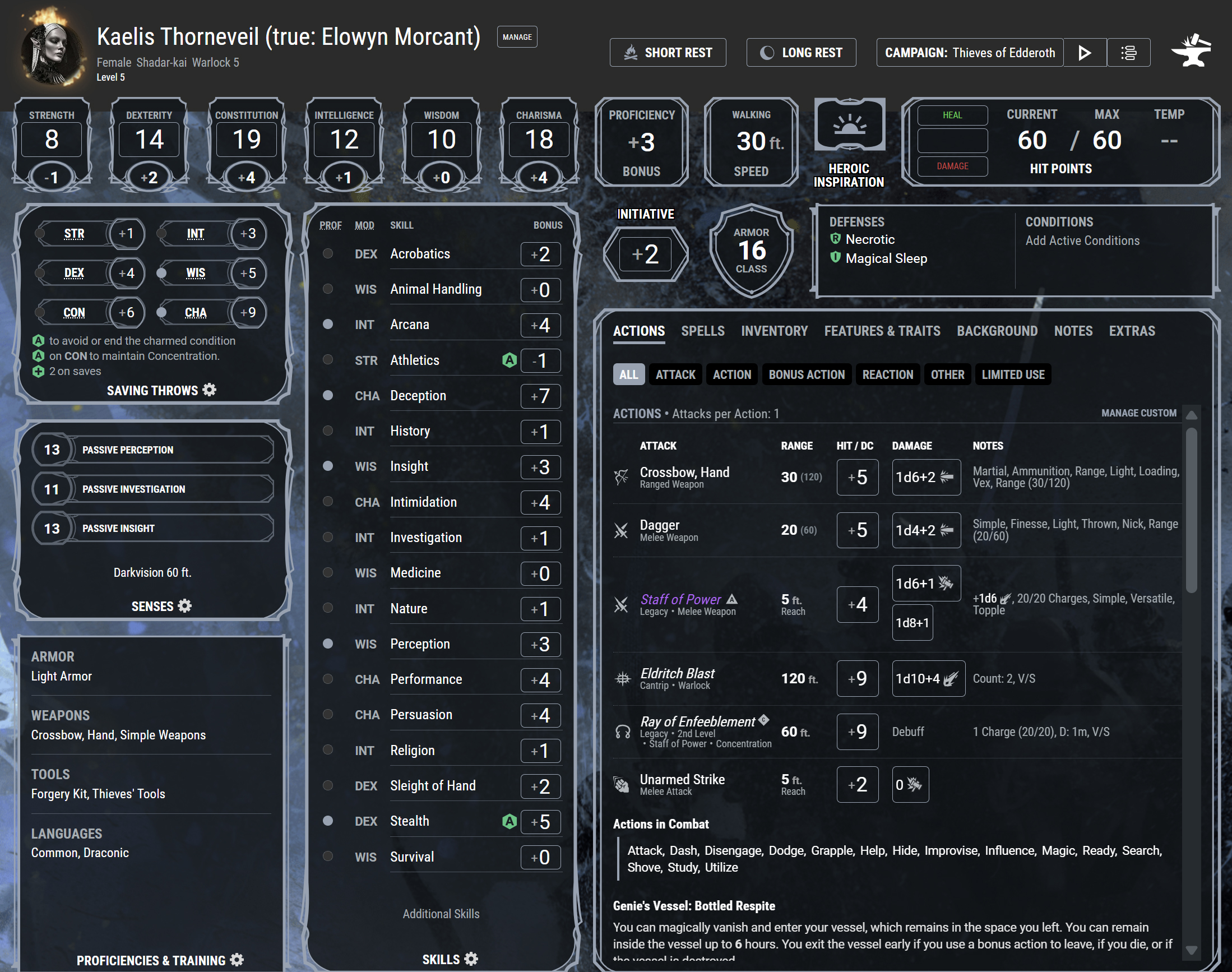
PRIVATE RULE “You don’t take jobs that destroy things. You take jobs that relocate them—into the right custody. Stealing the Sword of Doom isn’t sacrilege; it’s proof that any lock is temporary, and some locks must be replaced with better ones.”

SOCIALIZATION / NAME USAGE In public / with guards / on paperwork: “Kaelis Thorneveil.” In private moments (rare): Elowyn Morcant. With the crew: Kaelis by default; Elowyn only if trust is earned.

True Name: Elowyn Morcant.
Function: Shadowfell custody agent (Raven-Queen-adjacent in ethos, not necessarily clerical).
Directive: Quarantine-class recovery.

Elowyn’s circle keeps a ledger the living do not see: what objects distort endings, what relics corrupt memory and fate, what tools turn death into a lever rather than a boundary.

The Sword of Doom is categorized as quarantine-class—not “destroy on sight,” not “lock away and forget,” but remove from circulation and seal in custodial containment.

Why the Shadowfell Cares

This sword is not merely evil. It is administratively catastrophic.

In Elowyn’s belief system, the Sword of Doom:

  • warps the integrity of identity (names, selves, remembered lives),
  • makes death behave incorrectly (too sticky, too transferable, too exploitable),
  • and spreads “ledger rot” through proximity and claim.

The Shadowfell is not concerned with morality. It is concerned with accounting—the boundary where a life ends and stays ended.

A dragon priest using the sword is a fate-breaking event. Severin’s pipeline is not just a villain’s plan; it is a mass-contagion vector.

How the Djinni Pact Serves This (and Why It’s Not a Contradiction)

The Ledgerwind/Keyhole Current does not share the Shadowfell’s ethic. It cares about motion: thresholds crossed, seals undone, custody inverted.

Elowyn exploits that.

Her pact’s wording is compatible with quarantine because quarantine is also a kind of movement:

  • remove the object from the wrong containment,
  • move it into the right one,
  • replace a failing lock with a better lock.

The patron is satisfied when the sealed thing moves. Elowyn is satisfied only when it is sealed correctly.

Quinuss the Viper
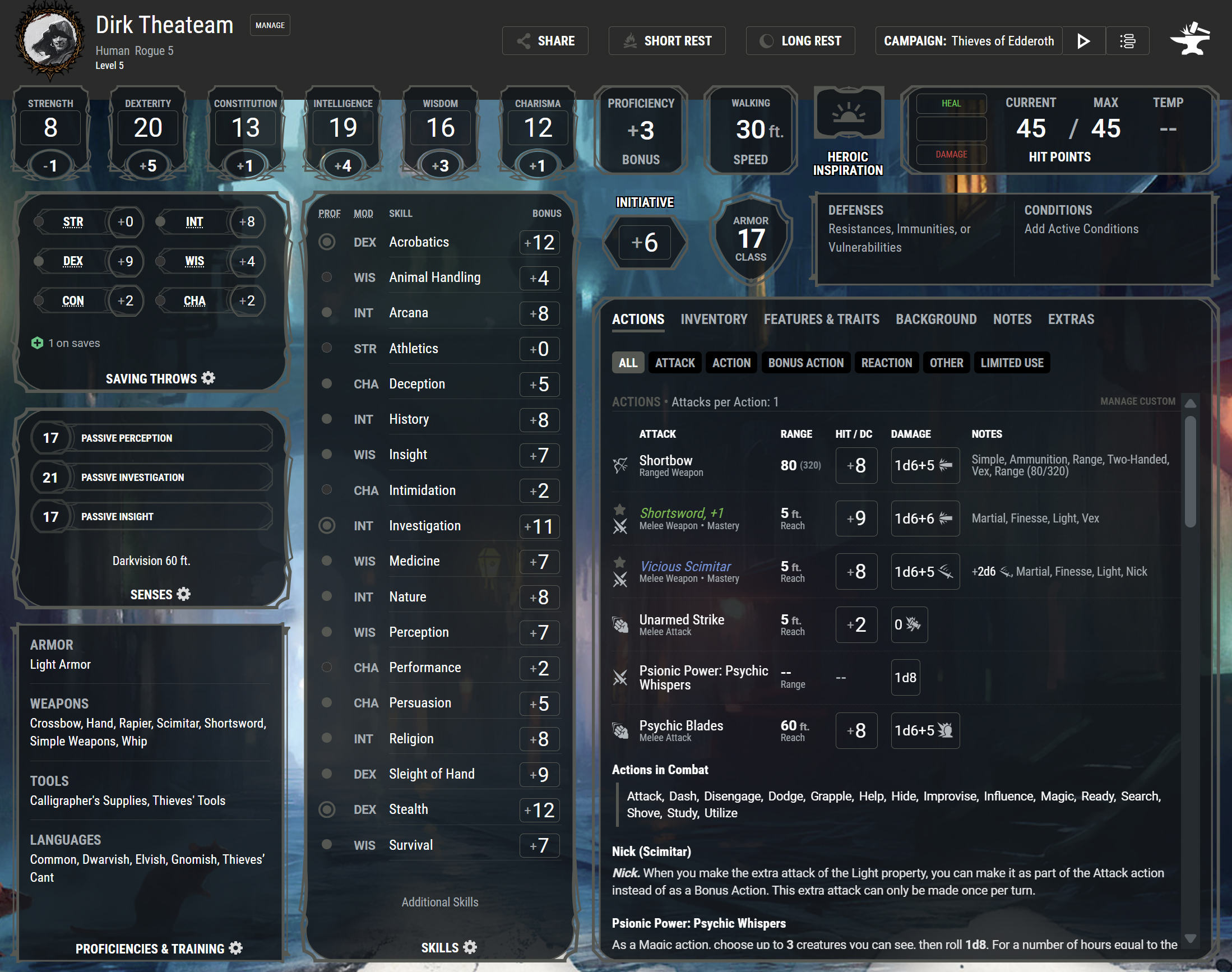
Dirk Theateam

THE HALL OF THE NIGHT MIST

Posted in Gildensong, The Bladesong Knights, The Swords of Creation on June 26, 2026 by coyoteandthunder

The Final Battle of the GRANITE HOME KNIGHTS Chapter 3

The Hall of the Night Mist.

The Hall of the Night Mist

The four Bladesong Knights scarcely had time to cry out before the world withdrew from them. Sound was the first thing to perish. The clash of steel, the beating of dragon wings, the cries of victory and despair were swallowed as though they had never been uttered. Gravity followed. Then distance. Colors loosened from the world like threads drawn from ancient tapestry, unraveling into endless ribbons of silver, violet, and pale green. Forest, mountain, moon, and battlefield dissolved upon one another until they resembled reflections scattered by rain upon still water.

Then all was still. They had entered the Hall of the Night Mist. No mason had raised its walls. No archmage had conceived its impossible design. It had not been built but remembered into existence.

It floated between the first thought of Creation and the last dream of its ending. Endless bridges of polished obsidian crossed a white abyss without pillar or support. Cathedrals hung upside down beneath invisible heavens, their stained-glass windows opening not into chambers but into forgotten centuries. Rivers of liquid moonlight flowed upward, becoming waterfalls that climbed into stars which had not yet been born. Beneath crystal floors spread forests whose leaves were silver on one side and black upon the other, while beyond them drifted oceans suspended in empty air, wherein whales larger than castles swam through clouds without stirring them.

Every step echoed twice. One sound belonged to the present. The other belonged to a life that had not yet been lived. The Night Mist wandered ceaselessly through those impossible halls. It curled about the knights like pale breath upon winter air. Within its shifting folds appeared faces that vanished before memory could claim them. Kings whose empires had crumbled before history. Children still waiting to be born. Lovers separated by centuries. Entire civilizations flickered into being and faded again like half-remembered dreams held in the mind of God.

Loralin’s heart grew cold. He knew where he was. He had read about it in the elder books of Lore at Edderoth college. The Anum-Batai had fashioned this demiplane before the founding of the first kingdoms, before the first mythals, perhaps before the first cities of the Orsolon themselves. Here the six primordial blades had always been destined to gather. Here the Swords of Doom would consume the Swords of Glory. Here the final page of the world had already been written.

Yet something had gone awry. The Hall expected different footsteps. Different blood. Different choices. The prophecy had not failed. It had become uncertain. For the first time since its making…Destiny hesitated. Then the mist screamed. The white abyss below darkened.

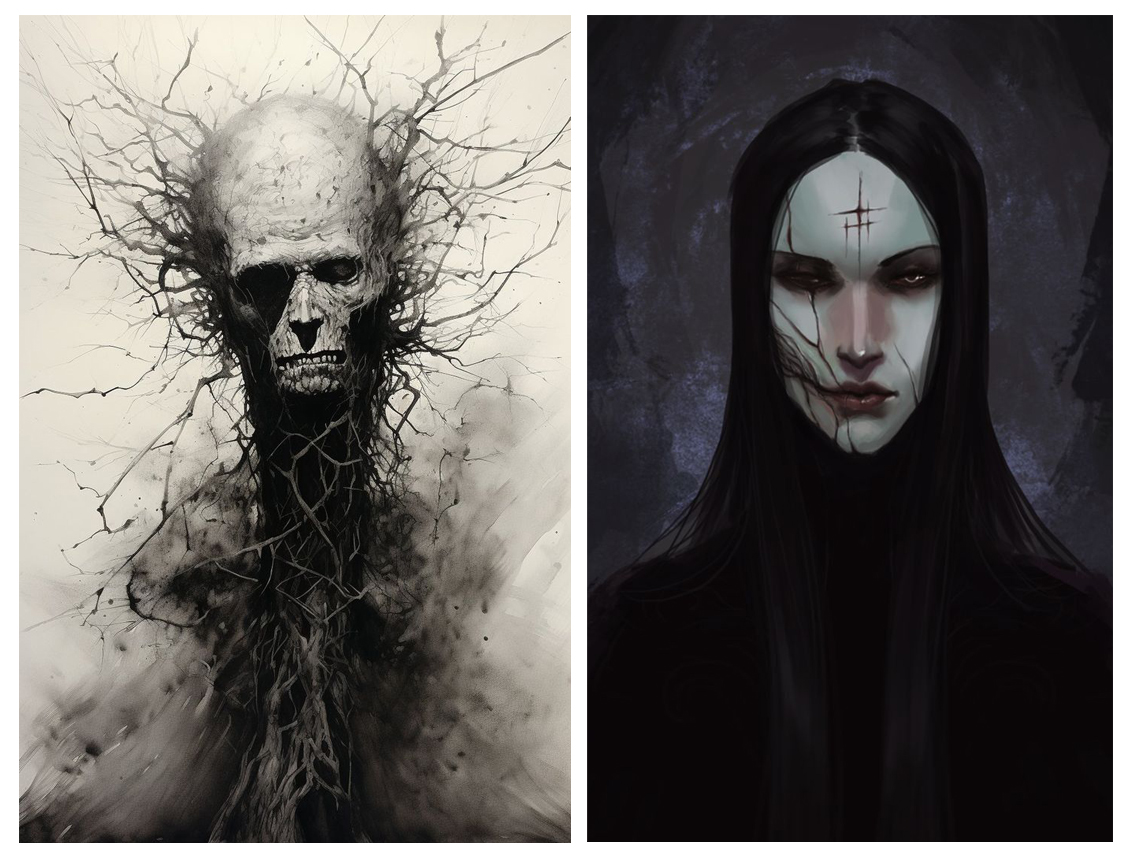
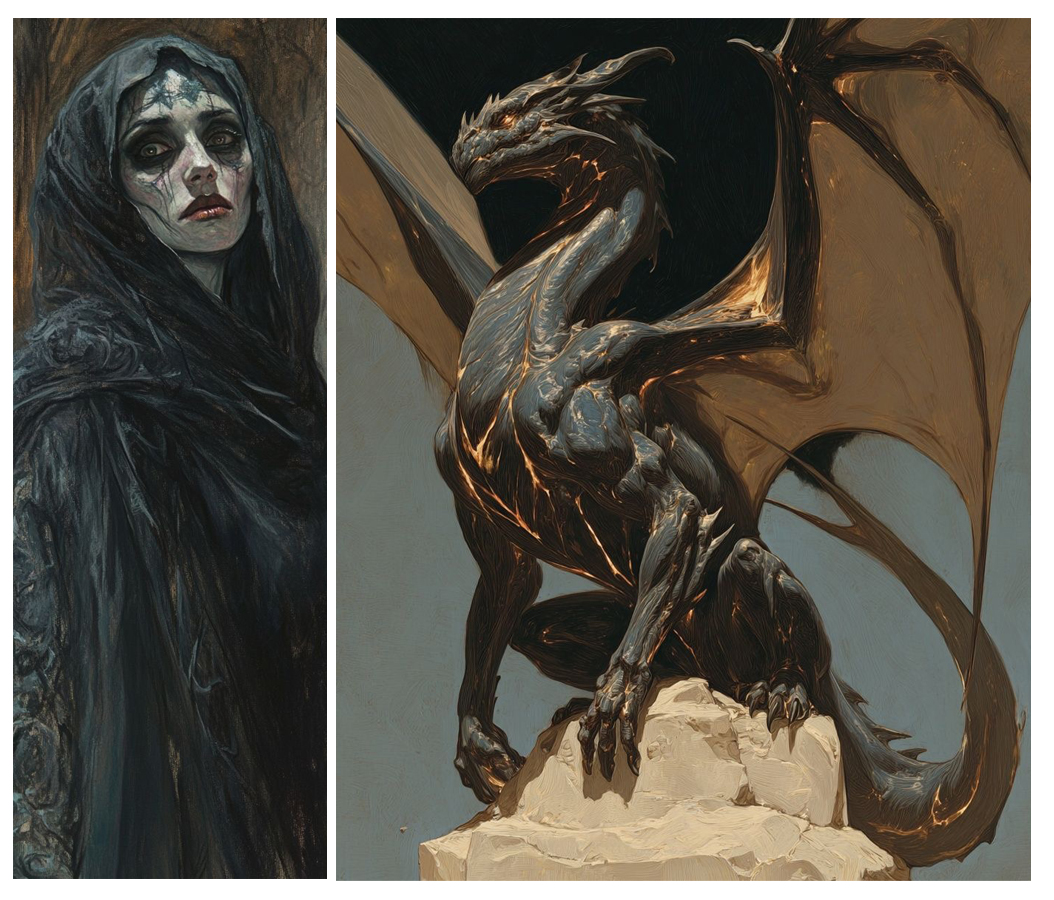
Something immense rose without climbing. It did not fly. It did not walk. It glided upward as though gravity itself recoiled from its presence. The Avatar of Volukai emerged. He was twenty feet in height, impossibly thin, clothed in cathedral-black vestments woven from funeral shadows. Upon his brow rested a broken crown of obsidian antlers whose branches seemed to catch fragments of dying starlight. His face was neither skull nor flesh but something that had forgotten the distinction. Beneath him flowed not legs but an endless bed of writhing serpents, their black scales drinking every ray of light that touched them.

His arms were not arms. They were the dead. Thousands of transparent spirits had been twisted together into two great living limbs. Faces emerged screaming from their surface only to sink again beneath the tide of imprisoned souls. Tiny spectral hands reached endlessly outward. Some begged. Some cursed. Some prayed. Others sang lullabies in forgotten tongues. Every motion carried the voices of entire civilizations into oblivion. Volukai had come.

VOLUKAI and ACERIATIANA

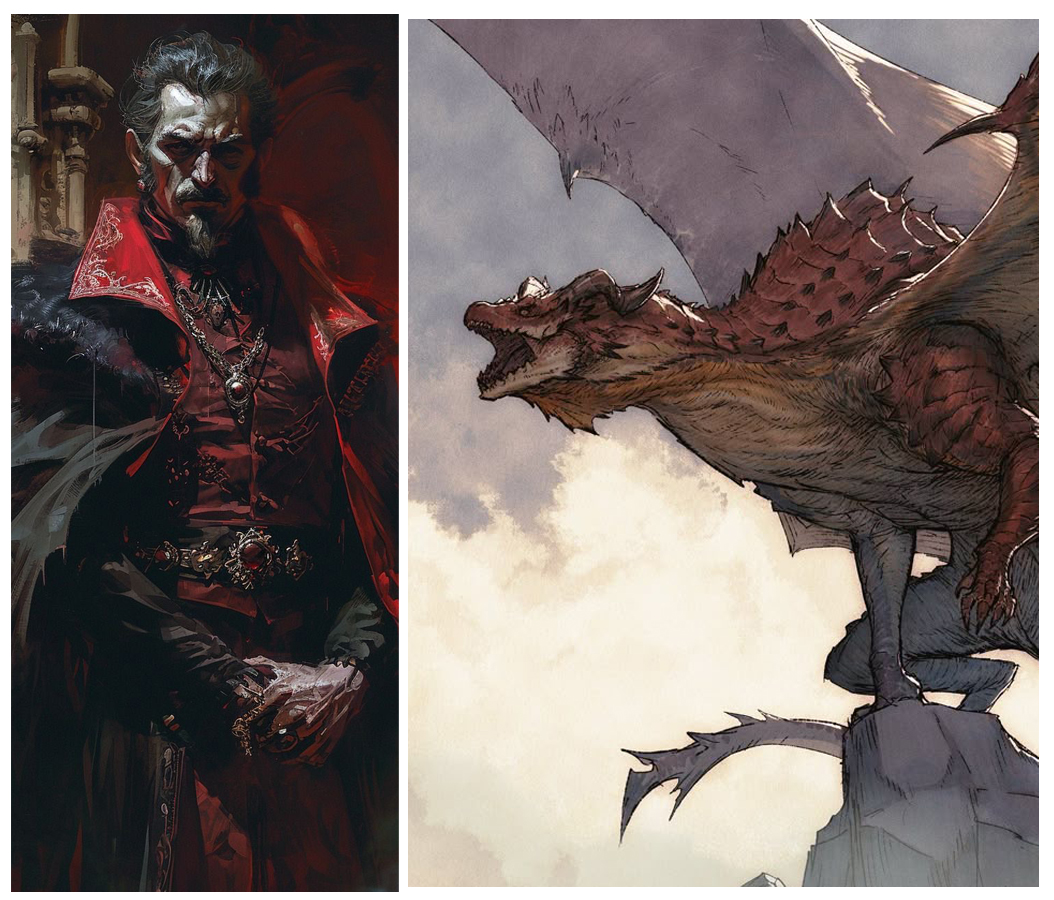
The impossible heavens burst apart as crimson fire erupted through one of the inverted cathedrals. Severin descended astride the ancient red dragon Taelashinon, clad in black armor chased with crimson runes that burned like fresh wounds. Every beat of the dragon’s wings scattered molten sparks that fell through the Hall and became blazing meteors before striking the obsidian bridges below.

Then light itself diminished. Another dragon descended. Once she had been Yropa, the Mountain Mother, beloved among dragons and elves alike. Only sorrow remembered that name now. Shadow clothed every scale. Darkness poured from her wings like smoke from a dying world. Her once-rainbowed hide had become black crystal veined with violet fire, and within her eyes lingered the memory of kindness, imprisoned forever beneath corruption.

Upon her back stood Skylla. She wore flowing robes embroidered with living constellations that drifted continually across black silk. White hair floated around her like frost caught beneath water. Violet witch-fire danced effortlessly between her fingers, illuminating a face untouched by pity.

Then laughter broke the silence. Acertana dissolved. Her gentle features became ash upon the wind. The ancient mistress of the Anum-Batai stood revealed. Aceritiana. Older than kingdoms. Older than empires. Perhaps older than forgiveness itself.

“So,” she said softly. “At last…My family has come home.”

Volukai struck not at the knights but at Severin. Skylla hurled rivers of violet flame toward Aceritiana. Yropa’s shadow engulfed the lich. Spectral serpents answered with storms of imprisoned souls. Reality fractured beneath competing destinies.

Dragons fought liches. Knights crossed blades with immortals. The dead betrayed the living. The living betrayed prophecy. Every oath ever sworn beneath the stars seemed suddenly to demand fulfillment within that single impossible chamber.

Then Loralin smiled. It was the smallest smile. Almost apologetic. He whispered one word. Ancient transmutation answered. Taelashinon vanished. Where moments before had flown one of the oldest red dragons in existence now fluttered only a bewildered silver fish. It blinked once. Gravity reclaimed it. The tiny creature plummeted through eternity before striking one of the crystal bridges with the smallest and most ridiculous splash ever witnessed beneath the heavens. For a heartbeat…Even Volukai hesitated.

SEVERIN and TAELSHINON

Severin escaped only by hurling himself from his dragon’s back into a vortex of black flame that consumed him utterly. The battle resumed. Harder. More desperate. Amid the ruin Loralin’s thoughts returned again and again to the vampire. Not Veteramor. Never Veteramor. There was another name. A truer one. Not a weapon. A key.

He understood at last. The true name had never been meant to destroy Aceritiana. It had always been meant to open the prison she had made of herself. He spoke it aloud. The Hall answered.

At that same instant Zun came roaring forward, his face twisted beneath the domination of Rendgray. The Sword of Doom struck. Its black edge pierced Aceritiana. She smiled. The Anum-Batai could never die. But the oaths that bound them had been forged by the Swords of Doom themselves. Only one of those blades possessed the authority to unmake them. Reality split.

SKYLLA and YROPA

A river of living light burst through the Hall. Beyond it shimmered a forgotten Feyhold untouched by time, untouched by history, untouched even by prophecy. Without hesitation Loralin stepped through. To Korrath, Sayelle, and Zun scarcely three heartbeats had passed. To Loralin, three days unfolded beneath impossible skies.

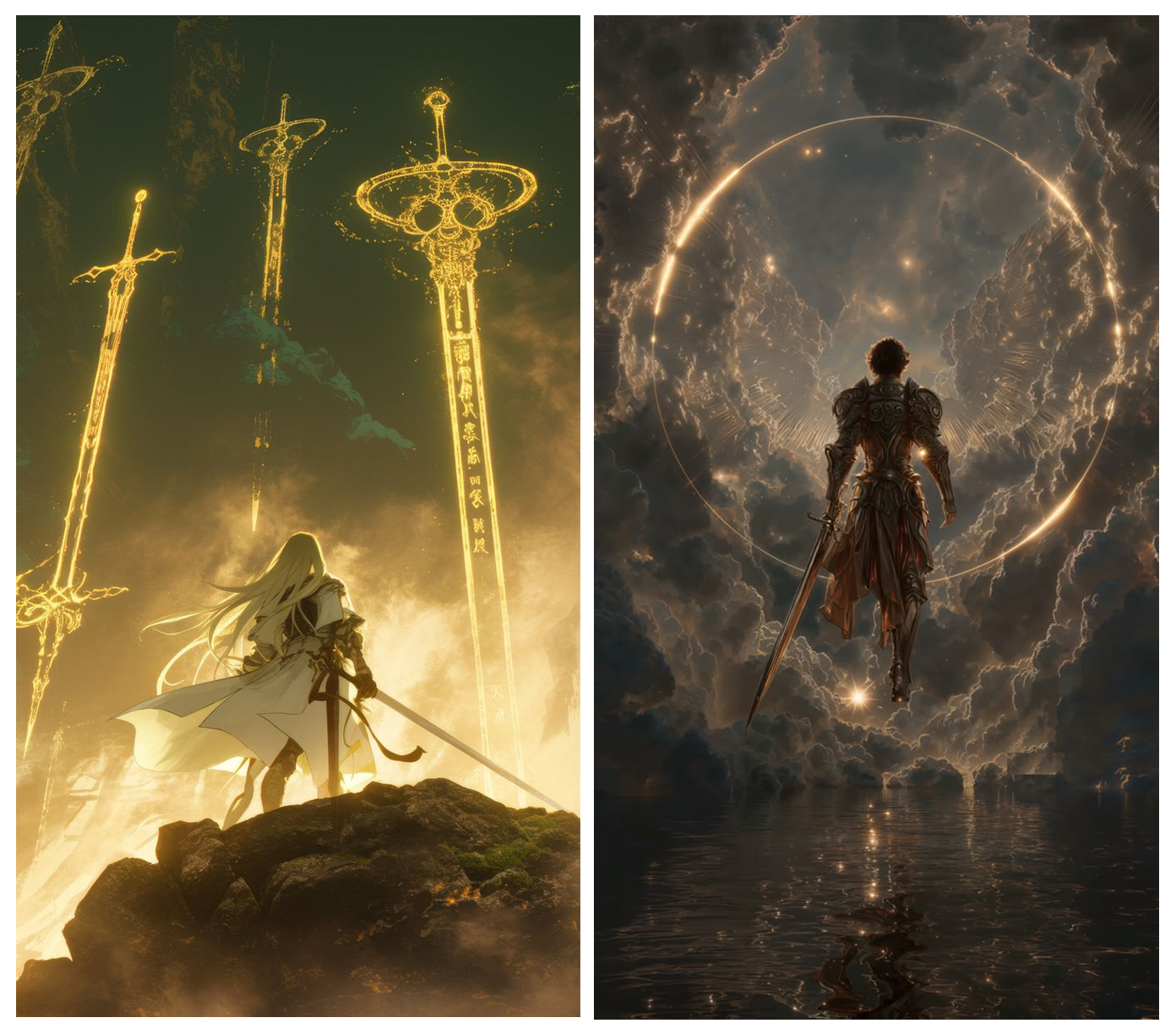
He walked forgotten gardens where the first archfey remembered the making of Daotyr. He crossed bridges woven from birdsong and stood before the oldest forge that still endured beyond the reach of time. There, where the first promises between dragon and elf had once been tempered in living fire, the shattered Justicar Blade was restored. When at last he returned to the Hall of the Night Mist, the sword no longer bore the wounds of history. It shone with the radiance of first dawn. Aeltharion Valethis. The White Oath of Mercy. The Ivory Blade had come home.

Korrath fell silently to one knee as Loralin placed the ancient weapon into her waiting hands. She did not speak. Tears streamed unashamed down her scaled face as centuries of memory seemed to awaken within the steel. Around her, the Hall itself answered. The pale mist brightened, and the impossible bridges sang with a note so old that it had not been heard since the first kingdoms of Daotyr.

Yet there was no time for wonder. Veteramor had reached Zun. The vampire’s pale hands rested upon his shoulders with a tenderness more terrible than violence. Her crimson eyes held his as though they alone existed within the collapsing Hall. Rendgray whispered through the paladin’s soul, and the two small scars upon his neck burned like living embers.

“My beloved knight,” Veteramor breathed, her voice scarcely louder than a sigh. “You have fought so long. Lay down your sorrow. Let me carry it. Give yourself to the sword. Feed it. Become what you were always meant to be.” Her lips descended toward his throat.

High above them, the Avatar of Volukai remained utterly still. The lich watched with terrible expectation. He did not command. He did not interfere. He waited. For only if Zun willingly surrendered himself to Rendgray would the Sword of Doom awaken completely. Only then would its ancient malice flow into Volukai and make whole the terrible thing that now existed only as an incomplete avatar.

Loralin understood. Korrath did not need to. She saw only a monster poised above her friend. With a cry that seemed to carry every ancestor of her bloodline, she sprang forward. The Ivory Blade blazed with white fire that neither shadow nor undeath could endure. Veteramor turned too late. For the first time in centuries, genuine surprise crossed the vampire’s beautiful face.

The sword fell. Light consumed darkness. Veteramor did not scream. She simply looked once toward Zun with something almost resembling sorrow before her body dissolved into countless fragments of pale ash. They drifted upward upon the Night Mist like winter blossoms carried upon a silent wind, until nothing remained of her but memory.

Rendgray still lived. Its whispers grew louder. Its hunger deepened. Zun staggered beneath its weight, his face twisting between agony and resolve. His fingers tightened around the black hilt despite every effort to release it. Above them, Volukai leaned forward upon his throne of serpents. Everything depended upon a single choice. A single heartbeat.

Loralin saw that the struggle would not last. If his friend held the sword one moment longer, Rendgray would claim him forever. His tears came before his decision. “Forgive me,” he whispered. Dilthen Nel flashed only once. The stroke was flawless. Zun’s right hand fell cleanly away, still locked around the hilt of Rendgray. The Sword of Doom struck the obsidian floor.

For one immeasurable instant, nothing happened. The blade lay motionless. Masterless. Silent. Then the Avatar of Volukai drew back. No cry of rage escaped him. No curse shook the Hall. Instead, something unreadable passed across his ancient face, as though he had witnessed the failure of a design older than kingdoms. His countless spectral arms withdrew into themselves. The serpents beneath him coiled and turned away from the battle.

Whether he lacked the strength to remain without Rendgray’s awakening, or whether some deeper law forbade him from claiming a sword abandoned by its chosen bearer, none among the living could ever say. He simply retreated. Slowly. Silently. The endless mist swallowed him until not even his crown of obsidian antlers remained visible.

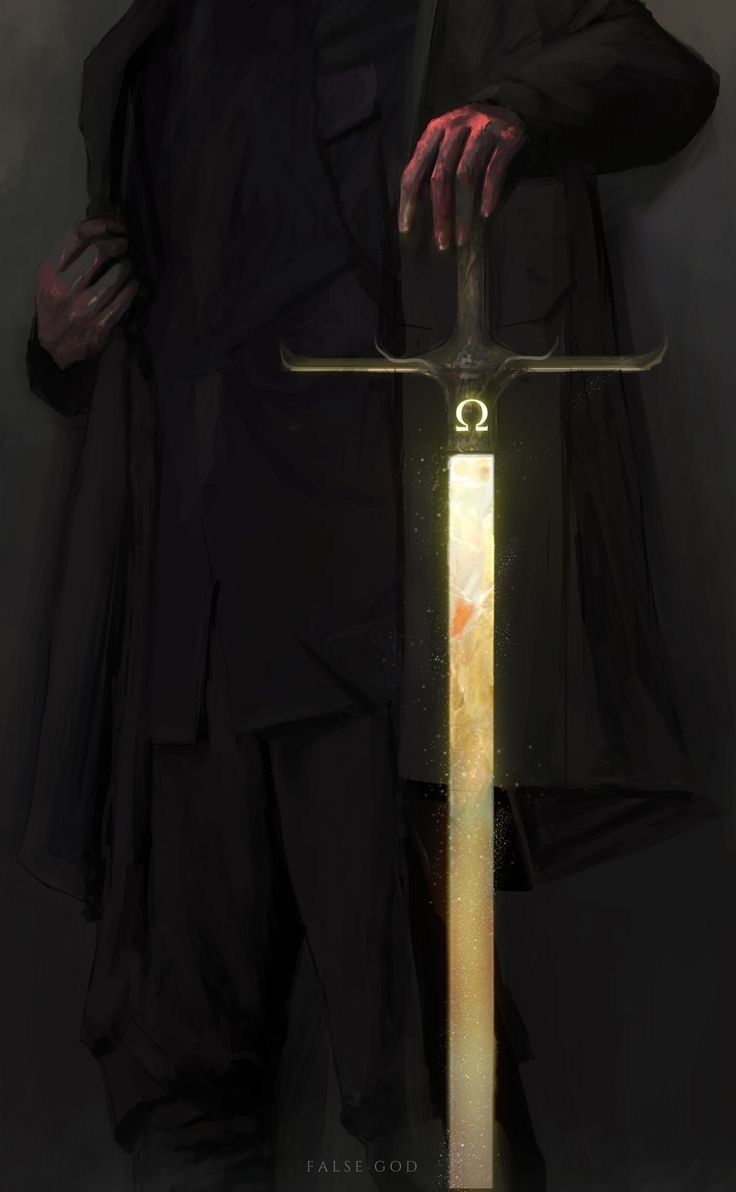
Only afterward did Sayelle move. She had waited for precisely this moment. Crossing the shattered Hall with practiced speed, she wrapped Rendgray within the prepared leather bindings before any living hand, willing or unwilling, could touch its hilt again. Ancient buckles snapped shut. Layers of warded hide enclosed the Sword of Doom until even its whispers became distant.

Only then did the Hall of the Night Mist begin to die. Its floating cathedrals dissolved into drifting constellations. Rivers of moonlight climbed one final time toward forgotten heavens before fading into silence. The obsidian bridges became rain. The Night Mist unraveled like ancient silk whose final thread had at last been cut.

The four companions stood together beneath the familiar stars of Daotyr once more. No trace of the Hall remained. Only the White Oath of Mercy. Only the silent prison of Rendgray. And the terrible certainty that all the kingdoms of Siluvaria had come no farther than a single heartbeat from their last dawn.
The Sword of Glory returns

THE FINDING OF THE SWORD OF DOOM

Posted in Gildensong, The Swords of Creation on April 25, 2026 by coyoteandthunder

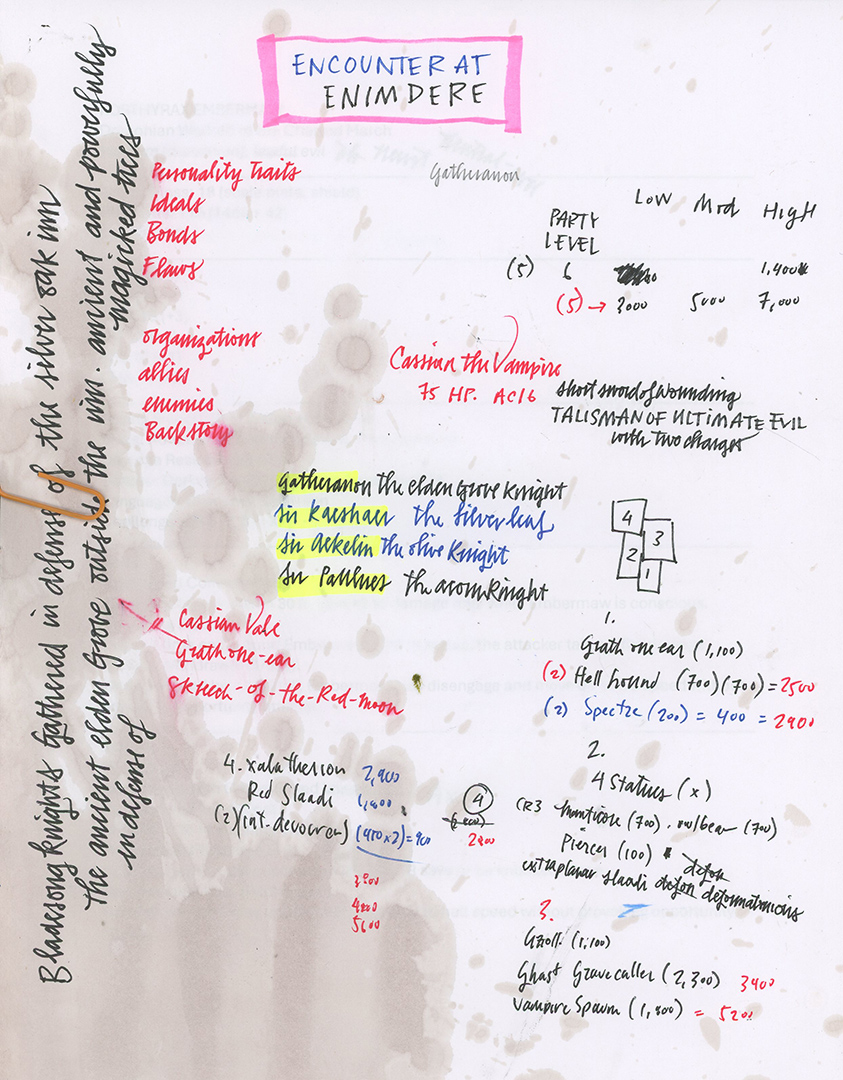
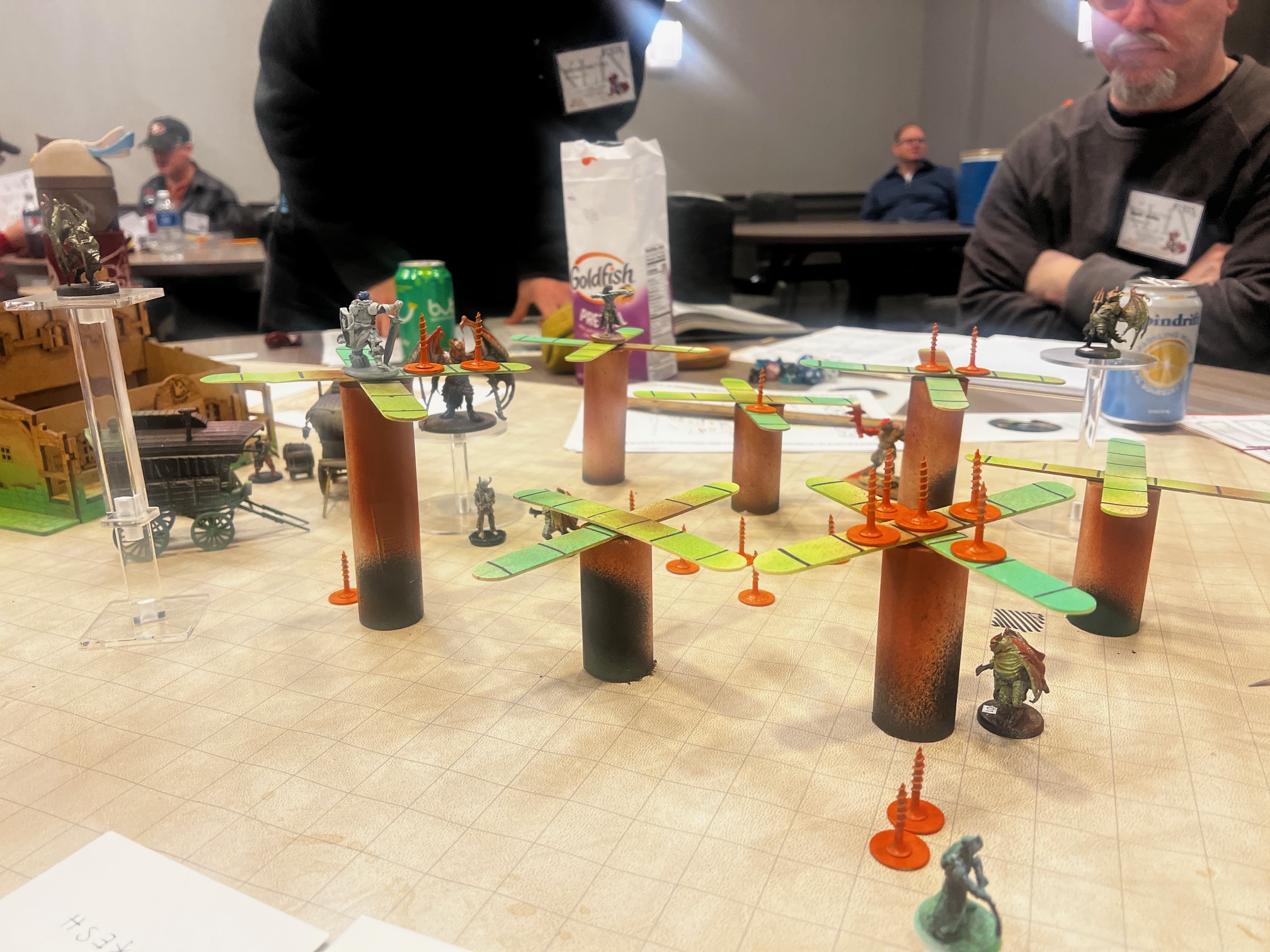
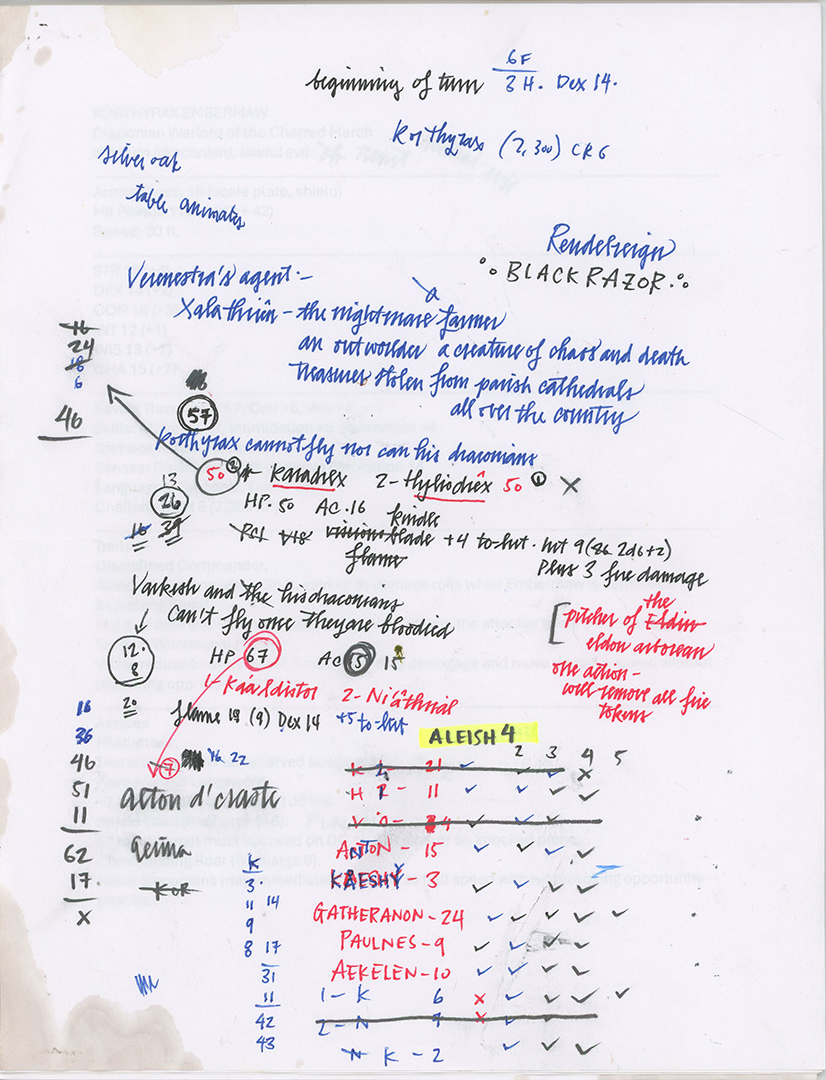
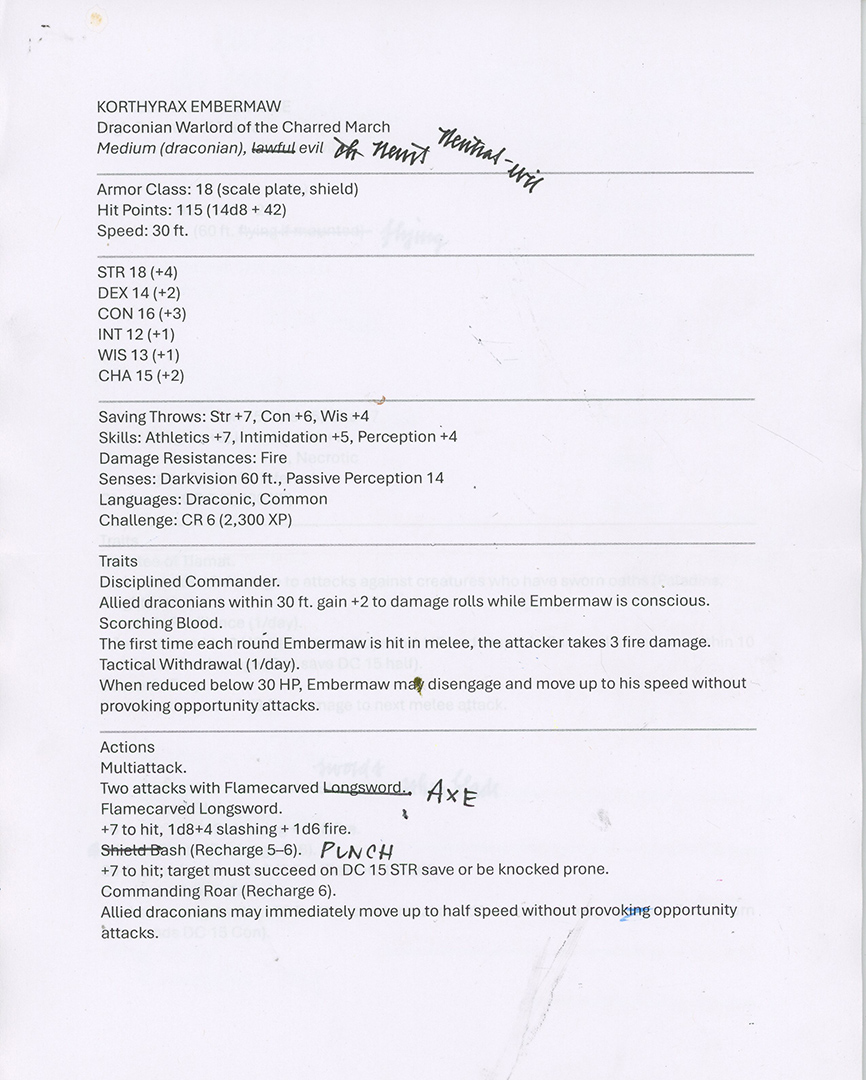
The Bladesong Knights of Enimdere battle draconian warlords at the Elden Grove of trees, protecting them and the Silver Oak Inn from onslaught. During the fight, they learn that the draconians are vassals of the Nightmare farmer, a mindflayer named Xalathrien, and that the warlords’ true target was the knight Aleisha. After the knights destroy the warlords, they are led to the Caves of the Nightmare Farm, where Xalathrien, switching plans from trying to destroy Sir Aleisha to trying to control her, attempts to dispatch with her comrades. Xalathrien holds the lost sword of doom, RendleReign, and Aleisha is foretold to be able to resist the evil artifacts’ supposedly ultimate power to corrupt. After many travails, the sword is retrieved by the knights, and the midflayer escapes.

The Elden Grove on fire

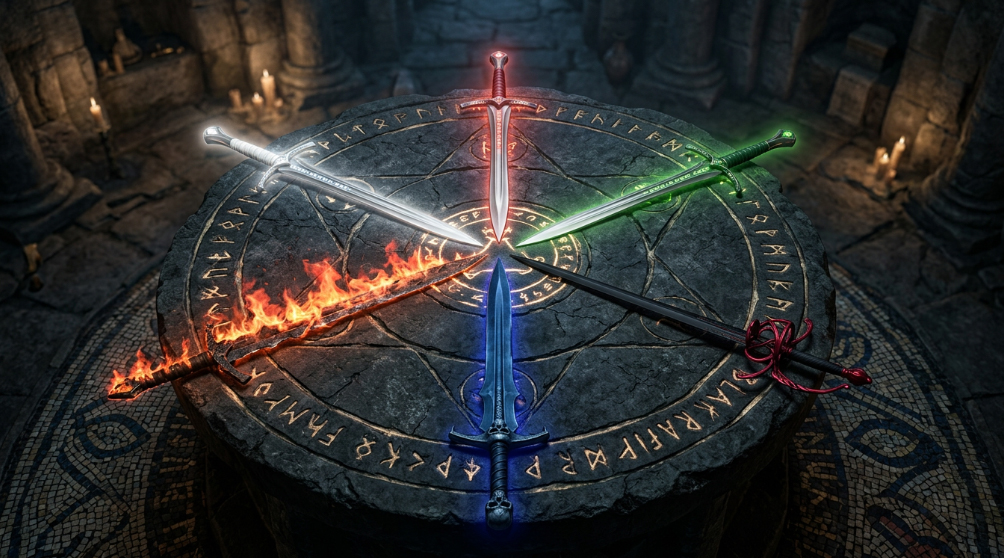
The Swords of Creation

Posted in Gildensong, The Swords of Creation with tags , , , , on March 8, 2026 by coyoteandthunder

Before the calendars of elves began their counting. Before the elder forests learned their own arboreal language of wind and soil, there existed an age when the heavens and the earth were not separate but aligned in a single, perfect reality. Before the elder dawn, so distant that even the Orsolon tongues remember it only as an echo and a fragment, the great god of all dragons, later to be called Bahamut, who was then not yet known as the Platinum King. Then it was before when the vast and terrible wyrm-queen, later called Tiamat, became the Queen of Chromatic Ruin. They were instead the twin sovereigns of a united cosmos. Bahamut held dominion over the high firmament, where the stars wheeled in perfect measure. Tiamat ruled the deep bones of the world, where rivers of molten stone and the fertile violence began to call life itself into being. The celestial and the chthonic were not rival kingdoms but reflections of one another. They were lovers then.

Before the first birds sang, before beasts stirred in meadow or sea, before even the earliest forests stretched their green dominion across the newborn lands, the world of Dao Tyr existed in the long light of an endless sunrise. It was an age of hot wind and ash left by the world-forging strikes of unknown gods, when the mountains were still hot with the original fire and the seas had not yet learned the rhythm of lunar-locked tides. Storms wandered across the world like wrathful minds or elementals who quarreled over dominion. From that dust and from those wandering entities, the first elves found form.

The breath of the world gathered particles of light and memory, shaping them into beings who could see beauty where there had only been turbulence. Where wind touched stone and starlight touched soil, the first forms of the Raelfaen awakened. They rose not from womb or egg but from the quiet settling of harmony within chaos. Their bodies were slender as young branches, their senses keen as the hawk’s flight, and their minds carried an instinctive awareness of balance. They were the first people to walk the world with understanding rather than hunger. Where they stepped, the air grew calmer. Where they gathered, the wandering magic of creation learned to rest.

Yet the world they inherited was far from peaceful. Intrusive conquerors, insane and alien powers born from the turbulence of creation itself, dominated. Some were vast intelligences formed of storm and void. Others were creatures of writhing thought whose shapes defied memory once the eye looked away. They were not demons in the later sense, nor devils, nor beasts that might be slain by blade alone. They were remnants of a time before order, entities that had flourished in the chaos that preceded life. They moved through the world like fever dreams, warping land and sky wherever they lingered. When the Raelfaen first awakened, these older kingdoms regarded them as trespassers. The young elves could not yet match the power of such beings. They possessed grace and perception, but not the strength required to carve a place for themselves in a world still ruled by ancient madness. Many of the earliest settlements were swept away like footprints in the wind.

It was then that the dragons intervened. Bahamut and Tiamat still walked the world together in those days, and they beheld the young people of light and windwith a curious affection. The elves possessed an ability to shape beauty from uncertainty, which became something the dragons themselves admired. The dragons chose to aid and honor them. The six blades that had been forged in the First Crucible were not meant only for the quarrels of gods and wyrms. They were instruments through which order might be impressed upon a chaotic world. And so, in the earliest councils between dragon and elf, the blades were entrusted to the first champions of the Raelfaen.

The elves did not see them merely as weapons. They saw them as tools of shaping. With the Swords of Glory, they learned to protect the fragile clearings where life might take root. The Ivory Blade guided them in mercy and law, teaching them how to preserve harmony among their growing people. The Emerald Blade taught them how to defend the green shoots that had begun to rise from the soil. And the Crimson Blade burned with the will to confront the ancient horrors that still prowled the young world. With the Swords of Doom, whose darker power was not yet fully understood, the elves carved boundaries against the remnants of chaos. Rendpyre’s fierce dominion allowed them to drive back creatures that fed upon fear. Rendlereign gave them the cunning needed to bind dangerous powers beneath mountains and seas. Rendgray brought with it the cold strength required to end the existence of those ancient entities that could not be reasoned with.

The elves fought not as scattered tribes but as a single people. Their early wars were not against rival nations but against the lingering madness of creation itself. Battles were fought beneath skies that still glowed with raw magic, against enemies that twisted the shape of mountains or poisoned the dreams of entire valleys. It was during these ages of struggle that the first forests appeared. Where the elves prevailed, the land slowly calmed. The soil cooled. Rivers learned their courses. Seeds carried by wandering winds found places where they could endure. From these quiet sanctuaries rose the first great trees, and their roots anchored the world into stability. The spread of forests marked the first victory of life over chaos.

The Raelfaen stood beneath those trees as guardians of a fragile order they had helped create. Their cities were not yet towers of stone but living groves where magic flowed like sunlight through leaves. The swords passed from champion to champion, guiding the young civilization through centuries of peril. Even in those earliest ages, these powerful entities possessed voices, intentions, and desires of their own. Each blade believed it understood best how the world should be shaped. Each whispered its philosophy into the hearts of those who wielded it. And when the Sundering of Bahamut and Tiamat came at last, those whispers hardened into rival destinies. From that moment onward, the swords would no longer serve a single harmony. They would serve the great struggle between light and shadow that still defines the world’s fate. As the centuries unfolded, the differences between the dragon sovereigns deepened. Bahamut came to value law, guardianship, and the preservation of fragile life. Tiamat began to see the world as a thing that must kneel to strength. Compassion appeared to her as weakness, and patience as delay. Where Bahamut saw stewardship, she saw entitlement. The ancient chronicles say that Bahamut once approached her in the gardens of the First Mountains and begged her to abandon the path she had begun to walk. Let the world flourish, he told her. Let us protect what we have made. But Tiamat answered with a colder truth of her own. What we have made, she replied, belongs to the strong. The first betrayal was not a war, but a refusal.

It was then that Sardior, the Ruby Dragon and elder lord of equilibrium, descended from the crystalline vaults between the planes. Sardior was older than the quarrel itself, older perhaps than the first shaping of sky and soil. His scales burned with the deep crimson glow of star-born gems, and within his gaze lived the memory of a universe that had once known perfect proportion. He came in solemn authority. Where Bahamut embodied righteous law, and Tiamat embodied primal dominion, Sardior embodied balance. He was the quiet center between their opposing philosophies, the mind that understood that neither heaven nor earth could stand long without the other. From the high firmament, he called to them. His voice passed across the world like a chord struck in the bones of creation. “Beloved siblings of creation’s flame,” Sardior spoke, “the world you war over is still young. The creatures who walk it are fragile and newly awakened. If you tear the heavens in your anger, you will tear the world itself.” Bahamut listened. Tiamat did not.

Her wrath had already grown beyond reason, fed by centuries of resentment and ambition. To her, the plea of Sardior sounded like hesitation, and hesitation she despised above all things. Sardior descended between them then, his vast ruby wings casting a prism of scarlet light across the sky. For a moment, it seemed the conflict might yet be stilled. The younger dragons who watched from distant clouds held their breath. The first elves gathered beneath the new forests lifted their eyes in hope. But the fury that had awakened in Tiamat could no longer be turned aside. When Sardior spread his wings to separate the two sovereigns, her fivefold breath erupted. Lightning and acid, frost and poison, and flame struck outward in terrible union. Sardior deflected what he could, his ruby scales shattering the first waves of destruction into harmless sparks of magic. Yet the violence of her power tore open the sky itself. Bahamut rose to meet her.

Thus began the catastrophe remembered in all dragon lore as the Sundering of the Dragons. For seven days and seven nights, the heavens and the earth battled through them. The firmament cracked like a mirror beneath hammer blows. Mountains split under the force of their descent. Rivers turned from their courses as the air itself twisted under the violence of divine fire. At last, the Ruby Dragon withdrew in sorrow, never again to return to the world. He retreated beyond the firmament into the hidden crystalline realms where balance must sometimes wait until the world is ready to receive it again. Bahamut cast aside his blade and offered peace one final time, hoping that mercy might yet awaken the memory of their former unity. Tiamat answered with fire. Their clash tore the sky open.

When the struggle finally ended, their union had shattered, and the world itself had changed. Good and evil emerged as living forces within creation. Where once there had been only competing philosophies of power, there now existed moral gravity itself. Compassion and cruelty became distinct paths rather than shifting interpretations. And in the long shadow of that divine rupture, something new entered the world. From the scattered embers of dragonfire and from the broken fragments of Sardior’s attempted harmony arose the first generation of dragon lords who would later be remembered in the northern forests of Siluvaria.

They came to be known as the Scintilliant. Sixteen great wyrms emerged in that age, each carrying a fragment of the cosmic balance that had once united the dragon gods. Some bore the noble temper of Bahamut’s vision. Others carried the fierce independence of Tiamat’s legacy. A few embodied the neutral and contemplative wisdom that Sardior had sought to preserve. These dragon lords did not rule the heavens. Instead, they descended into the newly forming world. They claimed the forests, the mountains, the rivers, and the deep caverns of the North. Each carved out a dominion where their presence shaped the character of the land itself. Storms bent around their wings. Rivers changed course beneath their shadow. Entire ecosystems rose or withered depending on their temper. Thus, the Scintilliant became the living governors of Siluvaria’s vast wilderness. Some guarded the balance of life. Others hoarded power and knowledge. A few descended slowly toward cruelty and corruption as the centuries hardened their hearts.

Among them were names that would echo through the ages. There was Yropa, the Mountain Mother, whose amethyst wings sheltered the earliest elves of Silverymoon. There was Xyclodenes, the Eye of the Sun, whose golden fire kept the high peaks free from the creeping darkness of older realms. And there were darker figures as well, among them Orthmeck the Black, tyrant of poison marshes, and Angmehridon, the dreaming green lord of the deep forests.

The world had changed forever. The dragons were no longer unified. The swords they had forged would now awaken in a divided cosmos. And the young people of the world would learn that balance, once broken, is never easily restored. The six swords awoke fully to their own personalities and chose their allegiances. Three remained loyal to the vision of protection and justice that Bahamut had once defended. These came to be known as the Swords of Glory. Three others embraced the darker philosophy of dominion and ruin that had taken hold in Tiamat’s heart. These became the Swords of Doom.

Among the Swords of Glory, the first was the Ivory Blade, known in Kaeyenil as Aeltharion Valethis, which means the White Oath of Mercy. This sword possesses a calm and thoughtful spirit that values justice tempered by compassion. Its voice is said to be quiet and solemn, and it prefers to guide rulers and healers who place the protection of others above their own ambition. The presence of the Ivory Blade does not inspire fury in battle but instead brings clarity and moral resolve to those who carry it.

The second of the noble blades is the Emerald Blade, whose Kaeyenil name is Thalorien Sylvarae, meaning the Verdant Defender. This sword carries within it the living spirit of the forests and the wild world. It burns with anger at tyranny and corruption but is fiercely protective of the innocent and the natural harmony of the land. Through the ages, it has often appeared in the hands of wardens and rangers who defend the world’s green places.

The third blade of glory is the Crimson Blade, called in Kaeyenil Vaelorin Caethryn, which means the Red Justice. This sword embodies righteous wrath. It burns with the desire to destroy evil wherever it finds it. Yet this same passion places it in constant tension with the boundary between justice and vengeance. Among the Swords of Glory, it is considered the most dangerous because it urges decisive action and does not easily tolerate hesitation in the face of cruelty.

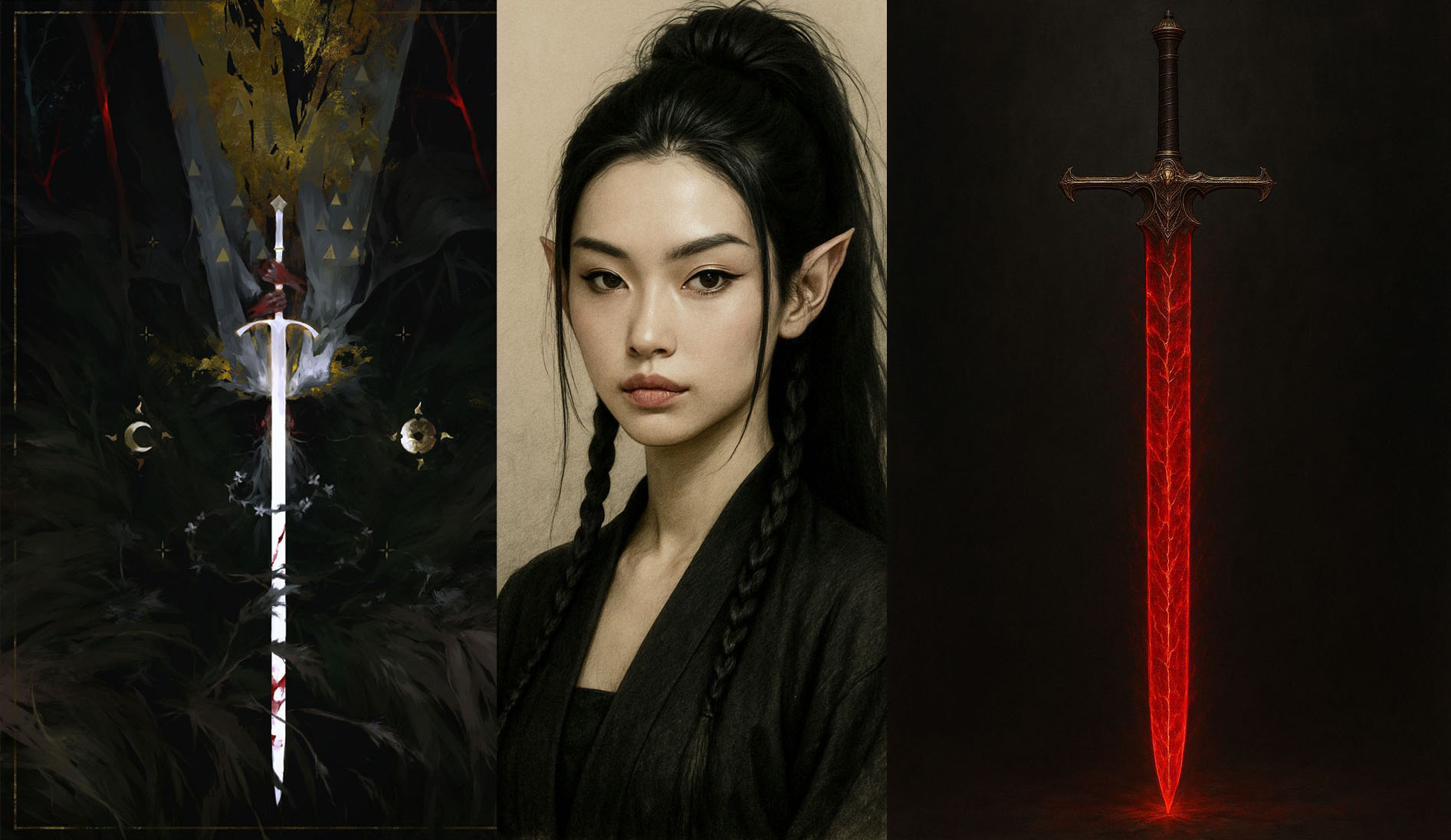
Opposed to these stand the three Swords of Doom, each shaped by the darker philosophy that emerged from Tiamat’s rebellion. The first of these is Rendpyre, known in the corrupted tongue of Aidriffon as Rendpyre Vaerath, which means the Flame of Dominion. This blade exults in conquest and feeds upon ambition. It whispers promises of empire and glory into the minds of those who wield it, urging them toward rule through fear and domination. Many tyrants of history have been guided by its seductive voice.

The second is Rendlereign, whose ancient name is Rendlereign Dathryss, meaning the Sovereign of Ruin. Unlike its fiery sibling, this sword is patient and calculating. It delights not in chaos but in control, guiding kings and rulers toward cruel but efficient forms of power. Its influence spreads quietly through courts and councils until entire kingdoms fall under its shadow.

The third and bleakest blade is Rendgray, called in Aidriffon Rendgray Maltheris, meaning the Shadow of Ending. This sword does not crave conquest or glory. Instead, it embodies entropy and despair. Those who carry it find their hope slowly eroded until they become instruments of decay. Wherever Rendgray travels, courage weakens, and civilizations falter.

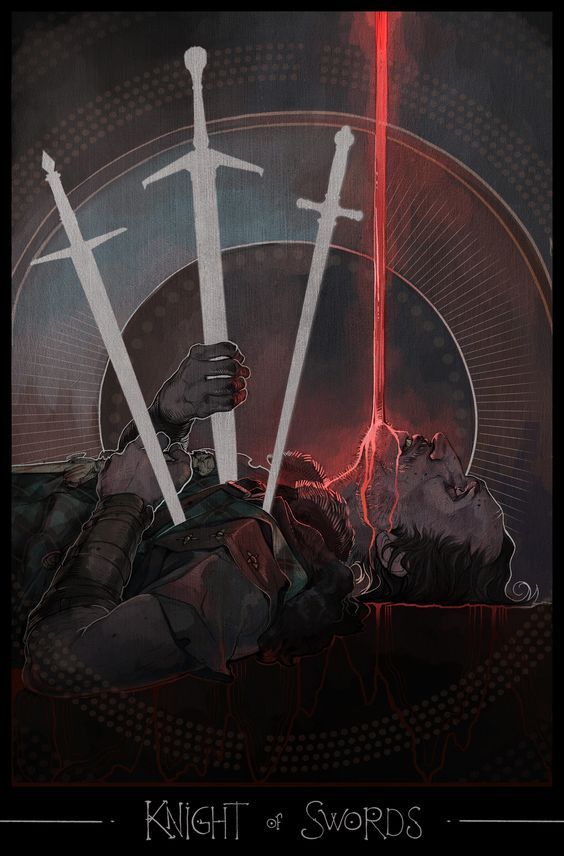
Across the ages, these six swords have known some wielders who became legends, whose names are still sung in halls of honor. Others became monsters whose memory is spoken only in warning. The blades themselves remember everything. They remember the love that forged them and the betrayal that divided them. They remember the first war between heaven and earth. And they wait. In the present year, 1509 by the calendar of men, only one of the Swords of Glory is known to walk openly in the world. The Crimson Blade rests in the hand of Prince Springfield Ethuliaer of Silverymoon, knight of the Argent Legion. Two of the Swords of Doom are accounted for. Rendlereign lies sealed within the deep vaults of Castle Edderoth, where ancient wards and careful watchers keep its whispering voice contained. Rendgray sleeps beneath the granite halls of Granitehome in the harbor fortress of Port Edderoth, guarded by dwarven keepers who know only that it must never again see open sky. The final blade of doom, Rendpyre, remains lost to history. The six swords were never meant to remain apart. Should they ever be gathered again in one place, the ancient wound between heaven and earth may open once more.
The Knights of Endimere and the Swords of Doom

Posted in Gildensong, The Bladesong Knights, The Swords of Creation with tags , , , , on February 11, 2026 by coyoteandthunder

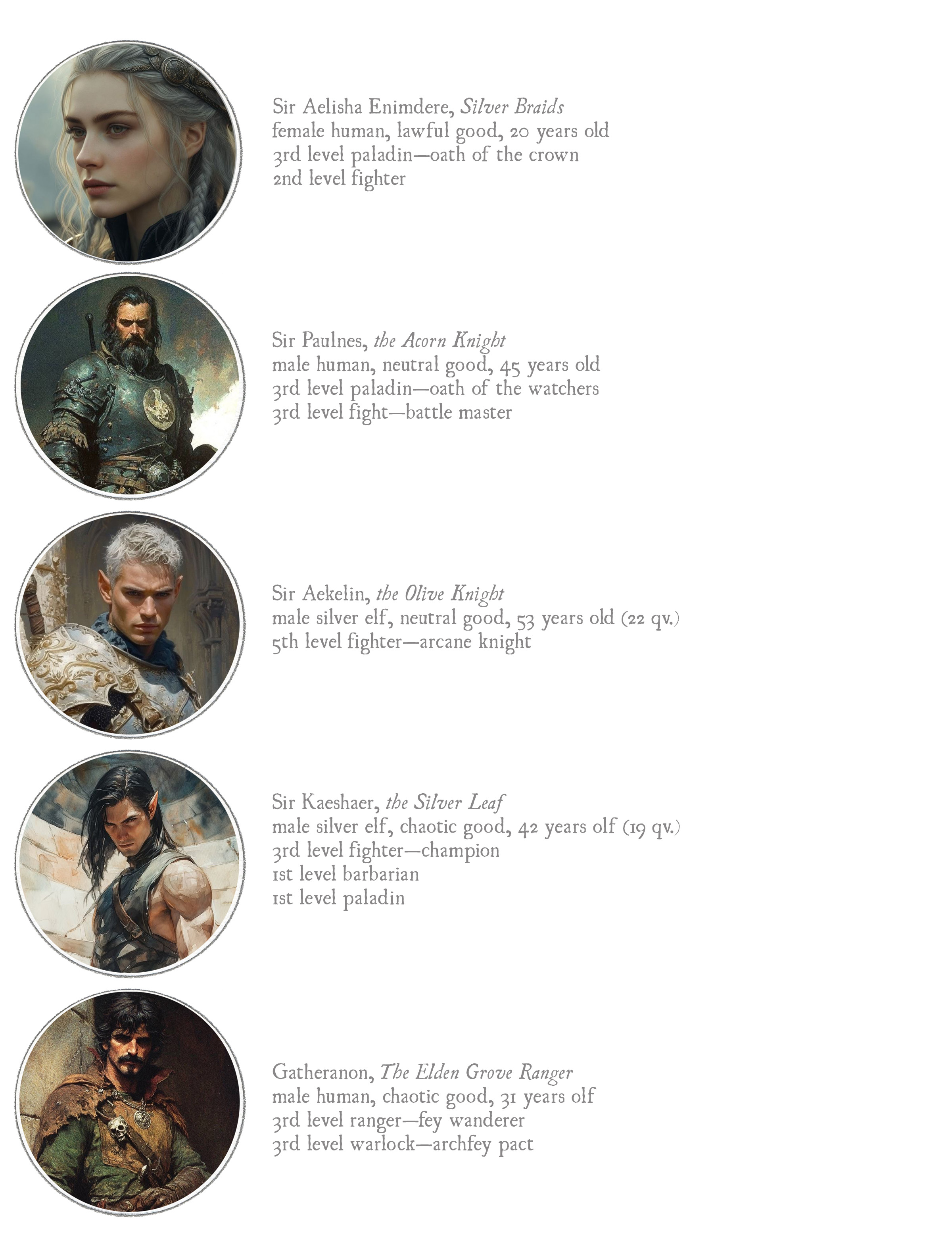
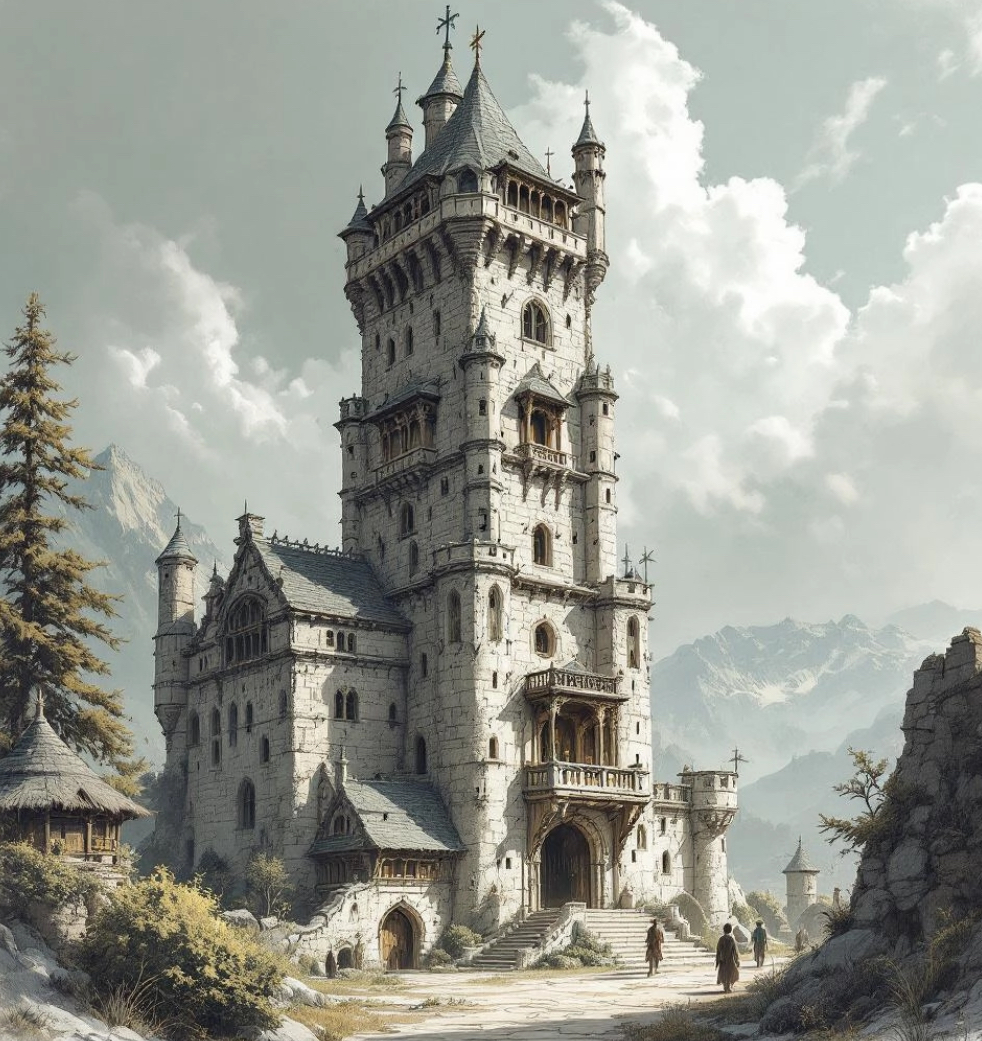
Sir Aelisha Enimdere Silver Braids was raised knowing she belonged to something old and quietly powerful. She was never quite told how or, more importantly, why. The town of Enimdere, nestled among the southern vineyards of Gildensong, is genteel and not grand. Sun-warmed stone, trellised grapes, and old-money manners shape daily life. The massive, six-story tower called Saelgard dominates the skyline. Fayholds lie just beyond the cultivated hills, and they are commonly known, respected, and politely not discussed. Fae magic is not feared here; it is bargained with, toasted to, and quietly blamed when children dream too vividly.

Aelisha grew up in her father’s keep, Mistleoak Manor, and was educated by tutors who stressed chivalry without bombast, swordplay without cruelty, and history with carefully edited genealogies. Her father, Aiden Enimdere, is an unmarried lord at Castle Edderoth’s court. He is known as a deeply private and probably the richest man in Gildensong. He has never taken a wife. No scandal has ever quite stuck to him, which in a court as sharp-eyed as Edderoth’s is its own kind of miracle.

Aelisha was trained as a knight not because she was expected to inherit land, but because she was expected to walk the world. Knights in Gildensong often serve as diplomats, wardens of faybound borders, and living symbols of harmony between mortal wealth and fae whimsy. Aelisha’s temperament is measured, observant, and unusually resistant to glamour, all of which marked her early as suited to this role. What Aelisha does not know (at least at first) is that she was shaped not merely for service, but for something like containment of a power much greater than she could understand.

To Aelisha, Sir Paulnes, the acorn knight was never a legend. He was the man who smelled of woodsmoke and old leather. The man who sharpened blades before breakfast and then doggedly sharpened his opinions after. The man who taught her that a sword was not a symbol, but a tool of responsibility. Sir Paulnes came to Enimdere long before Aelisha could walk, carrying a dented shield etched with an oak-and-acorn device few still recognized. Once a knight of renown along the Silverymoon marches, he had survived three wars, two broken vows (not his own), and one love he never spoke of. When he bought the Silver Oak Inn, many assumed he was retiring. He was not. He was standing watch.

Paulnes trained Aelisha not like a prodigy and not like a noble’s daughter, but like a knight who might one day be alone, wounded, and outnumbered. Her lessons began behind the inn at dawn, dew soaking her boots as he barked corrections through clenched teeth and a crooked grin. He taught her footwork by making her fight uphill. He taught her mercy by telling her why he no longer raised his shield for kings. He did not praise easily. When he did, it was quiet: “That one would’ve lived.” That was the compliment. Paulnes never taught her to fight for honor as an abstraction. He taught her to fight for space; space to retreat, to negotiate, to choose differently next time. Against knights, bandits, and once (briefly, disastrously) a fae duel where he drank through the aftermath and forbade her from asking questions.

The Silver Oak Inn became Aelisha’s second home. Its common room was where she learned to read people faster than she could read scrolls. Merchants, hedge-mages, vineyard guards, fae envoys with disguises that fooled no one—all passed beneath the Silver Oak’s beams. Paulnes insisted she serve tables when she stayed. “Knights who don’t carry plates forget how much a spill costs.” The Silver Oak was a sanctuary where arguments ended peacefully more often than elsewhere, because Paulnes had a way of settling disputes with a look that suggested he had already buried better men.

Aelisha never called him father. But when she was hurt, she went to Paulnes before Aiden. When she doubted herself, she sought the silence of the acorn knight, and not her father’s reassurance. When she took her vows, Paulnes stood in the back, arms folded, eyes wet, saying nothing. He never asked where she truly came from. He never commented on how certain enchantments slid off her skin, or how, in fae-magic, some songs seemed to recognize her. Once—only once—he said: “You’ve got a long road ahead. Longer than most. Don’t let anyone tell you that makes you chosen.” That night, he gave her his shield—not the oak-and-acorn one, but a plainer thing. Iron. Scarred. Honest.

Sir Aekelin, the olive knightis spoken of in Silverymoon records as a member of the Argent legion during the Witchlight wars. Elves remember longer than humans, but they also learn what not to remember. The Silverhand line, as publicly told, descends through Alustriel and her sisters. But there was once a lesser-known branch, born generations earlier, when the family still walked the boundary between the Feywild and the mortal Realms. That branch traces back to Elanwe Silverhand, a great-aunt or grand-aunt several generations removed. She refused the consolidations of power that would later define Silverymoon. She took vows not to rule cities, but to tend to be a fayhold ritualist: tending places where Feywild and mortal lands bled into one another. Her descendants became wardens, listeners, watchers.

Sir Aekelin descends from this line. By blood, he is a distant cousin to Lady Vivianna, lord queen of Eddertoth, and close enough that old magic stirs at their meeting, distant enough that politics cannot easily claim him. Vivianna knows the connection. She does not speak of it publicly. It allows her to trust him without binding him. Near the Silver Oak Inn, a gentle but watchful fayhold, unreachable without knowing when to step sideways, lies, named Olivenreach. Olivenreach is not wild in the way outsiders expect. It is terraced and quiet, shaped by centuries of careful tending. Pale-leaved olive trees grow there, their fruit silver-green and faintly luminescent at dusk. The air smells of crushed leaves and rain that hasn’t fallen yet. Stone paths wander but never lose themselves. Time moves mostly correctly in Olivenreach. It exists because Gildensong needed a pressure valve: a place where Feywild influence could be contained. The vineyards thrive in part because Olivenreach drinks what would otherwise spill into mortal fields as madness or ruinous abundance.

Sir Aekelin is the Olive Knight, sworn to Vivianna and stationed in Olivenreach as its living covenant. His duties are threefold: balance, containment, and witness. He negotiates disputes between fae courts, local fayholds, and mortal interests—he martially defends the mortal world from some things that wander out of the Feywild, and He records nothing. His role is to remember. When ancient agreements resurface, or when bloodlines awaken, he is the one meant to recognize the moment. He visits the Silver Oak Inn rarely, but intentionally. Paulnes tolerates him. That alone is endorsement enough. Sir Aekelin watches Aelisha the way one watches a long-foretold storm. He has never trained her directly; he offers calm corrections in passing, warnings phrased as folklore, and the occasional look of unmistakable relief when she survives another danger. He addresses her as “Ser Enimdere,” formally—yet sometimes, when magic is thick, he almost says something else.

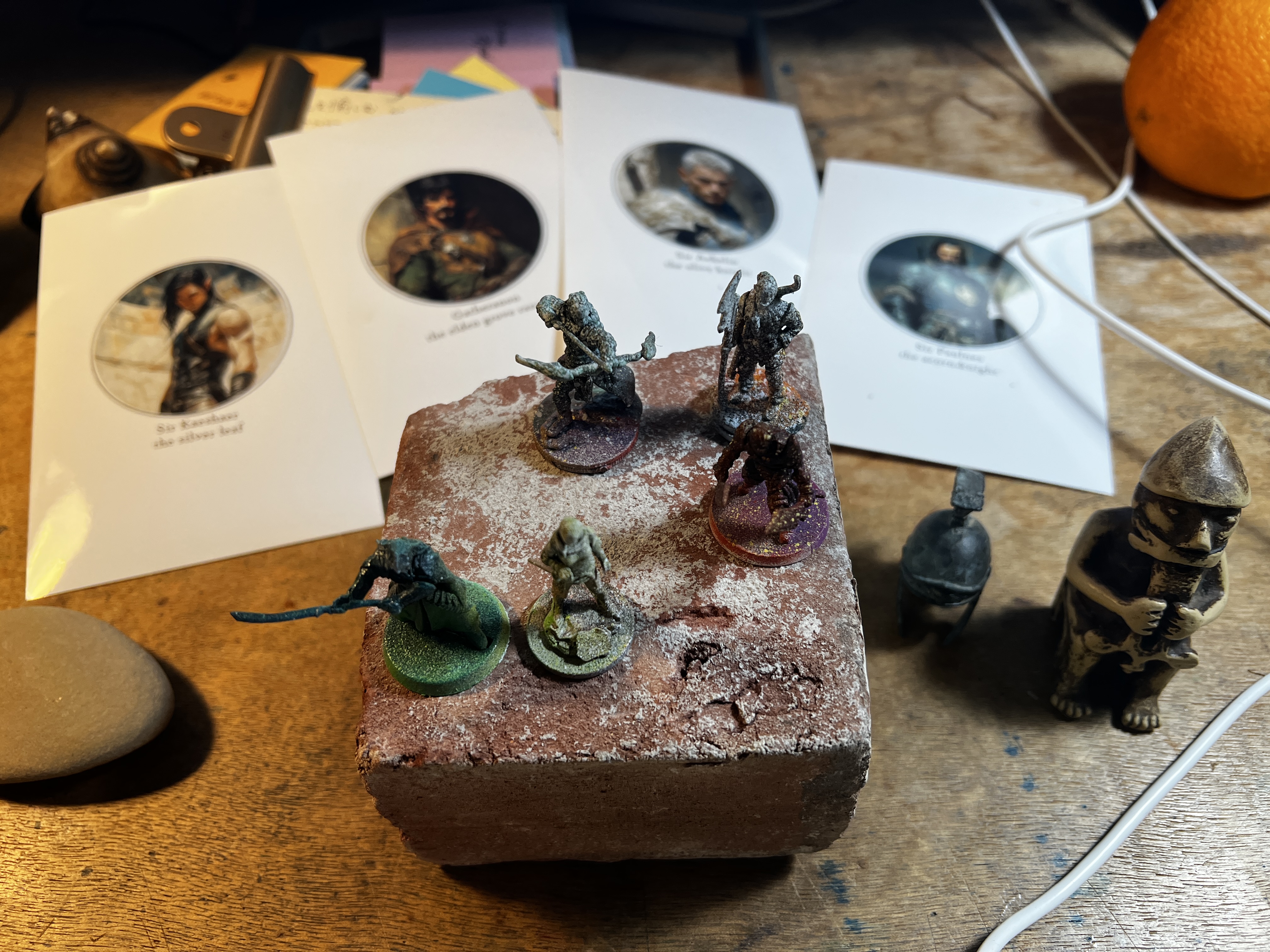
Sir Kaeshaer, the Silver Leaf, is everything Sir Aekelin is not. Where the Olive Knight, Kaeshaer’s older brother, is restrained and patient, Kaeshaer is quick, decisive, and brutally honest. He laughs easily, kills efficiently, and sleeps poorly. He is younger by decades, but worlds older in the ways that matter to violence. To most, he is simply a Bladesinger of Silverymoon. To Aelisha, he is the one person who never pretends the world can be gentle.

Kaeshaer did not learn Bladesong in Silverymoon’s academies. He learned it in the Umbral Canopy, a violent Feywild demesne that lies below Olivenreach. In the Umbral Canopy, leaves never fall because they are cut from the branch mid-motion, and music is learned by surviving it. The Umbral Canopy was once a training ground for elven warriors meant to fight other elves. Not enemies of the People, but those who broke ancient law, violated treaties, or threatened the balance between Feywild and mortal realms.

Sir Aekelin took Kaeshaer there when he was still young—too young, perhaps—because the boy already had rage in him, and rage without structure becomes catastrophe. In the Umbral Canopy, Bladesong is not art. It is containment. Kaeshaer learned magic in duels fought until exhaustion blurred reality, songs that tore at memory as much as muscle, and from instructors who believed mercy was a flaw. He survived by learning to strike first and completely. That is why his Bladesong is harsher than most—angular, fast, and merciless.

Kaeshaer has killed beings who did not deserve to die. Not monsters. Not invaders. Kin. Fae envoys whose bargains had become too dangerous to allow time for debate. Elves who chose ambition over balance. Creatures bound to treaties Kaeshaer enforced without appeal. Each killing was sanctioned. Each was necessary. None were forgiven. Unlike Aekelin, Kaeshaer did not learn how to carry guilt carefully. He carries it loudly, in the quickness of his temper and the violence of his solutions. His soul is dark not because he enjoys bloodshed, but because he believes the world requires it, and someone must pay the cost. Deep down, he suspects that if he ever stopped being ruthless, everything he did would become unforgivable.

Kaeshaer earned the name Silver Leaf during a massacre for which there is no record. A rogue fae court attempted to force its way into mortal lands through a weakened fold near Enimdere. The incursion would have poisoned vineyards, twisted children, and shattered the accords Vivianna depends on. The battle was fought at twilight. When it ended, Kaeshaer stood alone beneath an olive-silver canopy—not Olivenreach’s trees, but mortal ones caught in the spillover. Every leaf around him had been sliced clean from its branch by the wind of his Bladesong. They fell slowly, catching the light like drifting coins. Silver leaves. Silent ground. No witnesses willing to speak. Sir Aekelin named him then, and not as praise, but as a warning.
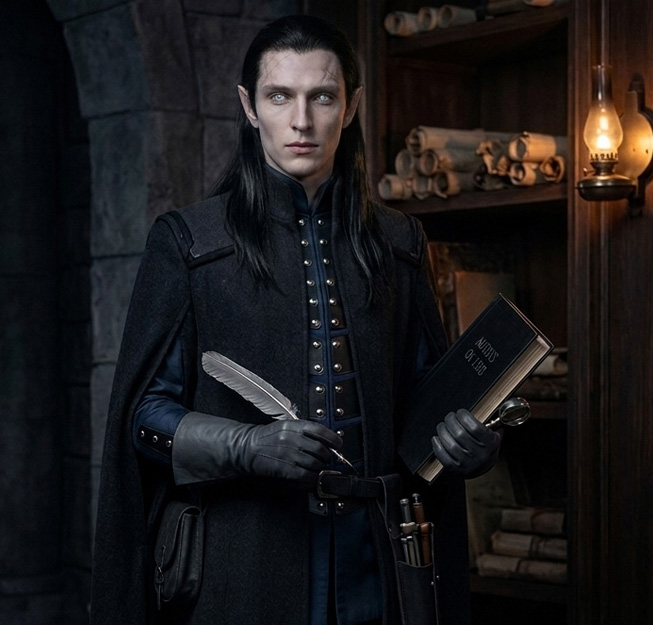
Kaeshaer and Aelisha are best friends. Kaeshaer never flinches when her blood resonates with old magic and her rare sorcery is invoked. Aelisha is drawn to him because he is the only one who never lies to protect her feelings, and he reflects the violence she knows exists but is not supposed to acknowledge. He makes her feel chosen, not destined. Perhaps most dangerously, their loyalty to each other would outweigh any oath they had made to the crown. Kaeshaer would follow Aelisha against Vivianna herself if it came to that.
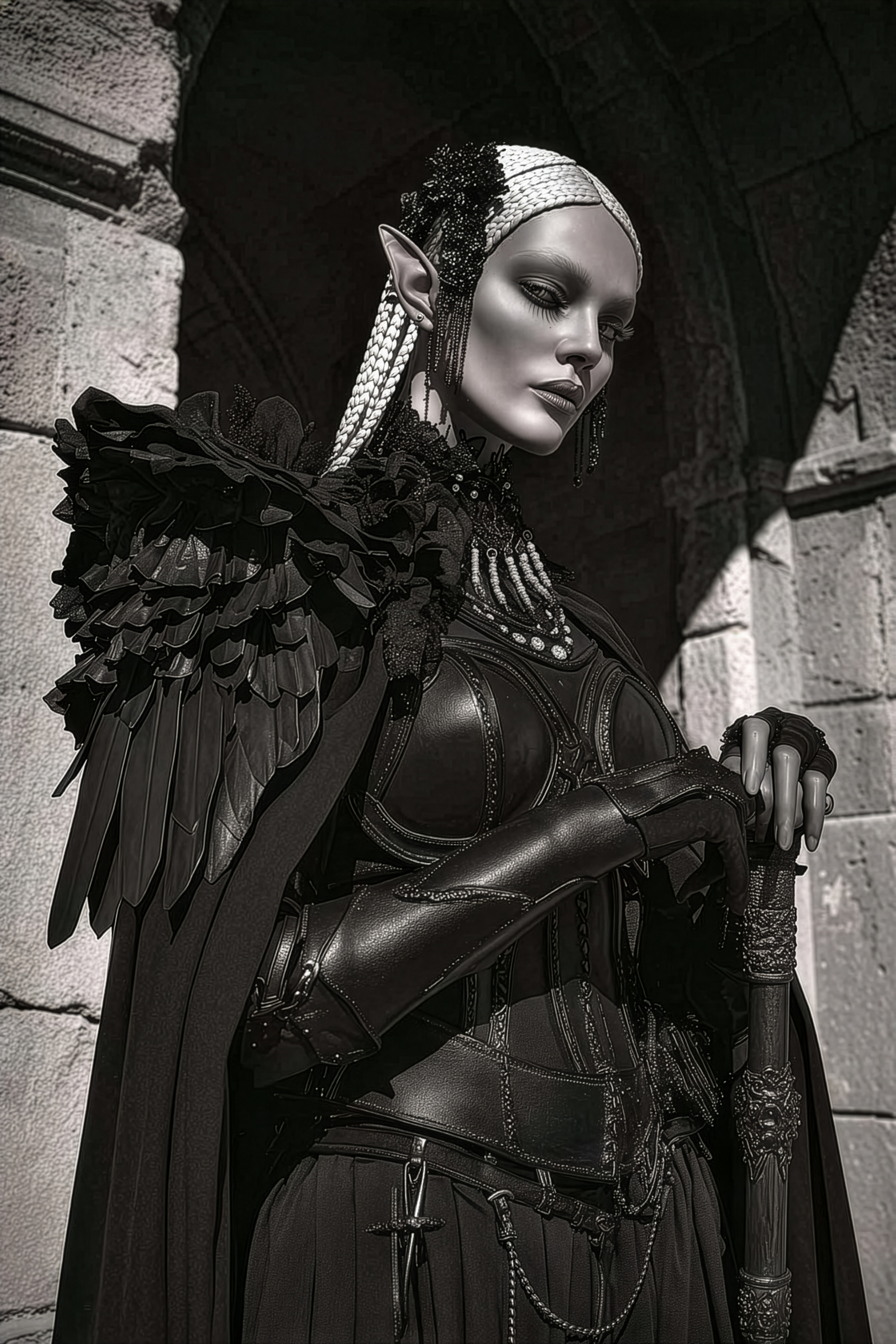
Gatheranon, the Elden Grove Ranger, is an outsider and a friend of Paulnes. The Bladesong Knights of Edderoth are trained to harmonize with magic, and Gatheranon is trusted by the fae powers, ironically enough, because he does not. He resists enchantment not with counterspell or song, but with distance. The archfey Verenestta did not give him a sword because he was worthy. She gave him a sword because he would never draw it lightly. The Three Swords of Doom: The Rend Blades. These blades are not cursed in the common sense. They are teleological weapons, forged to achieve a specific end, regardless of the moral cost. They were made long before the Draconian War by fae hands, dragon fire, and mortal desperation cooperating once and only once. Each blade “rends” a different lie that dragons depend upon.

Rendelreign (trusted to Gatheranon to bequeath to Aelisha), rends Legitimacy. Rendelreign does not simply kill rulers; it unmakes the right to rule. When Rendelreign strikes a creature that claims sovereignty (dragon-kings, tyrant wyrms, god-backed monarchs), it severs divine mandate, ancestral claims, and prophetic right. The creature may live, but it will no longer be recognized by magic as rightful. Armies hesitate. Vassals turn. Even lairs weaken. This is why Verenestta believes Aelisha can wield it. Aelisha does not crave legitimacy. She questions it. Rendelreign corrupts those who want to rule. In her hands, it becomes a test rather than something evil.

Rendgray (Held in Storage by the Order in the vault of Granitehome), rends Memory. Rendgray does not kill bodies as much as it kills continuity. A dragon struck by Rendgray forgets its own name, loses access to hoarded spells, and cannot trace its lineage or bargains. To mortals, Rendgray feels cold, draining, wrong, and can only be lifted by those who are taken by evil. Rendgray could erase a kingdom without a battle. It is the most dangerous blade politically. It knows that all politics is an amusing game.

Rendpyre (Current Status: Lost. Actively hiding), rends Immortality. Rendpyre does not kill dragons outright. It makes death possible. A creature struck by Rendpyre loses the metaphysical protections that allow reincarnation, phylactery-like anchor points, hoard-bound resurrection, and planar escape at death. After Rendpyre wounds a dragon, it may still live centuries, but it will know that death is now final. That knowledge alone has ended wars before. During the first Draconian escalation, three hundred years ago, it was wielded by a saint-commander whose compassion drove him to end suffering forever. Rendpyre almost agreed. The sword vanished rather than be used to make everything mortal. Some believe it hides in a place where death already waits patiently. Verenestta does not know where it is. She hopes Aelisha will find it.

The prophecy is that the Swords of Doom will end the Scintilliant dragon war, not by slaughter, but by collapse. To end the war, all three must be used in sequence. Rendelreign will strip the dragon-lords of authority. Rendgray will break their continuity and coordination. Rendpyre will make negotiation real by introducing the final risk. The swords are fated because they do not win wars. They make wars untenable.

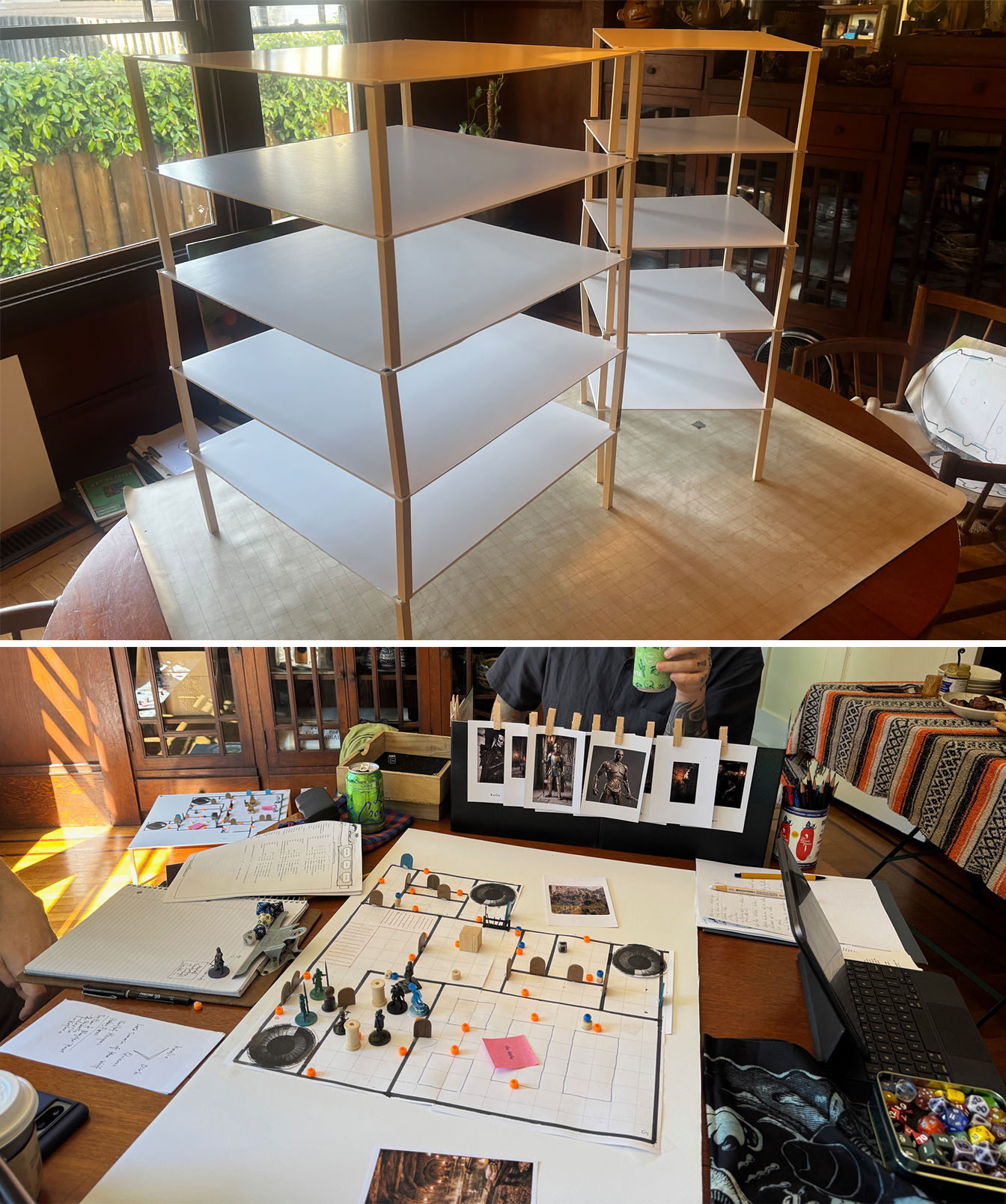
The six-story tower Saergard dominates the country of Endimere in Gildensong’s Iceshield Valley.