Archive for the The Fae People Category

Before the Fireflies

Posted in Gildensong, Rainmark, The Bladesong Knights, The Fae People on November 6, 2026 by coyoteandthunder
Benarion Naïlo

I. Before the Fireflies

In Verenestra’s household, the young Benarion was an attendant. He could stand near a conversation without becoming its subject, and he found this a more agreeable position than some would have found a place of honor. He had come from the Fae-held country within Silverymoon’s wider sphere. His father was an administrator in regional affairs, working behind the scenes as the city’s power and influence reached farther into the surrounding lands. His mother was a mage of some talent. She worked alongside Naelthir Osathus in the ancient forges, where moon fire and old Eladrin craft mingled beneath Silverymoon’s Mythal. Both served a city whose growing ambitions rested on much older foundations.

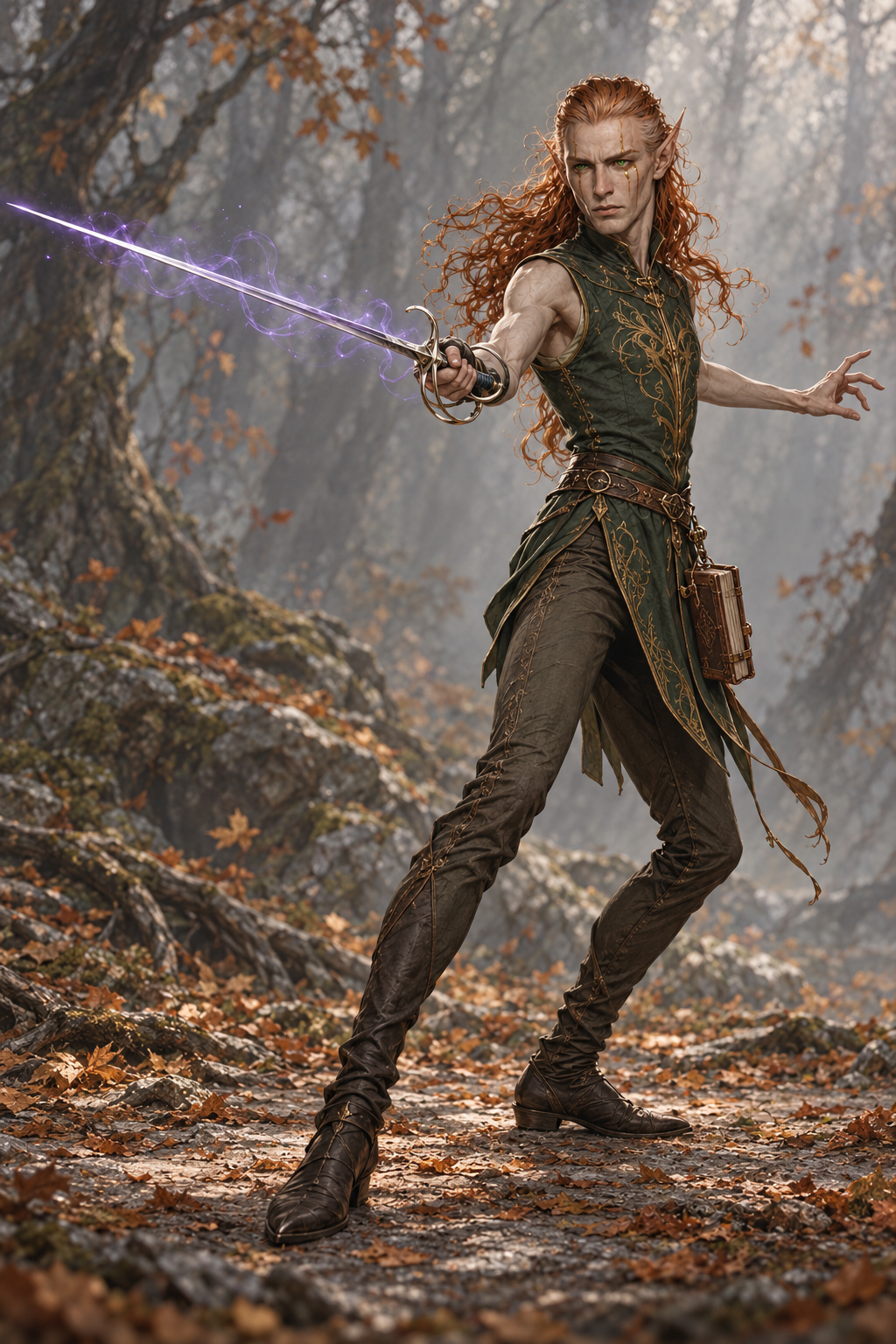
Ben’s gifts were noticed early. Magic came readily to him, and his hand learned the blade almost as readily. He was sent to a school of Bladesinging under Verenestra’s authority. She remained its patron and an occasional presence; other teachers corrected his stance and made him repeat difficult passages. He sometimes mistook quickness for understanding. A movement came easily, so he assumed he knew it. Then a small error in balance betrayed him, and he had to look again. He learned from those corrections. Soon he was watching for the things he had overlooked: the shifting of weight beneath an apparently effortless turn, the relation of a spell to the breath and body that gave it form.

The habit followed him out of the school. He noticed a change of weather over familiar trees, the posture of a visiting dignitary, the slight inclination of a traveller’s hat that made one courtesy different from another. He drew these things, or wrote them down. Sometimes he painted what he had passed a hundred times and only that day seen.

People found him easy company. He listened to their stories and troubles without trying to make a place for himself in every account. He could be trusted. He asked questions, remembered answers, and seldom offered more of his own life than the conversation required. He remained unimportant by choice. Before he spoke, he usually asked himself: Who am I in contact with?

It kept him attentive to the person before him, but it also let him remain the observer rather than the observed. Verenestra noticed where that attention went. His sword and magic were developing well. His notebooks had begun to turn to something his instructors were not teaching him. He was watching the mortals.

II. Fireflies. 851 DR

Humans fascinated Ben. Their houses seemed flimsy boxes to him, built with an urgency that scarcely allowed for weather, much less antiquity. Yet they planted trees whose shade mattered to them even when they could not expect to sit beneath it. They spoke of children and grandchildren as if some part of themselves could remain in those other lives. Then they spoke of death with a familiarity that troubled him more than fear would have done. They had so little time. Why did they look beyond it so often?

Some discussed an afterlife as though the life presently in their hands were only a preparation, and not a very important one. Ben would listen, trying to understand. The person speaking had a face he could draw, a voice he could learn to recognize. The other existence had neither. He could not yet comprehend giving so much of the visible life to the invisible one.

He thought of fireflies. An individual light appeared, held the eye, and vanished before he had quite followed its course. So brief a life might pass almost without mention in the reckonings of his own people. But when he looked closely, the darkness was full of such lights. Their brevity made him attentive. He watched humans spend an evening arguing and reconcile before morning. He watched them change a plan that had seemed certain the day before. They made promises with a haste that astonished him, yet sometimes kept them through much of the little time they had. They altered tools and customs without first seeking the permission of centuries. He studied them as seriously as he studied magic. Pages filled with hands, faces, gestures, clothing. He painted the changes they made in the land and tried to understand why one change was welcomed, and another mourned. Reports and artwork went back to Verenestra. She did not tell him what she thought of his observations. He came to believe that she valued them by what she asked him to do next.

In 851 DR, Valen Gildensong was leading a company of elves and humans through Giants Dale and the dangerous northern passes toward the Elder Valley. They were refugees, traveling toward a place in which they hoped to remain. Verenestra, who counseled Valen, asked Ben to accompany his retinue as part of the escort. The work required his blade and magic. It would also bring him among the people he had been trying to understand. He accepted readily.

He began the journey as an observer walking beside his subject. Hunger made that position difficult to maintain. Cold made it ridiculous. The hand whose shape he had been drawing could pass him something he needed; its owner could be afraid beside him, or quarrel with him, or make him laugh when he had thought himself too tired for laughter. They shared watches and fires, danger and suffering. A person whose habits he had recorded one evening might stand beside him with a weapon the next. His concern for the likeness in his notebook became concern for whether the person would be there when the company gathered again.

Valen took kindly to the young Eladrin who fought beside the refugees and afterward sat drawing them. Ben began to share what he knew of Bladesong: a form, a movement, a way to let blade and spell occupy the same moment. His education was unfinished, and he did not pretend otherwise. His companions changed what he taught them. They shortened movements, combined ideas, and discarded things that did not serve their bodies, their equipment, or the ground beneath their feet. Sometimes Ben corrected them. Sometimes he had to reconsider the correction. He made notes about that too.

By the end of the journey, the figures in his pages no longer stood for humanity. They were particular people, and he noticed their absence. With Valen’s support, he remained with a retinue among the northern communities instead of returning immediately to the Fae world. He had come to see how humans lived. Now there were people he did not wish to leave.

III. A New Song. 853–856 DR

When Valen founded the Bladesong Knights in 853 DR, Ben joined them. Verenestra had sent him with the refugees; she had not told him to enlist. The new allegiance was his choice. These people were building something he had helped protect on the road, and his skill could help keep it alive.

The order brought together older practices and the necessities of a young country. Ben’s Bladesong was one contribution among others. He taught what he knew and learned where his knowledge failed. No single moment made the Knights’ art complete. What worked on one road had to be reconsidered on another; a form learned from one teacher met a form learned elsewhere, and both were tried. Ben liked being present for this.

In the north, he supported rangers and patrols with sword and magic. Roads and settlements needed watching. Beyond the more familiar routes lay Fae boundaries that could not be understood simply by knowing where a marker stood. His upbringing and connections within Verenestra’s sphere gave him some sense of whom to approach and what an unfamiliar warning might mean. He served as a modest intermediary when one was needed. He could sometimes prevent a mistake from becoming an insult, or an insult from becoming a battle. He preferred to discover what a stranger intended before answering it with force. When protection required fighting, however, he had been trained to fight. The letters and drawings continued. He recorded the people and places he served, and the changes taking place about them. His notebooks were still those of a scholar, but increasingly the notebooks of someone with a stake in what he observed.

By 856 DR he had served for roughly three years. The northern frontier had become familiar. The great Rainmark stronghold of later centuries did not yet define his experience of that country. He knew routes, communities, duties, and the limits of what the young order could protect. Beyond those limits stood older places. Highspire was one of them. Reports of humanoid activity near the Spire brought a patrol into its approaches. Ben went to help observe and investigate. Toward dusk, the figures they had been watching began to move farther up the rising ground. The patrol followed.

IV. Highspire at Dusk. 856 DR

A shape appeared between the stones, disappeared, and appeared again farther along the slope. Ben watched the place it had left. The eye could give a body to a shadow, especially in that failing light, but a shadow did not choose a route. He followed with the others, keeping the movement in sight whenever the ground allowed it. He remembered the weight of his rapier at his side and the sound of his own breathing. Light remained on the higher stones after the hollows beneath them had grown dark.

Later, he could recover these things more readily than the pursuit itself. A voice remained, but he could not recall its words. Gaps remained where someone ought to have been beside him. He remembered deciding to go farther; he could not remember when that decision ceased to be part of an ordinary duty. By the time he entered Highspire, night had come.

The ruin bore the marks of an intention he could not read. He could recognize workmanship, the deliberateness of an angle or a passage, without knowing what those things had been made to accomplish. A doorway seemed too large for the space beyond it. Elsewhere, the depth of a shadow made him stop and reconsider the wall he had supposed it lay in. The old place did not resemble the works of the new Knights. It had belonged to a world in which other arrangements were taken for granted. Ben could see the remains of those arrangements. He did not know what remained of their power.

Then he heard a cadence in the stone. At first he took it for distant voices, some continuation of the activity he had come to investigate. He stopped and listened. The sound seemed to draw nearer without growing louder. It was as though he had been hearing something from outside a closed room and had discovered that he was already inside it. He moved toward it carefully. There was an opening. The air beyond it was still, and the dark continued farther than another chamber should have allowed. He waited at its edge, trying to place it within what he had seen of the building.

Then he crossed. He had no name for the country beyond. Mortileux was not a word that could explain the sudden loss of the ordinary night: the frontier sounds gone, the air changed, his footsteps giving him no trustworthy measure of distance. Something immense stirred in that darkness. Ben felt its attention before he understood that attention was what he felt. There was something draconic in its magnitude, something his training approached through comparisons and could not encompass. For a moment he seemed to himself no more substantial than one of the brief lives he had been studying.

Yet there was no malice in the presence’s regard. Within it lay the sense of others once near: company so deeply familiar that it had not needed to be thought about. Their nearness had belonged to the order of things. Now that order was broken, its memory remained. Ben felt the absence before he understood that what he was being given was a remembrance. He received no names, no account of a sanctuary or the Six who had rested there together. He knew only that something vast had once been less alone.

Farther in the gloom, another impression gathered about him. It had a different weight. A will was making a vow. He could feel the terrible concentration of the choice, the refusal to let an ending be an ending. He could repeat no words, only the sensation of a promise drawing tight around the being that spoke it. This was the fading trace of Volukai taking the Kai, though Ben knew neither name. It belonged to that older will. It was not an oath being asked of him, nor the intention of the presence that had first regarded him. He tried to turn toward the opening he had entered through. His recollection ended in darkness.

V. The Long Dream

His first records were marks. He put them in the codex whenever he could, counting the intervals he thought might be days. A scholar ought to preserve even a doubtful account. If he could not say what had happened, he could at least set down where certainty ended. But he could not always tell whether he had slept. Sometimes he woke with the sense of a long journey in his legs and found no change in the place around him. Sometimes an unfamiliar place seemed to hold years of his own habitation. The marks accumulated without restoring an order to what they counted.

Weeks became years. The years loosened from their numbers. Whether he had survived the first darkness, or whether surviving was still the right word for what he did there, remained beyond him. He continued. Something continued with him. The immense presence had become bearable. Perhaps it had dwindled; perhaps he had learned to encounter it differently. It did not tell him which. No bargain, no promise of service, no hour he could later identify as the beginning of their bond.

When a memory began to fail, it sometimes answered him. He would be trying to recover a face, finding only the arrangement of lines he had put on paper, and suddenly the person would turn. There was the particular movement of the mouth before speech. There was the voice, including the small hesitation he had never thought to record. A campfire warmed his hands. Someone laughed on the far side.

He knew these things had happened. For a while, he also knew they were happening again. The presence brought other remembrances. He entered places whose use he understood while he was in them, although he had never seen them before. There was a sense of welcome, of others at ease near one another. He could feel that each had a place. He could not have drawn a plan of the whole or written a history of what had made it possible. His own memories and those of his companion sometimes occupied the same room. A refugee fire burned within the feeling of an ancient sanctuary. Human voices spoke through a peace older than the company they belonged to. He accepted the meeting until he tried to distinguish its parts.

The presence helped him reach what he was losing. He attended to what it brought, giving it the nearness of being remembered with someone else. Neither sustained the other alone. Between them, a place became where recollection could be lived. After a time, he had work to finish there. Pigment dried at the edge of a shallow dish while he considered a color. Someone moved before he had finished a drawing, and he looked up with familiar impatience, then smiled. A question put aside the evening before returned while his hands were occupied with something else.

Sometimes a painted sky would remain more clearly in his memory than the place beneath it. He could recall mixing its grey, the small amount of blue he had added, the need to leave a pale space where the light was breaking through. Around that work lay a day he could almost recover: a voice behind him, weather at a window, the pleasure of having nowhere else he must be. There were ordinary interruptions. They made the life convincing long after he had ceased asking whether it was a life. He grew older. At first the changes were slight. A movement required more care. His hands looked different resting on a page. He found he was less eager to demonstrate what he knew, though he remained quite capable of being confidently wrong. In some matters patience came. In others he had to keep learning it.

He continued to draw and paint. When he put an old study beside a new one, the difference could astonish him. The subject had altered, but so had the person looking. The younger hand had pursued every detail with an urgency that left little room for the thing itself. The older one sometimes left a patch of paper untouched. There were people in those pictures. There were years he could afterward recover only through the certainty that he had loved someone during them. There were losses, reconciliations, and stretches of happiness that had no event at their center. Work was done. Company was welcome. Evening came without his fearing what would follow it.

The life would have been easier to dismiss if it had been nothing but torment. Yet he had been happy in it, and impatient, and absorbed in work that mattered to him. He had been glad to see someone. He had stayed silent when he ought to have spoken and spoken when listening would have served better. Such memories did not have the distance of a tale told to him. They belonged to the person he had become. The presence was woven through that becoming. Sometimes it was close enough to seem a companion beside him; sometimes he scarcely noticed it. He could not remember a version of this life from which it was wholly absent.

The rapier remained as well. He had modestly enchanted it when he carried it into Highspire, a good weapon for a young Bladesinger. Over its long life, it was used and kept, cared for, and worked upon. Further enchantment entered its making. He would retain moments of that work without being able to recover the whole: the familiarity of the metal in his hands, the blade as it had been, the blade afterward. The change did not come to him as a single marvel. It gathered a history.

As his own years grew long, he thought more and more about what would become of it after his death. The rapier had ceased to be merely the weapon he expected to carry on his next duty. He had kept it through too much of his life for that. Someone should receive it. By then, he often thought of the lost son. The name was Benarion. The absence did not fit the life he could recount. He could not follow it backward to a clear beginning. Yet it returned with the certainty of love: someone younger was missing, someone he cared for, and he could not set it aside because it was too hard to explain.

In still moments, he felt darkness around that younger one. It did not seem quite the darkness of death. There was something waiting within it. Ben found himself making provision for the son. He considered what might be useful to a young man, what should be preserved, what might survive until it was needed. The thought could enter a contented day without making it sorrowful. At other times the absence was so sharp that he had to stop what he was doing and wait for it to ease. He made the rapier a memorial. But he could not think of the memorial as something finished, with no one left to receive it. It required an heir.

Years of care went into that contradiction. He returned to the weapon, held it, remembered why he was keeping it. It lay across his aging hands with a familiarity that went beyond his ability to account for. Only very late did he understand. The young man in the darkness was himself. Beyond the life he was living, Benarion still lay in Mortileux, the young Eladrin who had crossed the threshold and had not yet awakened. He had been reaching toward his own sleeping life. The dream had recognized it before the old man could, giving him the absence and the love before it gave him understanding.

Knowing this did not wake him. It did not tell him how the two lives touched, or how a thing kept here might find its way into the hands of someone lying elsewhere. He understood the relationship more clearly than the world in which it had become possible. He remembered the young Knight’s eagerness. He remembered the privacy, the pleasure of being useful, the belief that a sufficiently careful observer could come to understand almost anything. He could regard those things tenderly now. He no longer needed to correct the boy before he could care for him. There was still somewhere for that young man to go. Ben left him the sword.

It was an ancestral weapon now, though the lineage by which it passed could not be traced to fathers and sons. The hand that had first carried it would receive what the old hand had kept. The memorial was also an inheritance. He could not explain how it would be delivered; he knew who it was intended for. By the reckoning of that life, he was about two thousand years old when it ended. He was content. Questions remained, and so did the people he had lost. Yet the years behind him had held work and affection, and the things left unfinished no longer required him to stand watch over them. The presence was near. He rested without trying to discover what the next moment ought to contain. His hands relaxed. He thought of the young man in the dark and of what he had left for him. Then his last breath passed.

VI. War Cries

A hundred voices answered another hundred. Ben drew breath and opened his eyes. The chanting pressed against him from every side, fierce cries of war and power driven higher by a voice above them all. He raised a hand toward his face. The movement was too quick. He looked at the fingers and waited for them to become the fingers he remembered. They did not.

His body was young. His chest filled easily with air. A heartbeat ago he had reached the end of a long life and had been ready for it. Now his heart was beating violently, and there was an army outside. For a little while the two certainties left no room for thought. Then training returned in a form small enough to use: stay still; listen; find the danger before it finds you. When he moved, something tore at his shoulder.

The cloth beneath his armor had stiffened and weakened. Fittings and fabric gave way under his touch. He caught at his cloak, and part of it came off in his hand. The rest slid from his shoulders into a heap of rotten threads and dust. He watched the dust settle. He had worn that cloak into Highspire at dusk. He had also lived so long without thinking of it that its return to his attention seemed impossible. His codex lay nearby. The binding scarcely held the leaves together. Their edges were dark and softened, breaking away beneath the lightest handling. He opened it a little, enough to recognize a drawing and the writing beside it.

His own work. The young hand, with its haste and its confidence that there would be time to put everything in order. The rapier lay within reach, its edge bright. He took it up. He knew the balance, but the knowledge did not end with the young Knight who had carried it into the ruin. He remembered keeping this blade through the long years. He remembered considering what the lost son would need. He had left it. He was the one who received it. The sword remained in his hands while he tried to make one truth displace the other. Neither yielded. The metal was cool and solid, bright among the ruined possessions, carrying a history the rest of the room could not explain. The cries outside forced him to attend to something else.

Draconians filled the camps beyond his hiding place. They gathered about an ancient black monolith, and upon it stood the figure whose bellowing voice raised their answering cries. Ben could not understand the language. He understood the ordering of a host, and what it meant when many separate bodies waited upon one will. He called inwardly for his companion. For a time there was little answer. Its quiet frightened him. Through all the years of the other life he had rarely needed to ask whether he was alone. Here he had awakened young among enemies, and the one being who might have shared his bewilderment had fallen almost silent. He waited, listened, and began the work he knew.

During the days that followed, he observed the camps from concealment. He watched who could interrupt whom, where orders traveled, which gatherings dissolved and which became companies ready to move. He kept what he had seen apart from what he merely suspected. His mind could lose its way in a memory, but a task with a beginning and an end helped him find the present camp again. Sometimes, when he was very still, the Vestige whispered.

A phrase might suggest command or rivalry. A gesture became comprehensible without the words accompanying it. Fragments of meaning met what he could observe, although he could not always recover them when he tried to repeat them to himself. The name Severin became attached to the figure on the monolith. Ben came to understand his importance, and something of the hierarchy beneath him. He did not learn the language. He learned enough to recognize that the preparations were nearing their purpose. For roughly a week he watched. An interval of waiting could still become another room, another age, the expectation of an old body. Then footsteps passed close enough to hear, and he was in Mortileux again. People beyond this place needed his report. He held to that when he could hold to little else.

VII. Dusk Again. 1510 DR

On the far side of the boundary, Yultha fell, and the protection she had held failed with her. Ben did not witness her death. In Mortileux, he heard thunder move through the old place and felt the air and stone answer together. The camps broke into motion. Orders passed through the waiting ranks. The gates opened. Pale light lay beyond them. It was scarcely more than the light left in an autumn sky, yet his eyes watered at the sight of it. The Draconians went toward it in their hundreds. Ben watched the movement, measuring what he knew of the host against the chance before him. He waited for a space he could use, then moved.

The passage had not opened for his sake. It was carrying war into the country he served. He could neither stop the host from where he stood nor remain behind and warn anyone. His opportunity lay within the same catastrophe. He took it. Noise and movement crowded the crossing. For an instant he could not tell whether he was leaving Mortileux or remembering his first step into it. He held the rapier close and continued toward the light. Cold air touched his face. He was atop Highspire. Above him lay an open sky, and the cool wind of an autumn dusk moved through the remains of his clothing. He stopped long enough to look up. Even the paleness hurt his eyes.

The invasion was still unfolding about him. He could not stay there. He turned toward the country beyond the Spire, seeking a way to reach his people. He had followed the patrol into dusk in 856 DR. He had returned to dusk in 1510. Six hundred and fifty-four years lay between the evenings. Ben had not yet learned what they had taken.

VIII. After the Return

Ben tried first to give a report: the camps in Mortileux, Severin upon the monolith, the ordering of the host. He separated what he had observed from the less certain impressions the Vestige had given him. The people questioning him had good reasons to listen. They also had reasons to doubt the man who had come from the direction of the invasion in the remains of ancient armor, carrying a disintegrating book and an immaculate sword. They asked his name and his service. He gave both. Benarion Naïlo, Bladesong Knight. He had joined when Valen founded the order. The questions began again.

He supposed he had explained himself badly. Setting aside the long life and its impossible inheritance, he began with the retinue and the patrol. These ordinary things seemed to trouble his listeners almost as much. They kept him under watch while they examined his account. Ben understood caution in a place under attack, but understanding did little to ease his bewilderment. He had come to return to duty and was being asked to prove that he had ever held it. Rainmark made that bewilderment larger.

The northern country now held a stronghold: walls and dwellings, stores and refuges, a school of arms. Things had been added, repaired, made customary. He could not connect those generations of labor with the frontier he had left behind. There were Bladesong Knights everywhere. They belonged to an institution old enough that its beginning required no daily thought. Customs Ben remembered taking shape were settled practice. Other things had changed until he recognized only the beginning of a movement, or the purpose of a form whose details were new to him.

He watched a familiar turn of the blade end in an unfamiliar way. The question came readily: who had taught that variation? Then he began to understand how many teachers might stand between the answer and his own life. They told him the year. He asked again, and received the same number. He could subtract. The answer was not beyond his ability. But knowing the sum did not make Valen’s voice remote, or place his human companions where the number said they must be. The patrol could seem nearer than that morning. His youth could seem distant beyond the quiet centuries of the life in which he had grown old.

He could find no place to stand from which all of it lay in the proper direction. Gradually his knowledge, his possessions, and the peculiarities of his condition made the simpler explanations harder to sustain. Suspicion gave way unevenly to the possibility that something extraordinary had happened. It was enough to allow a different kind of care. Eventually he was taken to Silverymoon. There, they gave him quiet, an examination, and help in attempting an account of his experience. His days could be arranged around something other than alarm. People brought him histories of the interval he had missed.

Some days he could read them. On others, a single name required him to close the book. Valen Gildensong was dead. Ben remembered wanting to show him a drawing. He remembered the living man taking an interest in it. There were other deeds in the history, consequences and endings of which Ben had known nothing. They did not make his memory false. They made it one small part of a life that had continued beyond his sight. The page could tell him when that life ended. It could not give him another evening in which to speak to its owner. His human companions, too, had lived their remaining years within the great absence. Some might have been remembered; some might have left little that could now be found. He wanted to know whether they had been happy, what they had made, which of the things they had discussed beside the fire had come to anything.

He had missed their living as completely as their deaths. Once he had wondered how they could spend so much of their short existence thinking about another life. Now he caught himself listening for the voices of people whose whole remaining future had already passed. He had learned something about their difficulty without finding an answer. He began to draw again. At first it required less of him than a conversation. A hand resting before him was there to be looked at. The light on a face belonged to the hour in which it fell. He could attend to these things without deciding which of his lives had taught him to see them.

He began making notes as well. Many were plain accounts of the present day: where he was, whom he had spoken to, what had happened that morning. He tried to give the day an order the older memories could not take from it. They sometimes took it nonetheless. A remembered room could interrupt the room about him. He might reach for something that belonged to the long life, or begin an answer whose listener was not there. On waking, he still sometimes expected the caution of an old body and was startled by the strength with which he sat up. He remained amiable. People still found him willing to listen. His privacy endured too, though now it was not always a preference. There were things he could not say without losing the thread of what he was trying to explain. The Vestige had become talkative.

Its quiet in the first days after awakening had passed, but speech had not brought the clarity Ben wanted. He asked about a place and felt as if he had once been welcomed there. He asked about danger and was answered with a grief whose object he could not identify. It could speak at length while leaving the smallest practical question unanswered. He grew impatient with it. Sometimes he had to put down what he was doing and wait until he could listen without trying to force its meaning into his own words. There was no other being to whom he could speak of the life in which he had grown old. The presence had been there. Whatever it was, whatever relation its old remembrances bore to the world outside them, they had sustained one another. He did not simply want it gone. He wanted to understand it, and he wanted to know whether it was well.

The rapier stayed near him through those days. He could not tell what further power might awaken in it, or account for all the workings that had already changed it. The weapon itself was plain enough beneath his hands. It had acquired a history within a life other people might have been tempted to call unreal. Ben could remember leaving it for the lost son with a tenderness that unsettled him. Now he was required to receive that tenderness. In youth he had known how to be useful to other people, and how to keep himself from becoming the subject of too much concern. He had not learned what to do with a gift the old man had left him. Sometimes he could only hold it, remembering.

As his attention steadied, he began asking more often for news from the north. Highspire still called to him. He could not tell whether the pull came from the place, the Vestige, or the unfinished portion of his own story. Its strength did not make him trust it. He had lived too long among things he could feel but could not explain. There were reasons to return that did not depend upon obeying the call. He had watched the Draconian host assemble. He had heard Severin raise it to fury. People were in danger because of the passage through which he himself had escaped. He could not let the uncertainty of his own life be a reason to withhold the help he could give.

The order he had joined remained, though he would have to discover what his allegiance meant among its present members. The people it protected were not substitutes for those he had lost. They had their own work, quarrels, affections, and things they hoped to accomplish. Some had begun telling him about them. He found himself asking how the work had gone. He remembered what someone had been worried about and wanted to know whether it had been resolved. A person’s absence from the usual company had begun to matter to him again. He was not recovered when he began preparing for the journey north. The two lives still overlapped, and the Vestige still answered in meanings that would not become explanations. Some mornings, his own hands looked unfamiliar to him.

But there was also a day to attend to, and people in it. He sorted the pages he would carry. Among the remembered faces were drawings of people he had met since his return. Their likenesses were no more complete than the older ones. He still had things he had not yet thought to ask them. He put those pages with his other work and made ready to take them north.
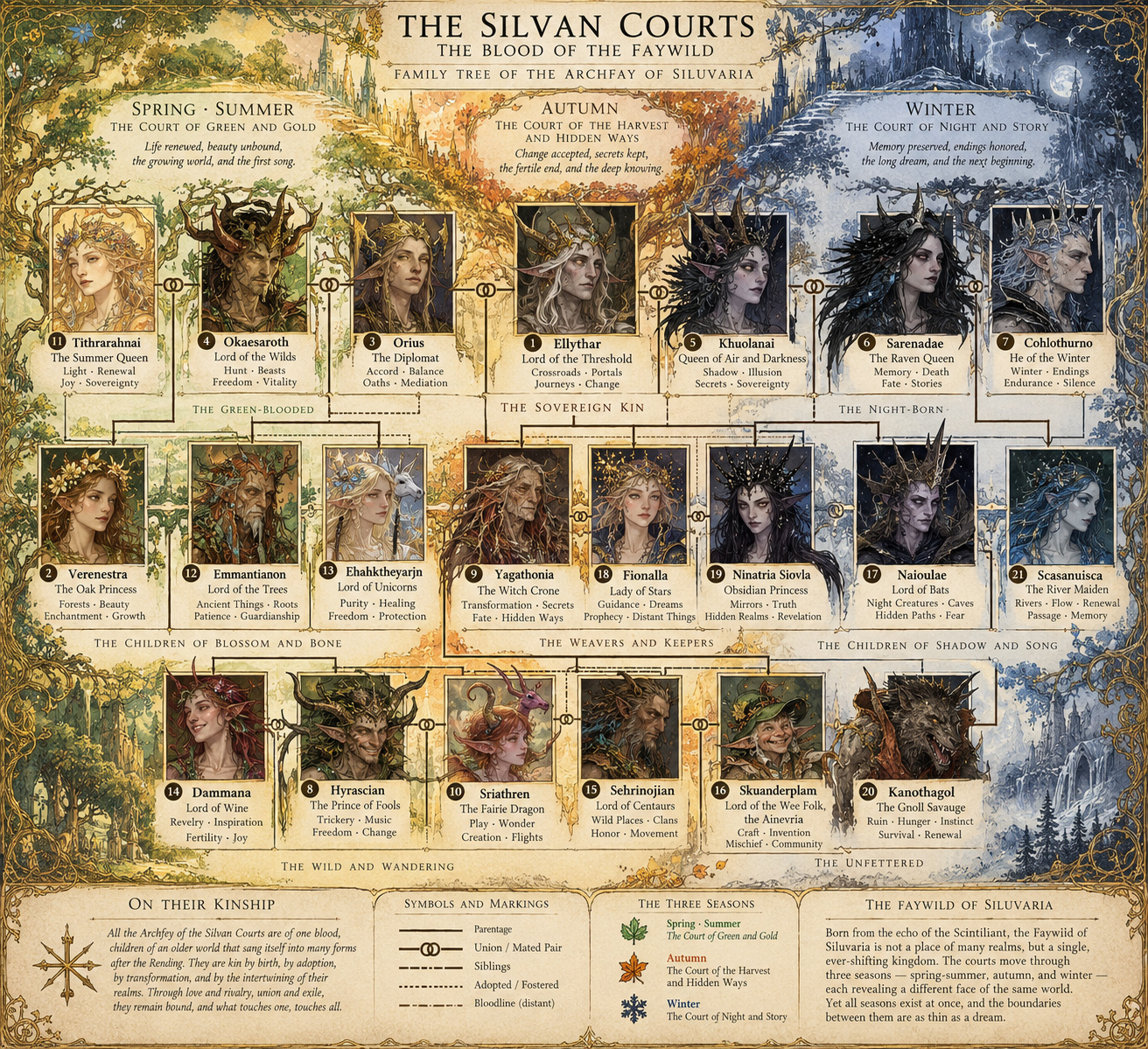
The Archfay

Posted in Siluvaria, The Fae People on October 25, 2026 by coyoteandthunder

THE BLOOD OF LILTHEN

Prologue: Before the Waters

In the beginning of the Faywild, there was no sea. Hollows existed, certainly, and long valleys where the earth had folded on itself, and caverns beneath the mountains that descended into darkness beyond any star’s reach. But those places held no water, and no rivers led to them. The land was young, and all its substance was uncertain. The mountains were soft as wax. The plains breathed in their sleep. Great forests of fungus, taller than kings’ towers, rose overnight from the steaming earth, their pale crowns unfolding beneath a sky that had not yet decided whether it was day or night.

There were mushrooms whose gills shed golden dust, and others whose roots wandered underground like searching fingers. There were towers of amber mold and vast shelves of black lichen, and in the valleys stood forests of translucent stalks through which the light of the Scintiliant passed in strange colors. Sometimes a thousand tiny eyes opened upon the surface of a single fungus, and sometimes a whole hillside sighed and moved away from the place where it had grown.

The Faywild had been born of the Rending, and it possessed something of the wound that had made it. It was not a country apart from Siluvaria, but a strange reflection of the Scintiliant, as the face of a beloved person might appear in broken glass. Mountains remembered other mountains. Valleys repeated the shapes of distant valleys. Sometimes a creature would look upon a tree and recognize it, although neither creature nor tree had existed the day before.

And in this unsteady country dwelt the First Kindred. Avarion and his consort Maelithrae, pioneering fae, had awakened together when the world was broken. Their children and descendants multiplied among the fungal forests, and with them came laughter, jealousy, invention, longing, and the first small cruelties of love.

Ellythar, eldest among the first children, wandered the boundaries of things and discovered that every boundary was not fixed. His sister Yagathonia learned the secret names of transformation and grew old before anyone understood what age meant. Their sister Khuolanai delighted in the darkness between the lights of the world, and gathered about herself those mysteries that could not endure the scrutiny of day.

From these three sprang the greater kindreds, until twenty-one archfay held dominion over the growing country, though none could yet say precisely what dominion meant. And there was another. Her name was Lilthen. She was the youngest daughter of Avarion and Maelithrae, born after the others, when the first astonishment of creation had given way to the ache of remembering. She had no throne, no court, and no creature that called her mistress. Yet she possessed a gift that none of her kindred could imitate.

When a fungus was torn from the earth, she felt the sundering of its roots. When a creature died, she heard the silence left behind it. When her brothers and sisters quarreled, she knew not merely what they said, but what each had hoped the other would understand. It was a troublesome gift in a family that had not yet learned to forgive. Lilthen was neither wholly beautiful nor wholly terrible. Her hair was dark as the earth beneath the oldest mushrooms, and her eyes were the color of garnets held against a candle. Her skin bore the faint red tracery of veins, as though the light of the world passed through her more freely than through other beings. When she laughed, the fungal forests opened their caps. When she wept, a red dew gathered upon the stones.

Chapter I: The Feast of the First Spores

The first great gathering of the Silvan kindred was held beneath a mushroom whose crown was wider than a valley. Its stem was white and ribbed like the column of an enormous temple, and its gills shone with a pale green light. Beneath it, the earth was warm and soft, and from every fissure rose the scent of wet stone, iron, and growing things. The occasion was a feast, although no one could remember who had called it.

Dammana, lord of wine, had discovered that the amber juices of certain fungi could be fermented, and he had filled a hundred vessels with his invention. He was delighted beyond measure, for he had found a substance that made the sorrowful merry, the timid brave, and the wise indiscreet. He poured the first cup for Lilthen. “Drink, little aunt,” he said, although she was younger than he. “For I have made a thing that teaches the heart to speak.”

“The heart has never lacked a voice,” answered Lilthen.

“Then I have made something that persuades the ears to listen.” Damana responded. Lilthen laughed and drank. Nearby, Hyrascian, the prince of fools, was balancing upon the curved stem of a mushroom, singing insulting verses about the dignity of kings who had not yet acquired kingdoms. His brother Skuanderplam, lord of the ainevria, had gathered a multitude of tiny woodland folk, who emerged from the folds of his cloak and stole ornaments from the assembled guests. Hyrascian had persuaded them to replace the stolen ornaments with beetles. Thus did Orius, the diplomat, discover a living insect in his ceremonial collar.

“I have negotiated peace between creatures with less reason than you,” Orius told Hyrascian.

“And did they keep it?” Hyrascian asked doubtfully

“For a time.” Replied the diplomat

“Then you must teach me how to rule.” Hyrascian pleaded

Orius removed the beetle and placed it gently upon the ground. “I suspect,” he said, “that you are beyond instruction.”

On the far side of the gathering, Tithrarahnai, the summer queen, sat beside Okaesaroth, lord of the wilds. Their affection was a thing of such abundance that the ground flowered wherever their hands touched. Okaesaroth wore a crown of branching antlers, though no deer had yet been born to the Faywild. Tithrarahnai wore a mantle of green and gold, woven from the first leaves of plants that had never before existed. They were magnificent, and knew it.

Their daughter Verenestra, the oak princess, wandered among the guests carrying a little tree in a bowl of earth. She had discovered the oak, and was greatly pleased with its stubbornness. “It grows slowly,” she told Lilthen, “and refuses to be hurried.”

Emmantianon, lord of the trees, bent over the little oak with grave attention. He had already begun to understand that patience might be a form of power greater than speed. Beside him stood Ehahktheyarjn, lord of unicorns, whose pale garments were unblemished by the steaming soil. He was troubled by the violence with which the young world grew. “Everything feeds upon something,” he said. “Even the smallest root destroys what lies beneath it.”

“That is not always cruelty,” Lilthen replied.

“No,” said Ehahktheyarjn. “But I fear we shall grow accustomed to cruelty by giving it other names.”

Sehrinojian, lord of centaurs, overheard them and laughed. “Then you should learn to run. There is wisdom in the distance between one’s heels and one’s troubles.” He was a restless being, broad of shoulder and quick to anger, who believed that no living creature ought to remain in one place long enough to become its prisoner.

Sriathren, the fairie dragon, circled above the feast, shedding iridescent sparks from his wings. He was small enough to perch upon Lilthen’s shoulder, but his pride was larger than the mushroom beneath which they gathered. “I have flown beyond the western hills,” he announced.

“And what lies there?” asked Lilthen.

“More hills.” But he would keep flying. For Sriathren could never bear the thought that something beautiful might exist beyond his knowledge.

At the center of the feast sat Ellythar. He was quiet, as he often was among his family, and watched the revelry with the expression of one who sees both the beginning and the ending of a story at once. He had discovered thresholds: between light and darkness, sleeping and waking, truth and invention. He knew that the Faywild was full of passages that had not yet been opened. Lilthen came to sit beside him. “You are troubled,” she said.

“I have found a door.”

“Where?” His little sister looked to him with wide eyes.

“Everywhere.” Ellythar looked to the horizon

“Then perhaps you have found the way forward.”

“That is what frightens me.”

Ellythar turned toward her. “Little sister, there are places in this country that ought not yet to be entered. We have come into being too quickly. The land remembers more than we know.”

“Then we must learn what it remembers.” Lilthen said confidently.

Ellythar took her hand. “But promise me that you will not open every door merely because someone asks you to.” Lilthen looked at him with such tenderness that he was ashamed of his fear.

“I promise to listen,” she said. It was not the promise he had requested. And he knew it.

Chapter II: The Daughter of Night

Not all the family rejoiced at the feast. Khuolanai, the queen of air and darkness, stood beneath the outermost shadow of the great mushroom, where its luminous gills could not reach. She wore no crown, for she considered crowns an admission that sovereignty required an audience. Her beauty was cold and severe, and her eyes reflected nothing.

Beside her stood Morvath, the Unremembered King, whose name was already slipping from the minds of those who heard it. Their children gathered around them. Cohlothurno, he of the winter, was pale and proud, and spoke seldom except to wound. He believed that all things beautiful were made more precious by the certainty of their ending.

Naioulae, lord of bats, listened to the feast from the darkness above. He had discovered the pleasure of hearing what others could not, and knew the location of every whisper beneath the mushroom’s enormous crown.

Ninatria Siovla, the obsidian princess, held a mirror of black glass in which the faces of her relatives appeared as they might become rather than as they were. She looked into it too often, and was beginning to mistake possibility for prophecy.

And Kanothagol, the Gnoll Savauge, crouched upon the warm earth beyond the feast, gnawing a bone. He wore no ornaments. His fur was matted with spores, his teeth were yellow, and his eyes were bright with the intelligence of an animal that has never required permission to live. He despised the feast. Not the food, for he loved food, nor the company, for he loved his kindred after his own fashion. He despised the manner in which they had begun to arrange themselves according to rank. “Look at them,” he growled to Naioulae. “They have been alive for scarcely a breath, and already they are deciding who shall stand above whom. Others must labor to acquire loyalty. Lilthen receives it merely by listening.”

Cohlothurno turned his pale eyes toward his aunt. “Do you envy her?”

“No.” But the word was spoken too quickly. At that moment Sarenadae approached. She was the Raven Queen, daughter of Yagathonia and sister to Tithrarahnai and Fionalla. Her garments were dark, and a single black feather lay upon her breast. She had begun to hear the voices of things that had ceased to exist, though in those early days there were few such voices. “I have heard something,” she said. “It said that one of us would die.” Kanothagol raised his head. He had smelled fear. And for the first time since the Rending, fear had the scent of blood.

Chapter III: The Promise of the Hollow Places

In those days the Faywild had begun to divide against itself. Not into separate kingdoms, for there was but one Faywild, and its lands were bound together by the strange reflection of the Scintiliant. Yet the archfay differed in what they desired the country to become. Tithrarahnai wished it to flourish. Okaesaroth wished it to remain wild. Emmantianon wished it to endure. Yagathonia wished it to change. Khuolanai wished it to keep its secrets. And Ellythar wished, above all, to monitor the passages and keep them safe. But the land was drying.

The molten valleys cooled into stone. The enormous fungi drank the moisture from the earth, and where their roots had passed, the soil became powder. Their crowns collapsed in clouds of spores that darkened the sky for days. Beneath them, creatures newly born to the Faywild struggled for nourishment. Scasanuisca, the river maiden, wandered the empty channels of the world and wept. She had been born with the knowledge of rivers, yet no river existed. She could hear their music in her dreams. She knew the turning of currents, the gathering of rain, the patient labor of water upon stone. But when she opened her hands, nothing flowed between her fingers. She came to Lilthen in sorrow. “I have been made for something that does not exist,” she said.

Lilthen embraced her. “Then perhaps it has not yet been made.”

“Who will make it?” the riverless maiden pleaded.

Lilthen had no answer. That evening she sought Yagathonia. The witch crone lived beneath a forest of red fungi, where the air was thick with spores and the ground was covered in the bones of creatures that had died before acquiring names.

Yagathonia sat before a cauldron fashioned from the hollow shell of an enormous beetle. Within it simmered a substance that changed color whenever she looked away. “Come in, child,” she said.

Lilthen had not announced herself. “You knew I was coming?” Yagathonia did not answer, but stirred the cauldron.

“What troubles you?” the crone answered

“The land is thirsty.” The fae maiden answered, “Scasanuisca hears rivers that have not been born.” Yagathonia stopped stirring.

“Everything may be made from something else.” The witch replied and looked at her for a long time. “Do you know what blood is?”

Lilthen touched the red veins beneath her wrist. “It is what carries life.”

“It is also what life cannot afford to lose.” Yagathonia mused.

“Could blood become water?”

“Certainly.”

Lilthen smiled. “Then we have found the answer.”

“No,” said Yagathonia. For the first time in her existence, the witch crone sounded afraid. “We have found a question.” She reached into the cauldron and drew forth a red thread, wet and shining. “Blood remembers the body from which it came. It remembers the warmth of the heart, the shape of the veins, the touch of the skin. If it were made into water, it would remember all these things still.”

Lilthen looked down at her hands. Yagathonia seized her wrist. “Do not think it, little one.” The witch’s fingers tightened. “Listen to me, Lilthen. There are gifts that cannot be given without making the giver a prisoner of the gift.”

Lilthen gently withdrew her hand. “And there are needs that cannot be answered without sacrifice.”

Chapter IV: The Three Betrayals

It was Ninatria Siovla who first saw the sea. She saw it in her obsidian mirror, winding through the Faywild in a thousand arms, filling the valleys and encircling the hills, passing beneath roots and through caverns, touching every geography of the newborn country. Its waters were dark red. Upon its shores stood forests taller than the fungal towers, and in its depths swam creatures whose names had not yet been spoken. She saw Scasanuisca dancing upon its waves. She saw Verenestra’s oaks growing beside its banks. She saw the unicorns of Ehahktheyarjn drinking from its tributaries, and the centaurs of Sehrinojian crossing its shallows. She saw the ainevria building little boats beneath the reeds, and Sriathren flying above the water with sunlight shining through his wings. And she saw Lilthen lying dead.

Ninatria Siovla dropped the mirror. It did not break. She carried it to Khuolanai. The queen of air and darkness gazed into the glass, and her expression changed. They discussed it for a while. Ninatria had seen the sea, and in the sea she had seen a new order of things. Water would connect the scattered lands. Rivers would carry voices, memories, creatures, and power. Whoever understood the sea would understand the movement of the Faywild itself.

She imagined its dark waters beneath her winter stars. And she desired it. “We must learn what the vision means,” Khuolonai said. Thus was the first betrayal committed: the withholding of a truth that might have saved a life.

The second betrayal belonged to Orius. The diplomat had discovered that Tithrarahnai and Khuolanai were preparing for conflict. The summer queen wished to bring forth forests and living rivers, while the queen of air and darkness feared that such abundance would leave no place for secrecy, silence, or the necessary endings of things. Orius believed that war between them would destroy the newborn country. He sought a compromise. He went first to Tithrarahnai.

“Would you accept a country in which the waters belong to neither court?” He asked the Summer Queen.

“Of course,” she answered. “Water should belong to all.”

Then he went to Khuolanai. “Would you accept a country in which the waters remember every sorrow, so that nothing lost may be forgotten?”

Khuolanai considered this. “Yes,” she said. Orius believed he had found peace. He did not understand that the two queens had agreed to different things. Tithrarahnai desired living water. Khuolanai desired remembered death. And between them stood Lilthen, whose blood might satisfy both.

Orius knew of Yagathonia’s discovery. He knew that Lilthen had begun to consider offering herself to the land. Yet he did not tell her that the queens had made their peace around the possibility of her sacrifice. He told himself that silence was necessary. He told himself that a diplomat must sometimes withhold the truth to prevent a greater evil. Thus was the second betrayal committed: the sacrifice of honesty upon the altar of peace.

The third betrayal was the cruelest. It belonged to Ellythar. He had discovered a threshold beneath the deepest hollow of the Faywild, a place where the broken reflection of the Scintiliant folded inward upon itself. There the land was thin, and the substance of the world could be changed. He knew that Lilthen had visited Yagathonia. He knew that she was seeking a way to bring water into the Faywild. And he knew that if she entered the hollow place, the transformation might become irreversible.

He went to her. “Do not go,” he said.

“Scasanuisca is dying of thirst for rivers that do not exist.”

“She will endure.”

“The forests are failing.”

“Then we shall make others.”

“The creatures are suffering.”

“Then let them suffer a little longer.”

Lilthen stared at him. “You do not mean that.”

“No,” he said. “I do not.” He took her hands.

“I have seen what lies beyond the threshold. It is not a place where one may give a little and return unchanged. It will take all that you offer.”

Lilthen looked toward the distant fungal forests. “Then perhaps I must offer all.”

Ellythar felt the terrible certainty of her words.He loved her more deeply than any of his kindred, for she alone had never asked him to explain the sorrow of knowing too many possible futures. And he was afraid. So he told her a lie. “The threshold is closed,” he said. “I have sealed it.”

Lilthen searched his face. “Then I shall find another way.” She kissed his brow and departed. Thus was the third betrayal committed: the lie told by love to preserve what love could not bear to lose.

Chapter V: The Murder of Lilthen

The murder took place beneath the Hollow Crown, where the greatest fungus in the Faywild had collapsed and left a crater so vast that its rim could not be seen from the center. The earth was warm. Red spores drifted through the darkness. Beneath the broken crown lay the threshold Ellythar had concealed. Lilthen came alone. Or so she believed. She carried no weapon. Around her neck hung a little oak leaf given by Verenestra, a feather from Sarenadae, and a bright scale shed by Sriathren. In her hands she held a cup of Dammana’s wine.

She had come to give herself to the land. But she had not come to die. Lilthen believed that the transformation could be shared. If each of her kindred offered a little of their power, the Faywild might receive its waters without the destruction of any one among them. She had written to them all. Some had answered. Some had not. At the edge of the crater stood Tithrarahnai and Okaesaroth, radiant even in the darkness. Beside them were Emmantianon, Verenestra, Ehahktheyarjn, and Sehrinojian. From the autumn paths came Orius, Dammana, Hyrascian, Skuanderplam, and Scasanuisca. Yagathonia arrived carrying her cauldron. Fionalla walked beside her, with stars caught in the folds of her garments. And from the shadows came Khuolanai, Cohlothurno, Naioulae, Ninatria Siovla, and Kanothagol. Sarenadae followed last. Ellythar stood apart. Sriathren circled above them, his wings glittering against the red darkness.

All twenty-one had come. Lilthen was overjoyed. “You see?” she cried. “We need not lose anything. Together we may make the waters.” But Yagathonia did not smile. The witch crone looked into her cauldron and saw that the substance within had turned black. “The threshold is hungry,” she whispered.

Khuolanai stepped forward. “Then let us feed it.”

Lilthen turned toward her sister. “What do you mean?”

“The land requires blood.”

“A little from each of us.” Khuolanai shook her head.

“The vision does not show a little.” Ninatria Siovla began to tremble.

Lilthen looked from one face to another. She saw the fear in Yagathonia’s eyes, the sorrow in Orius, the terrible stillness of Ellythar. And she understood. “You have decided,” she said. No one answered. “You have decided that I must die.”

Tithrarahnai rose in anger. “No!”

Her voice rang across the crater, and flowers sprang from the dark earth. “No one shall take your life.”

Khuolanai regarded her niece coldly. “Then there shall be no sea.”

“Let there be none.”

Scasanuisca fell to her knees. Lilthen looked at the river maiden and felt her sorrow like a blade beneath the ribs. She turned toward the others. “Will none of you speak?”

Hyrascian opened his mouth, but for once no jest came. Dammana dropped his cup. Verenestra began to weep. Ehahktheyarjn stepped forward. “This is wrong.” He looked toward the queens. And hesitated. That hesitation would haunt him forever.

Kanothagol rose from his crouch. “I will not kneel to this,” he growled. He bared his teeth at Khuolanai. “You call yourselves rulers, yet you would feed upon your own blood.”

Lilthen turned toward the threshold. “I shall enter willingly.”

Ellythar moved to stop her. But Khuolanai raised her hand. And the darkness closed around him. It was Cohlothurno who struck the first blow. He had been waiting for his mother’s command, believing that obedience was the highest form of loyalty. He drew from the cold air a blade of winter, thin and pale as the first frost upon a grave. He drove it into Lilthen’s back. The sound was very small. A breath. A gasp. The breaking of something that had never before been broken.

Lilthen staggered. She turned toward him. “Cohlothurno?” He could not meet her eyes.

Khuolanai stepped forward, but Sarenadae seized her arm. “No,” whispered the Raven Queen. For the first time, death had come among the archfay. And Sarenadae heard its voice. It was Lilthen’s. The dying archfay looked toward Ellythar. He struggled against the darkness, but could not reach her.

“Forgive me.” Ellythar wept.

Lilthen smiled through her pain. “I already have.” Then she fell into the threshold. And the world opened.

Chapter VI: The Thousand Arms

No one knew how much blood a body might contain until Lilthen died. The first torrent rose from the hollow like a mountain breaking apart. It was dark and thick and warm, and it carried within it the memories of every sorrow Lilthen had ever felt. It filled the crater. Then it overflowed. Across the molten plains it ran, carving channels through the soft earth. It poured beneath the fungal forests and broke their roots. It descended into caverns and rose again through distant springs. It divided around mountains, encircled hills, and found its way into every valley of the Faywild.

It became a sea with a thousand arms. And wherever its waters passed, the land changed. The great fungi collapsed upon its banks, and from their rotting substance rose the first true forests. Oaks thrust their roots into the dark soil. Willows bent over the red currents. Reeds grew in the shallows, and moss spread across the stones. The air cooled. Clouds gathered. Rain fell for the first time. Scasanuisca stood upon the shore and felt the waters answering her. She had received everything she had desired. And she hated herself for it. She waded into the sea until the dark water reached her throat.

“Lilthen,” she whispered. The waves touched her lips. They tasted of iron and salt, and memory. Far away, Sriathren flew above the new channels, following them through valleys and over hills until he understood that the waters had no single beginning and no final end. He returned exhausted, his wings stained red.

“The sea goes everywhere,” he told the others.

“Then she is everywhere,” said Verenestra.

Emmantianon knelt beside the first oak to grow upon its banks and placed his hand against the trunk. He felt the tree drinking Lilthen’s blood. And he understood that every forest of the Faywild would henceforth be nourished by a murder. Ehahktheyarjn led his unicorns to the shore, but they would not drink. He wept with shame.

Sehrinojian drove his centaurs across the shallows, searching for a place where the water ran clear. They found none. Skuanderplam built the first little boats, and the ainevria sailed them through the reeds. He told his people never to laugh at the sea, for its waters remembered every insult. Dammana poured his wine into the waves. It disappeared without a trace. From that day forward, he swore that no feast should begin without a cup poured for the dead.

Hyrascian wandered the shores in silence for a hundred days. When at last he spoke, it was to tell a joke so cruel that everyone who heard it began to weep. Thus did he discover that laughter and sorrow were not enemies, but close companions.

Orius traveled from one branch of the sea to another, seeking to reconcile the kindred. Yet every agreement he made was haunted by the knowledge that his silence had helped bring about Lilthen’s death. He became the greatest diplomat of the Faywild. And never again trusted a peace purchased without truth.

Yagathonia gathered a little of the sea in a black vessel and sealed it with seven knots. She knew that Lilthen’s blood could transform anything. But she also knew that every transformation would carry a debt. From that day onward, the witch crone demanded a price for every gift, not because she loved cruelty, but because she had learned what happened when the cost of magic was concealed.

Fionalla looked into the night and saw the stars reflected upon the wine-dark water. She gave each star a name, so that no life might vanish without remembrance.

Naioulae sent his bats through the caverns beneath the sea, and they returned with tales of submerged passages and forgotten chambers. He became the keeper of hidden routes, for he had learned that even grief possessed secret ways.

Ninatria Siovla looked into her obsidian mirror. For the first time, it showed her nothing. She had seen the future and failed to prevent it. Thereafter she feared her own visions, yet could not cease seeking them.

Cohlothurno stood upon the northern shore, where the sea had entered a valley of cold stone. He washed his hands. The blood would not come away. He summoned frost, and the water froze around his fingers. But beneath the ice the sea remained dark, and his reflection looked back at him with Lilthen’s eyes. He withdrew into winter. And winter became the season in which the family remembered what it had done.

Khuolanai stood alone upon a cliff above the new sea. She had obtained the country she desired: a land of hidden depths, dark waters, and memories that could never be erased. Yet she found no triumph in it. The waves below her whispered with Lilthen’s voice. Not accusing. Not forgiving.

And Khuolanai discovered that there is no darkness deep enough to conceal a crime from the heart that committed it.

Kanothagol came to her upon the cliff. He was covered in mud, and his teeth were stained with the blood of creatures that had died in the flood. “You have made a fine kingdom,” he said. Khuolanai did not answer. “A kingdom of blood.”

“Leave me.”

He laughed, but there was no joy in it. “You would have me kneel to you, mother. Yet the sea does not kneel. The beasts do not kneel. The dead do not kneel.” He turned away.

“Neither shall I.”

From that day forward, Kanothagol refused every summons to court unless he came by his own desire. And though he loved his family, he would never again trust its crowns.

Chapter VII: The First Turning

The murder of Lilthen did not destroy the Silvan kindred. It made them a family. Before her death, they had been bound by blood, but blood alone had meant little in a world where no one had yet learned what could be lost. Afterward, they were bound by memory, guilt, affection, resentment, and the knowledge that each had played some part in the making of the sea. Even those who had resisted the murder were changed by it.

Tithrarahnai could not forgive Khuolanai. Khuolanai could not endure Tithrarahnai’s forgiveness, had it been offered. Ellythar withdrew from the company of his siblings, for he had discovered that a threshold could be crossed only once, and that no door opened backward into innocence. Sarenadae gathered the last breath of Lilthen and held it within a black feather. She had become the keeper of the dead, though she had never desired such a calling. And Scasanuisca wandered the thousand arms of the sea, tending its currents and speaking to the sorrow that lived beneath them.

In time the waters cooled. The fungal forests gave way to groves of oak, beech, and willow. Meadows spread across the former plains of ash. Creatures multiplied, and the Faywild became crowded with strange life: bright-winged insects, whispering beasts, dancing folk, wandering spirits, and creatures that were neither animal nor plant, but something between. Yet the sea remained wine-dark.

Its waters were blood, though no longer blood in the ordinary sense. They flowed and gathered, rose as mist, fell as rain, and returned again through root and river. They carried life, but they carried memory also. And the kindred discovered that the sea changed with their passions. When Tithrarahnai rejoiced, its shores flowered. When Khuolanai brooded, its depths grew black and still. When Hyrascian laughed, its waves danced against the stones. When Yagathonia worked her transformations, strange creatures rose from its shallows. When Cohlothurno grieved, ice formed upon its northern arms. When Fionalla sang, the stars appeared upon its surface even beneath a clouded sky. When Dammana celebrated, the sea gave forth a fragrance like wine. When Scasanuisca mourned, its currents wandered into new channels. And when Ellythar opened a threshold, the waters passed through it, carrying the memory of Lilthen into places no living creature had yet discovered.

Thus the sea became the living conscience of the Faywild.  And because the kindred could not escape its remembrance, they began to make laws. The first law was that no archfay should take the life of another. The second was that no sovereign should hold dominion forever. The third was that every gift should be acknowledged, and every bargain should name its price. But these laws were not enough.

For the family had discovered that the desire to possess what one loves may become indistinguishable from the desire to destroy it. So they agreed upon the turning of the seasons. In spring-summer, the Court of Green and Gold would ascend, and the Faywild would flourish beneath the rule of Tithrarahnai and Okaesaroth. In autumn, the Court of the Harvest and Hidden Ways would inherit the land, and Ellythar, Orius, Yagathonia, and their kindred would govern the passages, bargains, celebrations, and reckonings of the world.

In winter, the Court of Night and Story would take its turn, and Khuolanai, Sarenadae, Cohlothurno, and the night-born would preserve the memories of all that had passed. There would be no separate realms. The Faywild would remain one country. But no season would reign forever. And the sea would touch them all.

Languages in Siluvarian Arcana

Posted in Siluvaria, Silverymoon, The Fae People on October 5, 2026 by coyoteandthunder

Linguistic basics

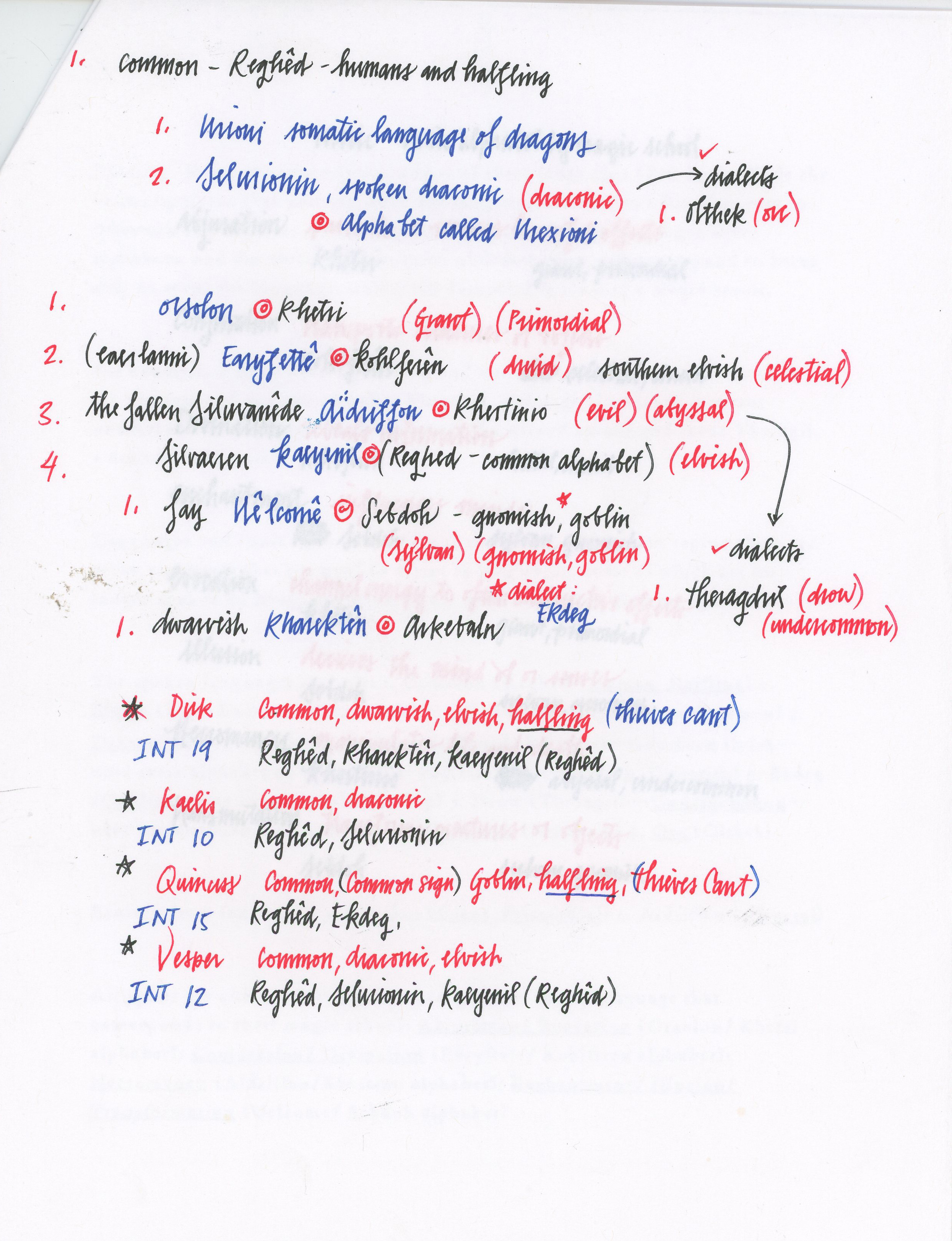
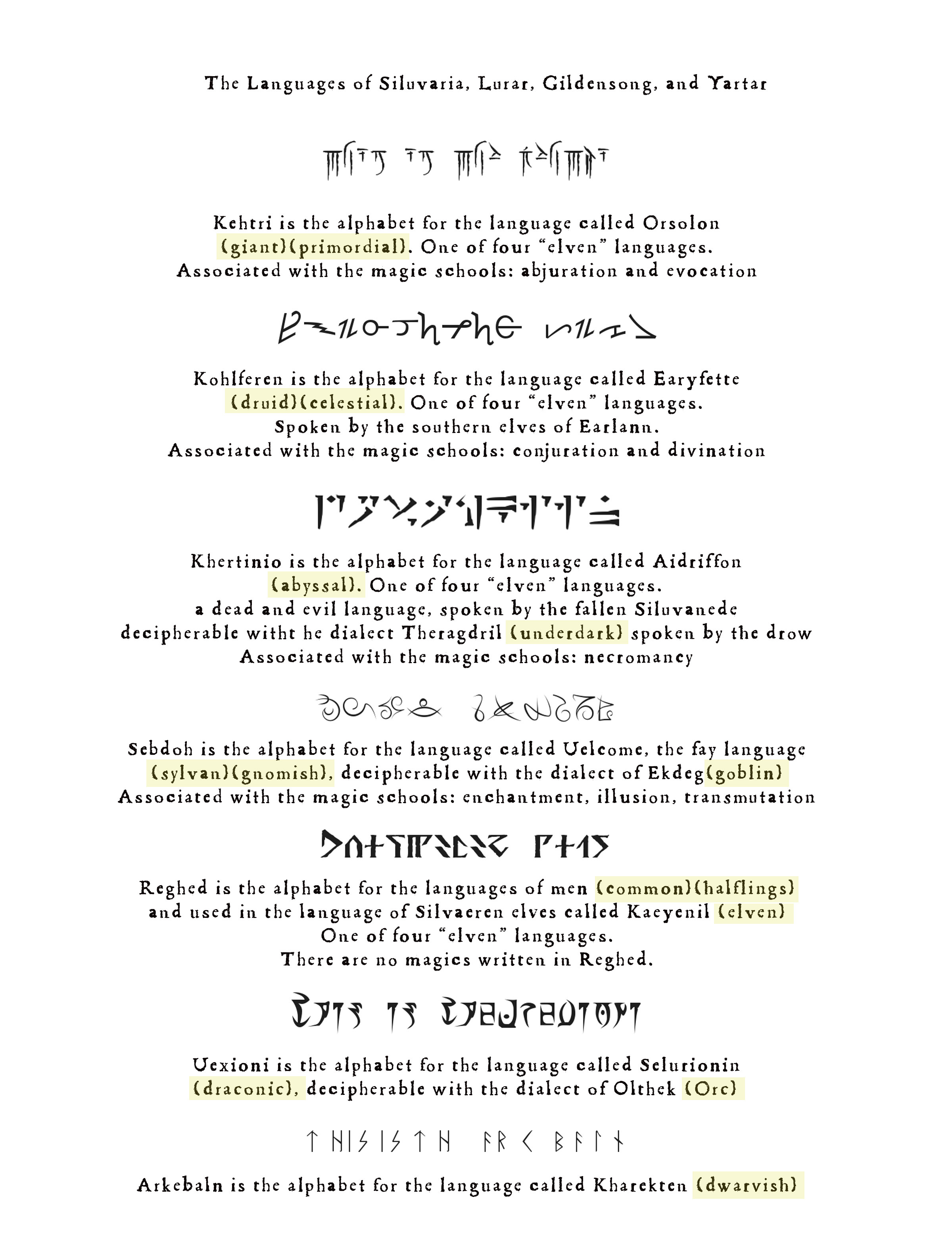
Literacy: Every character knows a base of three languages (PH, P37); While the book stipulates that you can write the language, literacy is a bit rarer in Siluvaria and requires an Intelligence score of 12. Some languages share alphabets, and the ability to recognize alphabets does not correspond to being able to speak the language, unless the character is reading a magic scroll.

For example, a drow wizard can read and use a necromantic scroll written in the esoteric and ancient alphabet Khertino, although the wizard may not understand it. They can do this because the wizard speaks and reads Theragil, a derivative of Aidriffon.   

Languages and runic alphabets: Across the greater Siluvarian region, seven alphabets are used to script 14 languages, some of which are no longer spoken by living cultures or are so esoteric that they are only employed.

The spoken languages include: 1. Common (Reghed—Human, Halfling) 2. Elvish (Kaey Enil—northern elvish—uses the same alphabet as Common) 3. Draconic (Selurionin—draconians) 4. Druid (Earyfette—southern elvish—uses the same alphabet as Celestial) 5. Fae (Uelcome—Sylvan, Gnomish) 6. Ekdeg (Goblin—uses the same alphabet as Fae) 7. Drow (Theragril—Undercommon—uses the same alphabet as Aidriffon) 8. Dwarvish (Arkebaln) 9. Orc (Olthek)

Esoteric/rare languages: 1. Orsolon (Giant, Primordial) 2. Aidriffon (Abyssal)

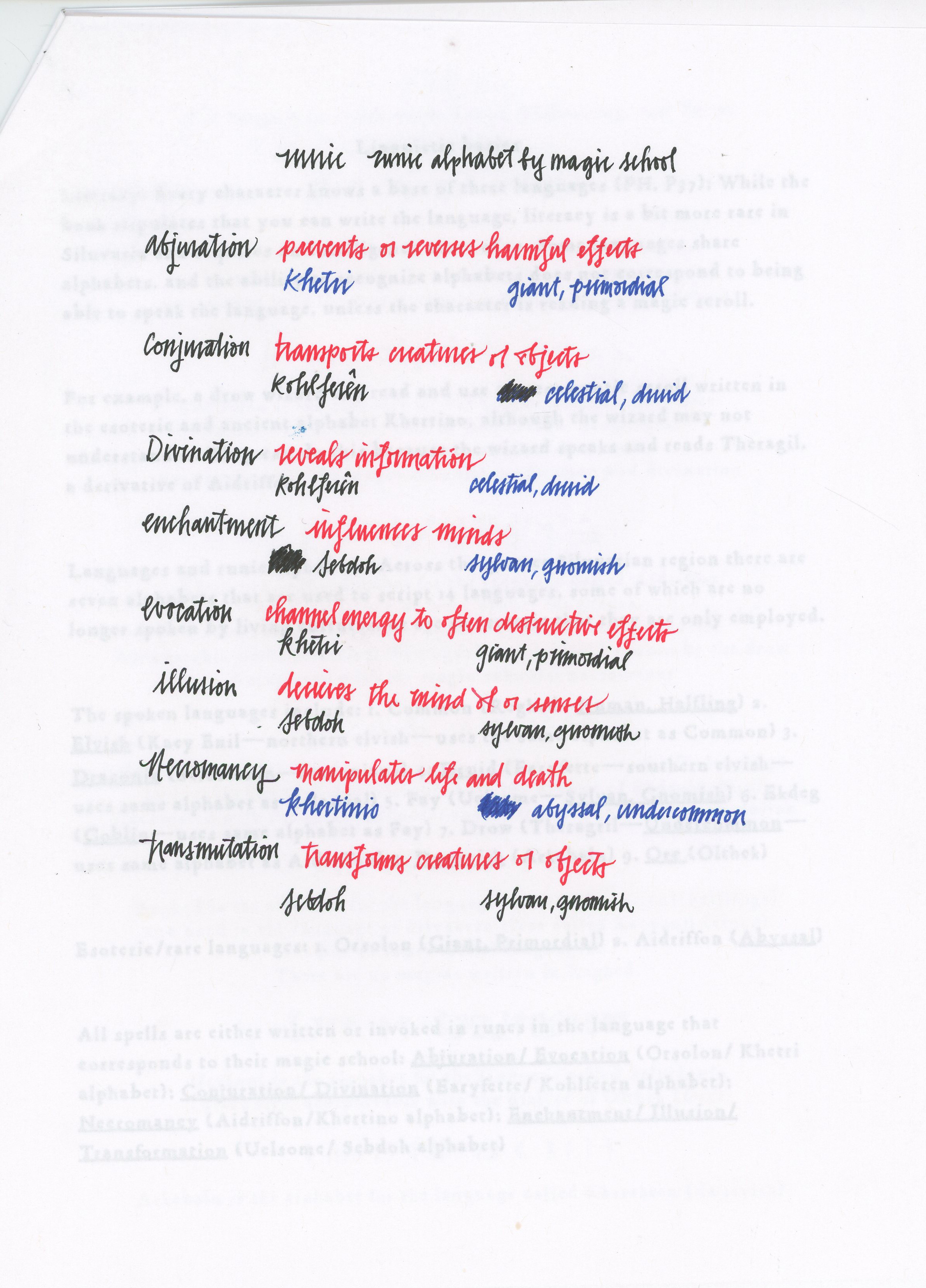
All spells are either written or invoked in runes in the language that corresponds to their magic school: Abjuration/ Evocation (Orsolon/ Khetri alphabet); Conjuration/ Divination (Earyfette/ Kohlferen alphabet); Necromancy (Aidriffon/Khertino alphabet); Enchantment/ Illusion/ Transformation (Uelsome/ Sebdoh alphabet)

Further notes on the draconic language.

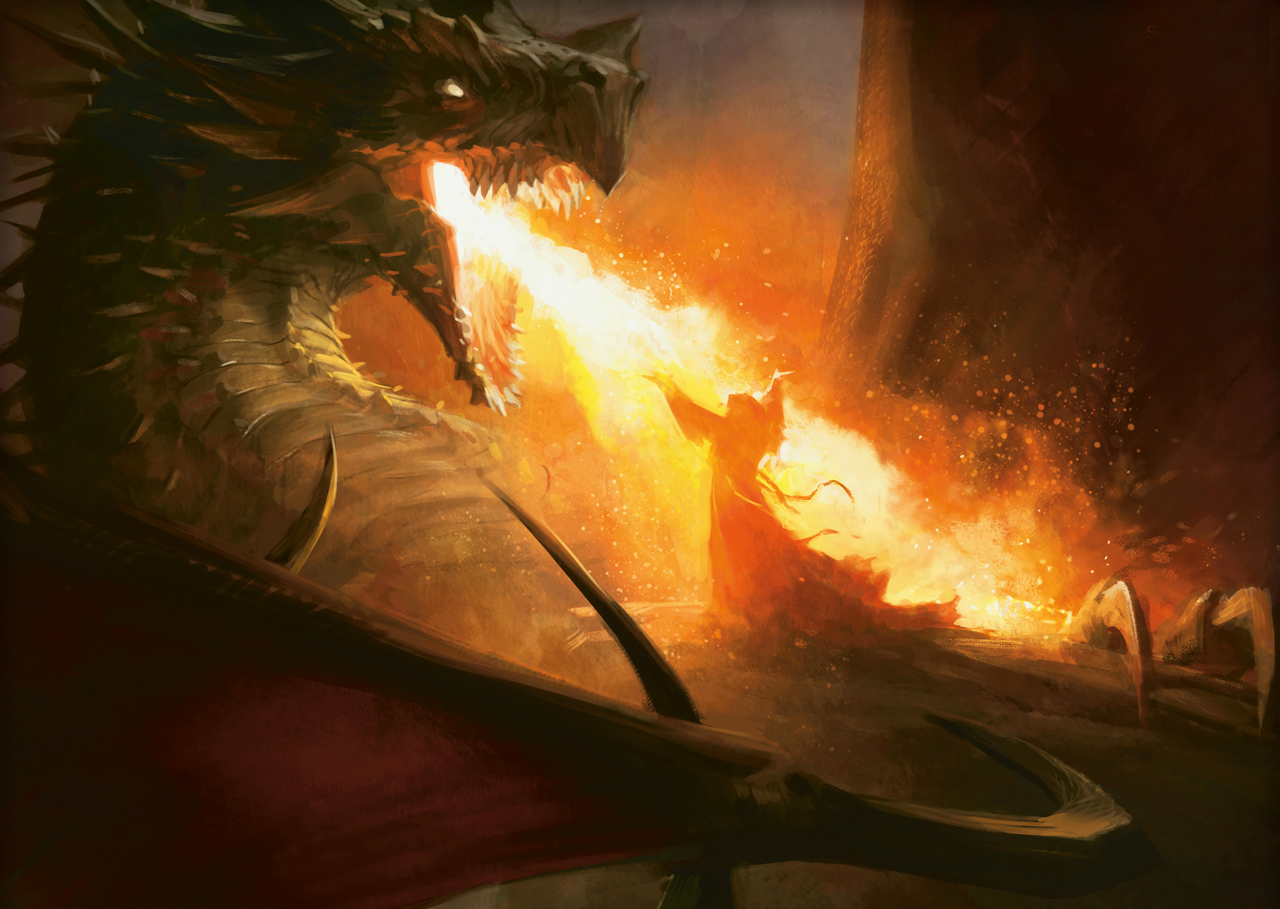
The spoken version of the draconic language is a non-syllabic language that is impossible for the anatomy of humanoid physiology to emulate. According to Yropa (great wyrm: khetri <Virmistrius>), recorded by the Silvaeren sages of Silverymoon, the name of the eldest draconic language is called Urioni. Urioni is an innate, somatic language of gestures, postures, and subtle movements of the dragon’s face and body used solely in discussing ancient matters between dragons of all creeds. All dragons’ true names are long sentences comprised of sounds found in nature, the alphabetic structure, as it is, of this most ancient of Daotyr’s languages.  There is no written version of Urioni.

Several iterations of Urioni have survived modern times, and many of those versions are pronounceable and apprehendable by humanoid races. In Northern Siluvaria, the land of the Scintilliant, the ubiquitous draconic language spoken by Silvaeren sages and dragon-kind alike is called SelUrionin, commonly called wyrm-speak. Its alphabet is called Urexioni. The new-come race of draconians speak a heavily accented dialect of wyrm-speak. Only with great struggle and regular misinterpretation can the elves of the High Forest and beyond understand or communicate with them.  

The Fae enemies of the North

Posted in Ehmis Ogh, Innien, The Fae Dark, The Fae People, The North on April 10, 2013 by coyoteandthunder

fayenemiesIn the long and harsh Winter of 1156, Fort Loren was set upon by a trio of enemies from the Underdark. Their mission was to take control of the Creation Forge in the Fae North and spawn an army of Titanbound Forge spawnlings. Mirana, the half-giant dark elf, the Oni known as Orlok and the Fae witch called Ula did manage to take advantage of the distraction that was the siege of the Dragonbred Faederkin (below) and take the Forge. In an act of desperation, before driving off the interlopers, the Defenders of Fort Loren were forced to destroy the ancient and unique Creation Forge.

dragon bred faederkin


The Defenders of Fort Loren

Posted in Ehmis Ogh, Elves, Innien, Men, The Fae People on April 4, 2013 by coyoteandthunder

defenders_1Fort Loren lies two days ride West of Behlwis in Northern Innien – a wild and desolate, fae-filled region known as Ehmis Ogh (Eh-miss-uff). Fort Loren is the secret guard of one of the world’s last Creation Forges. It is guarded by multiple brigades of Belhwin archers, Dehlfold warriors and warforged soldiers.

Loren Fort


The Lords of Loren Fort are the Half-Firbolg Ythilian, the elite-warforged knight of Theriol, simply called Flint, and the elven archdruid Sahfein.

defenders_2


Safein


The Dragonkin Wars

Posted in Gavin Wel, Lesivith, the Archfey, The Dragongods, The Fae Dark, The Fae People, The North, The Shadow Road, the Talisman on October 22, 2011 by coyoteandthunder

Announcing the publishing of the Valena Quoul, the history of the Dragon Kin Wars in the ancient lands of Unon. Click here or on the picture above to link to the PDF. This book is another chapter in the hugely involved plot of how the shadow grows over this campaign world. I am still experimenting with my idea of publishing a novel version of the campaign world…been working on it for twenty years. When published, of course, I will only use appropriated art with permission. I appreciate all the artists’ talents on this website and if permission is ever requested I will of course abide. For now, the site is published for personal use only.

The Secret of the Island of Blood

Posted in Ancient Lands, The Fae Dark, The Fae People on October 15, 2011 by coyoteandthunder

The Dark Mistress died years ago. Her dark spirit continues to linger in the dark feywilds around the mansion that was built by her lover before they were both betrayed. Salymira was her name. Once a shadar kai and then the mistress of Janulen of the Black Sword keep, now a tragic, cautionary tale of passion and shadow.

Janulen was an artificer of fantastic renown who specialized in thunder magic. Then living at Mantan, the Black Sword Keep atop Mountain Iredinn, in the days before the event known as the Gherivoninacht, the night the mountains crashed into the sea. Janulen was contracted by the Dark lord Maurphiun to create a device  to be called the Gherivon, the thunder machine. Mauphriun, a thrall of the Shadow King Alnayab, chose Janulen for the job because of the remote location and his singular talent.

Janulen lived alone with his wife Ralyria and his assistant, the faederkin Thanataign. For many years Janulen struggled to construct the Gherivon for his dark employer. Maurphiun, a scholar of ancient history, moved to the mountain to aid and observe Janulen and his designs. IT became clear to Maurphiun that the building of the Gherivon would drive Janulen insane as the construction of the device might literally tear his mind apart. Maurphiun contracted the services of a Shadar Kai sorceress and consort, Salymira, to soothe and revitalize the exhausted Janulen. In those years, the ShadarKai were known to inhabit and consort with the Dark Elves of Baestelix, and this is where the two lovers began their triste, all to the betrayal of Ralyria.

In the year 1125, in the hours before the Gherivoninacht, in the last moments before the activation of the Gherivon, Ralyria learned of her betrayal. She found the mansion of Phytherios on the other side of the mountain peak and asertained its dark purpose. A legendary fury arose in her heart. A fury so great that an elemental daemon named Farthuriel from the FeyDark, heard her woeful heart beat and came to taste her rage. Farthuriel offered to take the heart of Janulen and cast it into the dark well, and in return, Ralyria would let him transform her rage into a mighty thing. “Anything! I will give you anything to condemn Janulen’s heart to the void!” Ralyria gladly screamed.

Thanataign, the faederkin, every faithful to Janulen, overheard this dark bargain and reported it to his lord. Maurphiun was there when Thanataign reported on Ralyria’s dark dargain. Maurphiun sensed that this daemon, this Fartheriel of the Black Well, might actually have the ability to stop the Gherivon from activating. To save his agenda, Maurphiun made a dark deal of his own with Farthuriel to become an undead demi-lich, trading a bit of his soul, so that the Gherivon might not be interrupted.

He did not know, however, that indeed Faruthiel had betrayed Ralyria too, and had transformed her into a black dragon to kill Janulen. As the Gherivon was activated, the dragon attacked and the incantation ritual to realize its full power was never manifest. For indeed the Gherivoninacht occured, reducing the Southrin Mountain range to the sea, but lo, the plan was to destroy all of Ethilistyr as well. Ralyria pierced Janulen’s heart with her vile tooth and sent the doomed artifacer to a unliving state of wraithdom. Maurphiun, in a blind need to fulfill a plan that was never fully realized, keeps trying to subdue the dragon, who still haunts the mist trail.

The Raelfaen and the Eladrin

Posted in the Archfey, The Fae Dark, The Fae People on October 14, 2011 by coyoteandthunder

With the coming of Shadow, the splintering of the Astral Tower in the Game of Mountains, and the rise of the ancient Fae power of the Aoltha Pana, in the Seventh Aepoch of the Raelfaen, a cultural and spiritual divide has occured, or has become evident, between who may be called Eladrin and who may be called Raelfaen. For fifty thousand years, the two races have been one and the same, interchangable and in harmonium. No longer is that the case. In the recent days following the Dragonkin War, the Pale Court of Raelfaen at Tem Salaam as presided over by Lady Kasalai, in the ancient lands of Unon, has ruled what all of the finer sylvan races have already known: the onyx-eyed Raelfaen are of shadow and can not be known as one people with the ivory-eyed Eladrin. Nowhere is this more periously felt than the ancient city of TemAol. 200 miles west of Gavin Wel, TemAol, the City of Silver Trees, is the Eladrin/Raelfaen capitol of Lauwerfel in the Feydark. Passions run wild in this ancient place of nethermagic where  fine weaponry is crafted, including Raven Blades form the Black Orchid Knights, and are exported to the rich success of its citizenry. What was once whole has now been split as a snake’s tongue, the paths of these two ancient peoples now diverge. How and to what mortal end all this goes, none now can say.

Voyage into the Feydark

Posted in Ancient Lands, The Fae Dark, The Fae People on September 29, 2011 by coyoteandthunder


The Amoria, formerly known as the Gold Wing, was once a proud war galleon of Gavin Wel, the premier war vessel of the Raven Queen’s navy. Since then it has been retrofitted, painted and is now a derelict pirate-ghost ship, still under the command of Aeryn the Gold. The ship was built in 1115 and served in Penelius’ Navy during the Dragonkin Wars for the next five years. It was restored in 1130 by the necromancer of Dinnae, Athol the Red. It has 38 oars and is powered by team of 76 eladrin zombies whose souls have been retired to the Shadowfel. It is 135 feet long, 43 feet wide and weighs 220 tons. Its main mast is 85 feet tall.


Aeryn, the only captain the Amoria has ever known has gone from celebrated general to privateer in the age of the Feydark.


Dzjaran, a horsemaster of Hyth Anir, surrendered his three destriers when Netherdann relieved him of his head.

The first family of Raelfaen Eladrin

Posted in Gavin Wel, The Fae People, The Sherriff on August 14, 2011 by coyoteandthunder